

For millennia, natural stone has been utilized as a flooring material all throughout the world. Natural stone is a sustainable flooring option because of its durability, minimal care profile, and recyclability, in addition to its timeless aesthetic attributes. This case study looks at the advantages of using natural stone flooring in high-traffic areas.
Various flooring materials age at different rates and in different ways. Vinyl composition tile, for example, requires periodic refinishing and quickly loses its surface quality. Natural stone flooring, on the other hand, matures gently and can last for generations, as many historical examples demonstrate. While some estimates put the lifespan of flooring at 50 years, the National Association of Home Builders thinks that natural stone, especially granite, marble, and slate, can endure up to 100 years with adequate care.
Though natural stone flooring will outlast a building, its useful life does not have to end there. Natural stone’s longevity makes it a perfect material for reclamation and reuse in a range of applications; for ideas, see the National Stone Council’s case study on the use of salvaged stone. (Be sure to evaluate the stone as you would for virgin material before using it in a structural project.) This capability results in cost reductions not just in terms of installation but also in terms of environmental expenditures. When stone is given a second life, it saves energy, water, and materials that would otherwise be used in its extraction and processing.
Repair & Maintenance
Unlike vinyl flooring, coated concrete, or ceramic tile, 자연석 has a consistent color and structure throughout. Surface scratches and damage are less visible with this integrated finish. Integral finishes are more easily repaired and consequently have a much longer lifespan than surface finishes. This feature, when combined with its durability, contributes to a minimal maintenance and repair profile for the product. However, due to foot activity and grime, natural stone installed in high-traffic areas may gradually fade. To remove the abrasive forces that cause dulling, stone floors merely need to be swept or cleaned on a regular basis. To prevent abrasive particles from entering the building, entry mats are recommended. Chemical solutions can be used to clean stone floors more thoroughly if necessary; contact your stone provider for a suitable product. In circumstances demanding high-gloss finishes, such a basic maintenance program will significantly reduce the requirement for polishing.
The Life-Cycle Cost is the price paid over the course of a person
Stone flooring’s somewhat high material and installation costs may prevent some designers from investigating it further. Natural stone, on the other hand, is cost-effective due to its long useful life and low maintenance requirements. Although high-quality stone, such as marble and Turkish travertine, have installation costs of $21/ft2 and $12.50/ft2, respectively (as opposed to under $10/ft2 for most other products), their annual expenses are less than those of some competing materials, according to a life-cycle cost (LCC) study commissioned by the Tile Council of North America. Sheet vinyl and vinyl composition tile (VCT) are more than twice as expensive as travertine or marble.
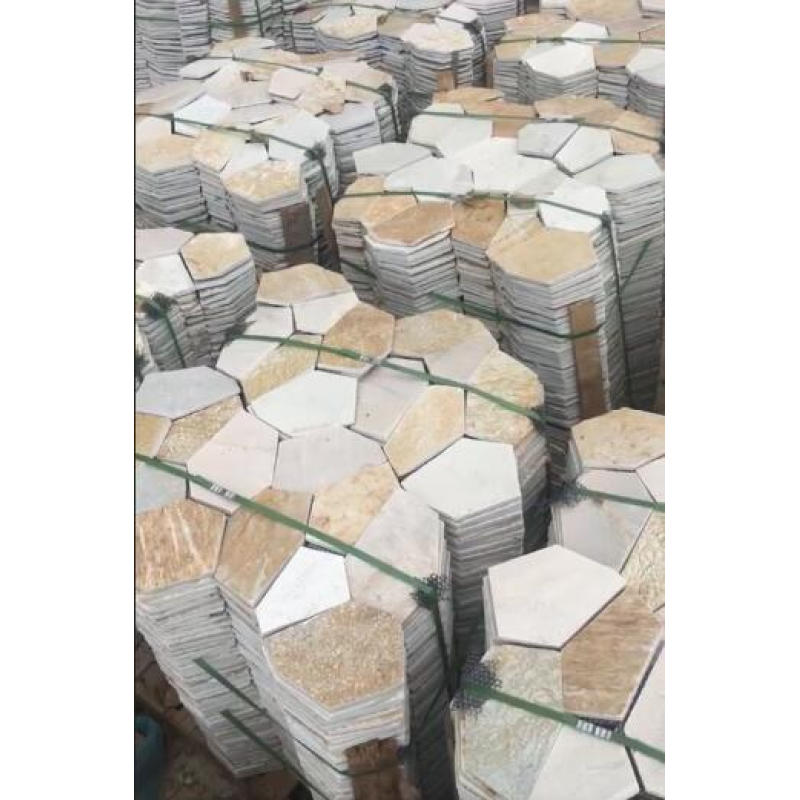
허니 골드 슬레이트 포장 매트
Air Quality in the Home
Due to the creation of dust, allergens, and volatile organic compounds (VOCs), several flooring products may contribute to poor indoor air quality. Dust and allergens can cause respiratory, cutaneous, and ocular discomfort, while VOCs can cause everything from headaches to respiratory irritation, and some are suspected or proven carcinogens.
Volatile organic compounds found in flooring are more often connected with the products used in its manufacture, installation, and maintenance or refurbishment than with the flooring itself. Adhesives, such as those used on carpet padding and tile, and chemical finishes, such as polyurethane for hardwood, are examples of such items. Even with frequent cleaning, carpet harbors particles that may be allergens or transmit bacteria, and binders commonly employed in carpet manufacture generate VOCs.
Natural stone can help to prevent particle aggregation as well as the production of volatile organic compounds (VOCs). Dust and allergens cannot accumulate on the surface of stone, especially when a regular cleaning plan is maintained; the tiny surface area of a sealed stone floor prevents this. Cleaning can be done with a water and soft (non-acidic) soap solution. Furthermore, to produce a glossy appearance, natural stone surface treatments require just abrasion (rather than chemical polishing compounds), and stone itself contains no VOCs. Even the cement and grout used to secure stone do not have an adverse effect on interior air quality. Stone sealant, which is traditionally VOC-rich, is nearly always required for stain and scratch prevention, but low-VOC alternatives are also available.
요약
Natural stone has several advantages over other types of flooring. Stone is both low-maintenance and cost-effective, and its durability allows it to be rescued and reused repeatedly. Most importantly, if low-VOC sealants are used, natural stone flooring does not contribute to poor indoor air quality. Natural stone is a good choice for high-traffic areas because of these characteristics.






 아프리카 사람
 알바니아
알바니아 암하라어
암하라어 아라비아 말
 아르메니아 사람
 아제르바이잔
 바스크 사람
 벨로루시어
벨로루시어 벵골 사람
벵골 사람  보스니아어
보스니아어 불가리아 사람
 카탈로니아 사람
 세부아노어
세부아노어 중국
중국 중국(대만)
 코르시카어
코르시카어 크로아티아어
 체코 사람
체코 사람 덴마크 말
덴마크 말 네덜란드 사람
 영어
영어 에스페란토 말
 에스토니아 사람
 핀란드어
핀란드어 프랑스 국민
 프리지아어
프리지아어 갈리시아어
갈리시아어 그루지야 사람
 독일 사람
독일 사람 그리스 어
그리스 어 구자라트어
구자라트어 아이티 크리올어
 하우사
하우사 하와이 사람
 헤브라이 사람
 아니요
아니요 먀오족
먀오족 헝가리 인
헝가리 인 아이슬란드어
 이보
이보 인도네시아 인
 아일랜드의
아일랜드의 이탈리아 사람
 일본어
일본어 자바어
자바어 칸나다어
칸나다어 카자흐어
카자흐어 크메르어
크메르어 르완다
르완다 한국인
한국인 쿠르드어
쿠르드어 키르기스어
키르기스어 결핵
결핵 라틴어
라틴어 라트비아 사람
 리투아니아 사람
 룩셈부르크어
 마케도니아 어
 말가시
말가시 말레이 사람
 말라얄람어
말라얄람어 몰티즈
몰티즈 마오리족
마오리족 마라티어
마라티어 몽고 어
몽고 어 미얀마
미얀마 네팔어
네팔어 노르웨이 인
 노르웨이 인
 옥시탄
옥시탄 파슈토어
파슈토어 페르시아 인
 광택
광택 포르투갈 인
  펀자브어
펀자브어 루마니아 사람
 러시아인
러시아인 사모아어
사모아어 스코틀랜드 게일어
 세르비아 사람
 영어
영어 쇼나
쇼나 신디어
신디어 신할라어
신할라어 슬로바키아 사람
 슬로베니아
슬로베니아 소말리아어
소말리아어 스페인의
스페인의 순다어
순다어 스와힐리어
스와힐리어 스웨덴어
스웨덴어 타갈로그어
타갈로그어 타직어
타직어 타밀 사람
타밀 사람 타타르어
타타르어 텔루구어
텔루구어 태국어
태국어 터키어
터키어 투르크멘 말
 우크라이나 인
 우르두어
우르두어 위구르어
위구르어 우즈벡어
우즈벡어 베트남어
베트남어 웨일스 말
웨일스 말