

In-ground patios and pathways have become an essential part of any residential landscape. Backyards, in particular, create lots of opportunity for stone and concrete accents to balance out plants and softscapes.
There are several different materials you can use for in-ground patios and pathways, but the three most common are slabs, pavers, og flagstone.
Here’s our pros and cons list for each material so you can make the best choice for your backyard.

When it comes time to landscape a yard, homeowners can become very quickly overwhelmed by the sheer number of choices they’re presented with:
What plants do you want? What season is it? Soil or mulch? Aggregate? Do you want a feature like a water feature eller lighting, and where would you like them? What type of wood and will it be a wooden structure?
It gets exhausting quickly, and most homeowners end up deferring to the experts they’ve hired to make the important decisions regarding design and function.
However, when it comes time to choose concrete, stone, and other hardscaping materials for in-ground patios and pathways, it’s important for residents to provide their input. In-ground hardscapes tend to be the most permanent additions to your yard.
In order to help you make your decision, we’ve put together a handy pros and cons guide to help you differentiate between common installation materials.

Flaggstein is solid stone that comes in a variety of natural colours and shapes. It’s quarried in solid pieces from sedimentary rocks like limestone, sandstone, bluestone, and slate.
Due to its weight, size, and colour variances, it tends to be more time consuming (and therefore more expensive) to install, but it’s simply unbeatable if you’re seeking a timeless, natural look.
If you choose flagstone for a patio or pathway, it’s important to remember that flagstone will have small spaces between each rock once it’s laid, allowing for water permeation.
However, you’ll want to choose a material to fill the cracks to mitigate pooling, and to prevent the legs of patio furniture from getting stuck. Some common choices include grass, soil, moss, or hardy groundcovers.
Flagstone can also come in a variety of earthy colours, including browns, reds, grays, and blues.

A flagstone patio with moss growing between the stones
Slabs are large (but thin) segmental concrete blocks. Their size and shape (usually rectangular or square) allow them to more easily intermingle with softscapes, helping bridge literal and figurative gaps in your landscape.

Unlike pavers and heller, slabs can be laid with or without gaps between them. Pathways can be straight lines or gentle, detached curves, and patios can be spaced-out grids with groundcover or grass between them, or laid with no spaces to create uniform rectangular or square patios.
Slabs are a great choice for unusual or creative pathway and patio applications that intermingle with softscapes; however, their large size makes them prone to cracking if the ground beneath them shifts.
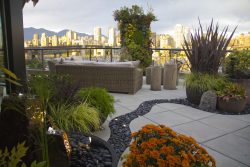
A high-end slab patio.
Pavers are small, segmental blocks with a wide array of applications. Their small size allows them to be used to create lots of shapes and patterns.

Pavers are interlocking, which makes them extremely strong and durable when installed properly. They’re extremely versatile and can even be used to make roads and driveways.
As pathways and patios, they can be installed in curves, which makes them ideal for circular patios and non-linear pathways. Pavers need to be compacted using a plate compactor after installation, and jointing sand must be swept thoroughly between the cracks to prevent soil buildup and weeds. Therefore, jointing sand should be reapplied once per year.
Pavers can be installed in a variety of different patterns. The most common patterns are running bond, herringbone, og ashler.
 afrikansk
  albansk
  amharisk
  arabisk
  armensk
  aserbajdsjansk
  baskisk
  hviterussisk
  bengali
  bosnisk
  Bulgarsk
  katalansk
  Cebuano
  Kina
Kina  Kina (Taiwan)
  korsikansk
  Kroatisk
  tsjekkisk
  dansk
dansk  nederlandsk
  Engelsk
  Esperanto
  estisk
  finsk
finsk  fransk
  frisisk
  galisisk
  georgisk
  tysk
tysk  gresk
gresk  Gujarati
  haitisk kreolsk
  hausa
hausa  hawaiisk
  Hebraisk
  Nei
Nei  Miao
Miao  ungarsk
  islandsk
  igbo
igbo  indonesisk
  irsk
irsk  italiensk
  japansk
  javanesisk
  Kannada
  kasakhisk
  Khmer
Khmer  rwandisk
  koreansk
  kurdisk
  kirgisisk
  TB
TB  latin
latin  latvisk
  litauisk
  luxemburgsk
  makedonsk
  Malgashi
  malaysisk
  Malayalam
  maltesisk
  Maori
Maori  Marathi
  mongolsk
  Myanmar
  nepalesisk
  norsk
norsk  norsk
norsk  oksitansk
  Pashto
  persisk
  Pusse
Pusse  portugisisk
  Punjabi
  rumensk
  russisk
  samoansk
  skotsk gælisk
  serbisk
  Engelsk
  Shona
Shona  Sindhi
  singalesisk
  slovakisk
  slovensk
  Somali
  spansk
  Sundanesisk
  Swahili
  svensk
  Tagalog
  tadsjikisk
  Tamil
Tamil  tatarisk
  Telugu
  Thai
Thai  tyrkisk
  turkmenske
  ukrainsk
  Urdu
Urdu  Uigur
Uigur  usbekisk
  vietnamesisk
  walisisk




