

Industry sales of stacked stone panels have been rising steadily each year for the last five years. While we cut and split individual natural thin stone from New England – all day every day – we see customers from every region of the country choosing stacked stone panels. Here are the pros and cons of these panels.
PRO: Stones are cut, fit, and glued together into an interlocking panel with no mesh backing. This significantly reduces onsite cutting and allows for a much quicker install.
CON: The panels still have to be handled carefully during installation to avoid breakage.

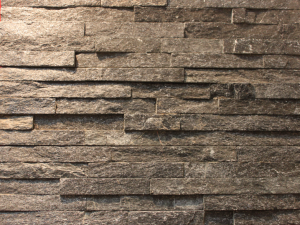
PRO: The panels fit together without modification. The seams are offset and disappear when you stagger the panels by 1/3 of their length.
CON: If you don’t stagger the panels, you will see a stepped stairway seam.
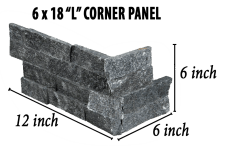
PRO: Panels have matching corners that interlock perfectly with one short, and one long side. This allows for weaving back and forth to stagger the joints.
CON: to shorten a corner, you’ll need to make stepped cuts using a wet saw. The same applies to flat panels.
PRO: Panels install much faster than individual stones. A stonemason can install 100 square feet a day.
CON: For larger vertical walls it is best to install three vertical feet, then let the mortar adhere for 24 hours prior to installing the next section above it.
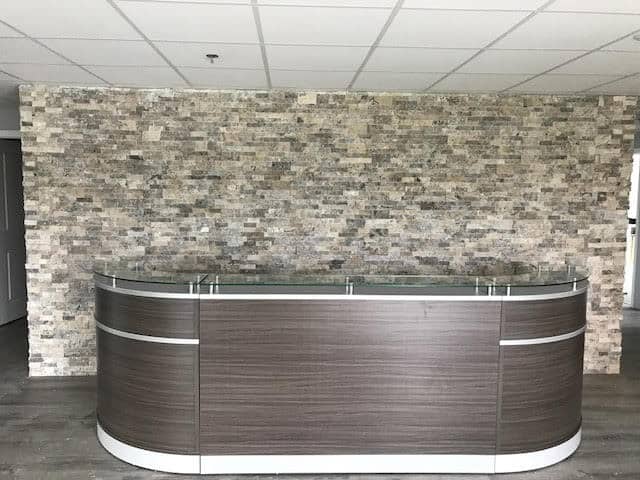
PRO: You don’t have to worry about selecting individual stones.
CON: You can’t create a custom mix of stones or colors but there are plenty of beautiful colors to choose.
 afrykanin
  albański
  amharski
  arabski
  ormiański
  azerbejdżański
  baskijski
  białoruski
  bengalski
  bośniacki
  bułgarski
  kataloński
  Cebuański
  Chiny
Chiny  Chiny (Tajwan)
  korsykański
  chorwacki
  Czech
Czech  duński
  Holenderski
  język angielski
  esperanto
  estoński
  fiński
  Francuski
  fryzyjski
  galicyjski
  gruziński
  Niemiecki
  grecki
  gudżarati
  Kreolski haitański
  hausa
hausa  hawajski
  hebrajski
  Nie
Nie  Miao
Miao  język węgierski
  islandzki
  ibo
ibo  indonezyjski
  Irlandczyk
  Włoski
  język japoński
  jawajski
  Kannada
  kazachski
  Khmer
Khmer  Rwandyjski
  koreański
  kurdyjski
  Kirgiski
  gruźlica
  łacina
  łotewski
  litewski
  luksemburski
  macedoński
  Malgashi
  malajski
  malajalam
  Maltański
  Maoryski
  marathi
  mongolski
  Myanmar
  Nepalski
  norweski
  norweski
  oksytański
  paszto
  perski
  Polski
  portugalski
  Pendżabski
  rumuński
  Rosyjski
  Samoański
  szkocki gaelicki
  serbski
  język angielski
  Shona
Shona  Sindhi
  syngaleski
  słowacki
  słoweński
  somalijski
  hiszpański
  Sundajczyk
  Suahili
  szwedzki
  tagalski
  tadżycki
  Tamil
Tamil  Tatar
Tatar  telugu
  tajski
  turecki
  Turkmeni
  ukraiński
  urdu
urdu  Ujgur
Ujgur  uzbecki
  wietnamski
  walijski




