The longevity of stone puts any human concept of old age to shame. Stone creates a sense of permanence and solidity, even when worn and weathered. It’s been used throughout history as the structure and facade of buildings- buildings that have literally stood the test of time.
While natural stone has been the material of choice for millennia, glass has dominated commercial construction—especially large scale projects like skyscrapers—in recent years. But architects are increasingly reacting to this glut of glass by returning to stone for their projects. For many developers and architects, glass had become the default, a sterile, too obvious choice which resulted in a flat, texture-less and uninspired design.
Le passage du verre à la pierre est également le résultat de préoccupations environnementales. Le maire de la ville de New York, Bill De Blasio, a récemment déménagé interdire les nouveaux gratte-ciel en verre in the city, making New York the first city to mandate energy efficiency. But it won’t be the last: According to the United Nations, 40% of the world’s energy consumption can be attributed to buildings. Pressure to construct buildings in a sustainably responsible manner is being felt by developers and architects around the world.
INDIANA LIMESTONE – FULL COLOR BLEND™ façade sur béton préfabriqué | Stade Yankee | Architecte : Populous
“It’s pretty well known in the industry that those glass facade buildings are not energy efficient,” said Hugo Vega, vice president of Architectural Sales at Polycor. “Meaning that in the summer it becomes super hot and you need to have an extensive system of air conditioning and in the winter you need a lot of heating as compared to a traditional building with more stone.”
The design community has been embracing stone for facade design instead, and just in time, as changes in building codes and regulations are set to further tighten architects’ design choices. Natural stone plays an important role in the future of sustainable architecture thanks to its life-cycle, durability, ease of care, low maintenance, and energy efficiency— the list goes on. The minimal environmental impact that innovative cladding wall systems provide is another reason the building industry is moving back to natural materials.
Les pierres naturelles Polycor conviennent à une variété de systèmes d’ancrage et de support de façade. Regarde comment.
“Energy inefficient glass facades concerns are a good driver for the growing popularity of stone cladding,” said Vega.
Vega understands this continued demand for stone cladding better than just about anyone: he’s been the driving force behind the development of the cladding division of Polycor and he has an in-depth understanding of what architects and builders are looking for in their products.
BETHEL WHITE® et CAMBRIAN BLACK® panneaux de granit de 3 cm sur système Eclad installés sur la structure existante | Édifice TD | Architecte : WZMH
“The type of stone will dictate possible finishes, thickness, and more,” said Vega. “For example, it’s inadvisable to use polished 3cm marble and expose it to the elements for cladding. Direct communication with selected quarries will help validate the block sizes and thus the maximum finished panel sizes, what natural features can be expected in the stone, and the availability of the material according to job size and phases.” Specification challenges can present themselves throughout a project, such as alternate stones being introduced by other parties and detracting from the initial design intent. Maintaining a close contact with the quarry teams helps ensure this is preserved. As Hugo points out, “Make sure to specify the true, branded names of the materials to avoid being supplied with undesired alternates.” The old days of calling out Marbre italien doesn’t cut it anymore.
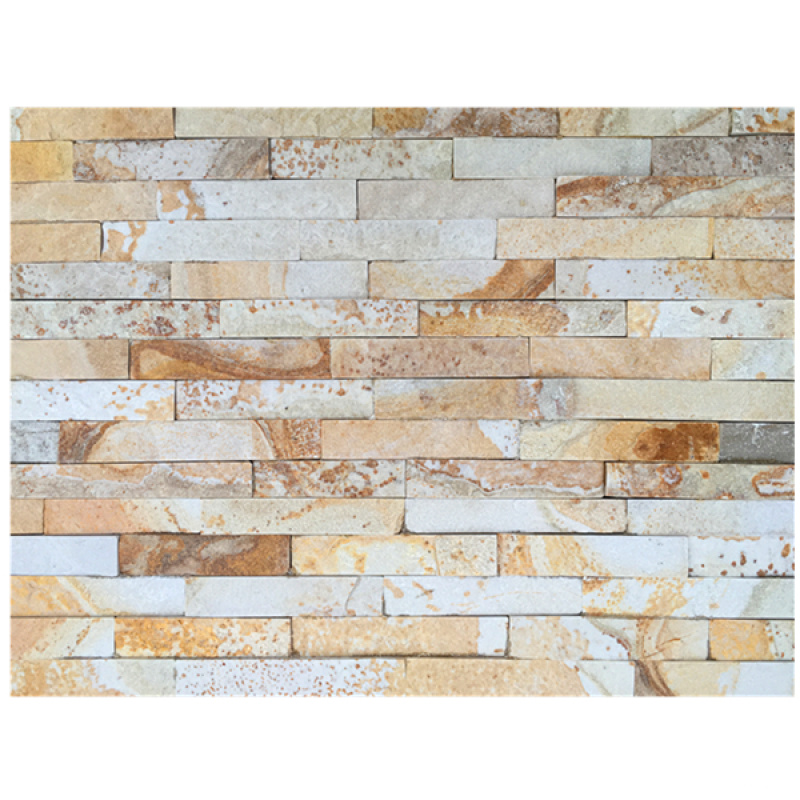
Stone cladding isn’t just the smart alternative to energy efficient glass, it’s also the simple choice, thanks to new cladding attachment systems.
“These new attachment systems allow stone to be used for lighter applications, when the structure has not been designed for a heavy full bed,” said Vega. “They also allow for a faster installation compared to traditional methods.“
Des solutions de revêtement innovantes permettent de plus grandes possibilités de conception | Sur la photo : calcaire d'Indiana à coupe mince Litecore collé sur un support en nid d'abeille en aluminium
Les innovations en matière de revêtement peuvent offrir une solution élégante et rentable pour incorporer les couleurs et les textures de la pierre naturelle sans les complications d'un transport coûteux et d'une installation longue. Tout en personnifiant le caractère authentique de la pierre naturelle, certains de ces systèmes restent légers pour faciliter leur utilisation, ce qui en fait un choix judicieux pour répondre aux exigences strictes auxquelles les architectes doivent répondre dans les codes du bâtiment modernes.
Les pierres naturelles Polycor conviennent à une variété de systèmes d’ancrage et de support de façade. Originaire du Carrières Polycor and all through production, the stones are manufactured to each of our partner system’s specifications from ultra-thin profiles up to full thickness dimensional elements complimenting a wide range of facade structures.
Lors du choix d'une pierre pour le revêtement, les architectes doivent prendre en compte de nombreux facteurs : l'apparence, l'utilisation prévue, la taille du projet, la résistance, la durabilité et les performances. En choisissant les pierres Polycor pour les façades, les architectes bénéficient de notre pleine maîtrise de la chaîne d'approvisionnement, depuis le substrat rocheux jusqu'au point d'installation. L’avantage de travailler avec une entreprise comme Polycor est que, puisque nous possédons nos carrières, nous pouvons répondre directement à toutes les questions ou préoccupations qu’un architecte pourrait avoir pendant le processus d’élaboration des spécifications d’une façade au lieu d’avoir 2 ou 3 intermédiaires.
Polycor Bethel White® granite quarry | Bethel, VT
“We have a wide array of our own limestone, granite and marble, so architects can discuss with the source and get accurate and reliable information,” said Vega. “We fabricate ourselves and sell blocks to other fabricators, ensuring competitiveness of the offers, while preserving the design intent. We work with industry leaders like Éclad, Pierre d'Hofmann and others to offer a complete cladding solution for the project.“
Vega s'est intéressé aux technologies de revêtement innovantes et a travaillé avec des experts en recherche et développement dans nos usines de fabrication pour fabriquer des revêtements en pierre naturelle d'épaisseur variable pouvant être utilisés à l'intérieur ou à l'extérieur d'un bâtiment. Il est généralement fixé via un système de rail et de pince indépendant.
Polycor’s stone veneer can be installed over solid facing, which eliminates the challenge of removing the original substructure in some cases. Some stone panels are cut thin, while still maintaining the authentic look and feel of a thicker stone without the heavy weight of a 3-6 inch deep stone veneer, making installation fast and simple. Polycor’s thin stones are compatible in many cladding configurations and are manufactured for systems like Litecore, une solution qui offre une pierre à une fraction du poids et une installation deux fois plus rapide.
Image gracieuseté de : Litecore
Ces panneaux muraux composites polyvalents utilisent de la pierre Polycor découpée en un placage ultra-mince. Adhérés à des nids d'abeilles en couches, pris en sandwich entre des feuilles d'aluminium et un treillis en fibre de verre, les panneaux offrent un système de façade léger, à faible densité et à haute résistance.
KODIAK BROWN™ ultra thin 1cm granite with carbon fiber backing on Eclad system | Architect: Régis Côtés
Les dalles Polycor de 1 cm avec support en fibre de carbone sont des produits en pierre naturelle ultra fines, légères et durables qui reposent sur un support exclusif adhéré utilisé à la place de l'aluminium. Les panneaux de pierre résultants sont adaptés pour s'intégrer aux systèmes de revêtement Eclad et Elemex.
GEORGIA MARBLE – WHITE CHEROKEE™and Indiana Limestone facade on precast concrete | 900 16th St. Washington, D.C. | Architect: Robert AM Stern
3cm stone mechanically anchored to thin, precast concrete panels provides additional installation advantages. Companies such as Hoffman Stone systems are compatible with Polycor’s stones.
Polycor possède l'expertise nécessaire pour créer n'importe quel projet, du simple mur aux bancs, en passant par des projets architecturaux exceptionnels et des intérieurs de halls de grande hauteur. Chaque solution permet aux architectes de concevoir des extérieurs de bâtiments innovants, durables et esthétiques intégrant des surfaces en pierre.
“These solutions can also be used interchangeably to blend with more traditional architectural elements and stone masonry construction such as full bed trim, cornices, lintels and things of that nature,” said Vega. “And again, once the material is specified, it can be used on any cladding system, traditional masonry and fabricated by pretty much all the fabricators operating on the market today. This way architects can lock in their design intent, and let engineers and builders establish means and methods to realize the design within budget.”
INDIANA LIMESTONE – STANDARD BUFF™ bardage alliant un ajout moderne à une maçonnerie traditionnelle | Sénat du Canada, Ottawa, CA | Architecte : Diamant Schmitt
Ancré dans le passé mais prêt pour l’avenir, le revêtement en pierre naturelle répond aux besoins de l’architecture et du design modernes. Et même si les innovations en matière de revêtement continuent de rendre la pierre fine plus facile que jamais à utiliser, le revêtement n’est pas le seul avenir de la pierre naturelle.
 africain
  albanais
  Amharique
  arabe
arabe  arménien
  azerbaïdjanais
  Basque
  biélorusse
  bengali
  bosniaque
  bulgare
  catalan
  Cebuano
  Chine
Chine  Chine (Taïwan)
  Corse
Corse  croate
  tchèque
  danois
  Néerlandais
  Anglais
  espéranto
  estonien
  finlandais
  Français
  frison
  Galicien
  géorgien
  Allemand
  grec
grec  Gujarati
  Créole haïtien
  haoussa
  hawaïen
  hébreu
  Non
Non  Miao
Miao  hongrois
  islandais
  igbo
igbo  indonésien
  irlandais
  italien
  Japonais
  Javanais
  Kannada
  kazakh
  Khmer
Khmer  Rwandais
  coréen
  kurde
kurde  Kirghize
  tuberculose
  Latin
Latin  letton
  lituanien
  luxembourgeois
  Macédonien
  Malgashi
  malais
  Malayalam
  maltais
  Maori
Maori  Marathi
  mongol
  Birmanie
  Népalais
  norvégien
  norvégien
  Occitan
  pachtou
  persan
  polonais
  Portugais
  Pendjabi
  roumain
  russe
russe  Samoan
  Gaélique écossais
  serbe
serbe  Anglais
  Shona
Shona  Sindhi
  Cinghalais
  slovaque
  slovène
  somali
  Espagnol
  Soundanais
  Swahili
  suédois
  Tagalog
  tadjik
  Tamil
Tamil  tatar
tatar  Télougou
  thaïlandais
  turc
turc  Turkmènes
  ukrainien
  Ourdou
  Ouïghour
  Ouzbek
  vietnamien
  gallois