

LINHA DO TEMPO:
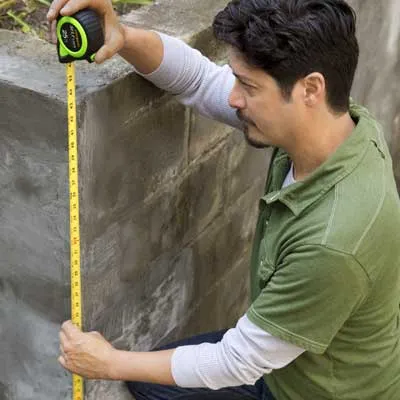
To calculate the number of universal corners to order, measure the height in inches of each outside wall corner, as shown, divide by 16, and round up to the nearest whole number. You’ll fill the area between the corners with flat panels. To calculate how many you’ll need, multiply the wall’s width by its height in feet and divide the resulting area by 2 (each panel covers 2 square feet). Subtract the number of universal corners from the result, then add 10 percent to your order of flat panels. Add one universal corner to be safe.
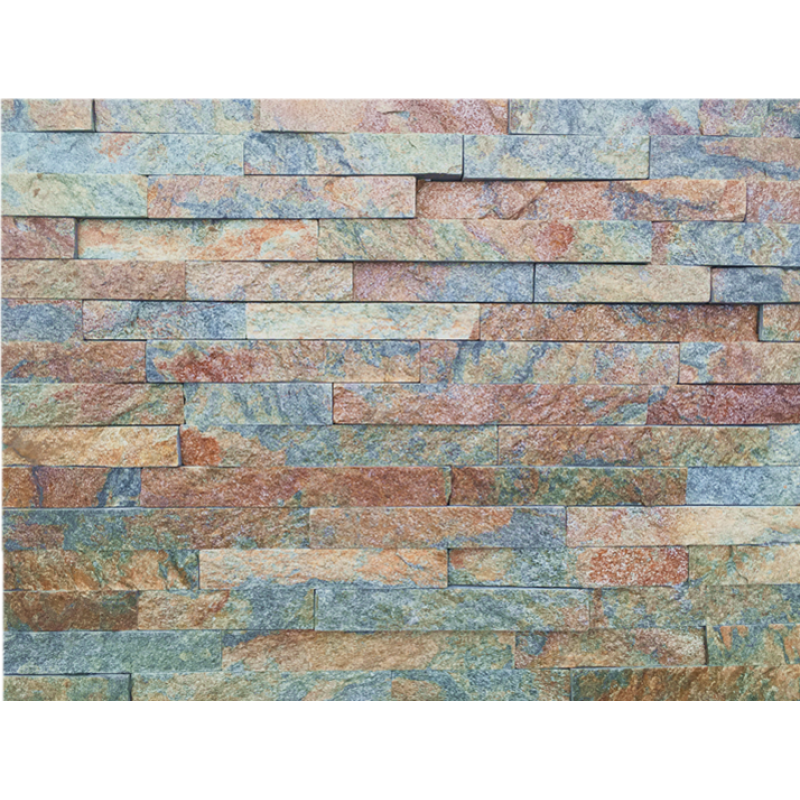
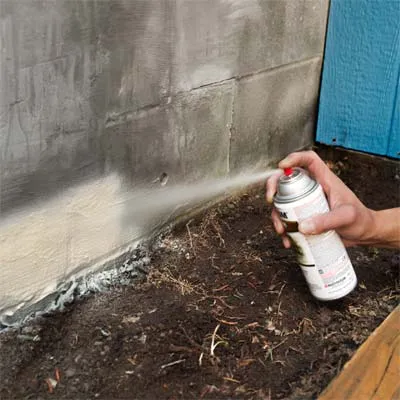
The panels must be installed above ground level, resting on a plastic support called a starter strip, so you’ll want to paint the wall below the strip to match the stone. Find a spray-paint color similar to the palette of your stone panels and paint the bottom few inches of the wall.
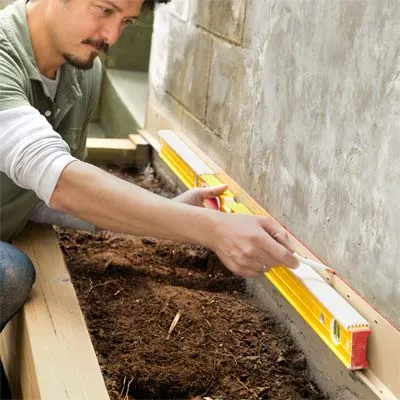
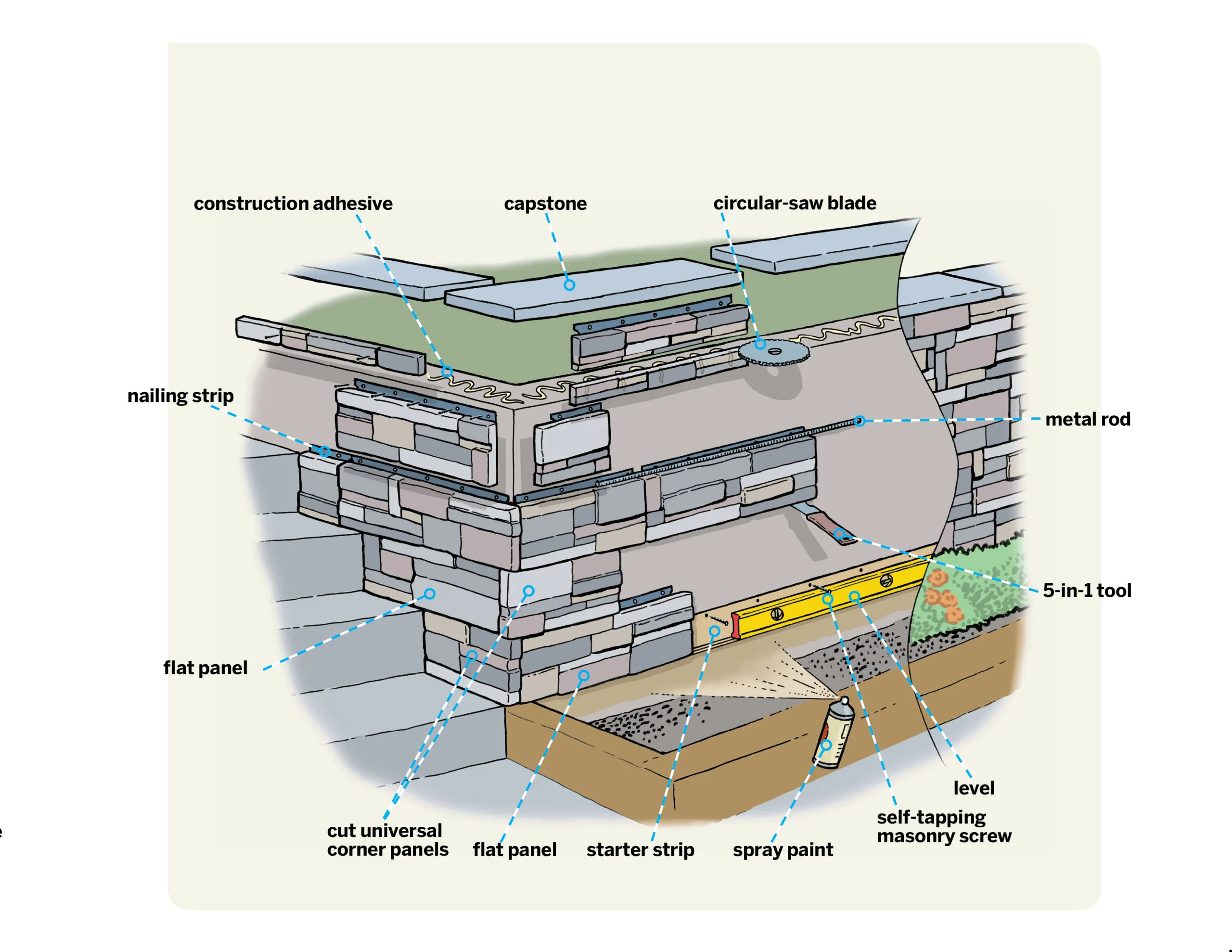
Set the location for the starter strip, at least 2 inches above any soil. Here, the strip’s lip aligns with the top of a stair on the adjacent side of the corner. Fit your drill/driver with a 3/16-inch masonry bit and drill a pilot hole through a slot in the strip near the corner and into the wall. Drive in a masonry screw to secure that end, then use the 4-foot level to bring the strip to level, and mark a line, as shown. Drill pilot holes and fasten the strip in two or three more spots, maintaining level.
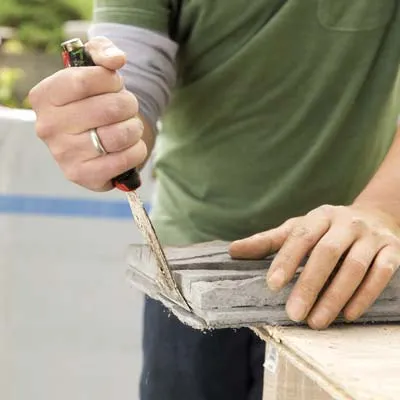
Os painéis planos têm uma aba em cada lado que se encaixa nas ranhuras dos painéis planos adjacentes, mas precisa ser removida de qualquer extremidade que forme um canto. Coloque o painel voltado para cima em uma superfície de trabalho e use a lâmina da ferramenta 5 em 1 para retirar a aba, conforme mostrado. A borda plana resultante formará um canto estreito.
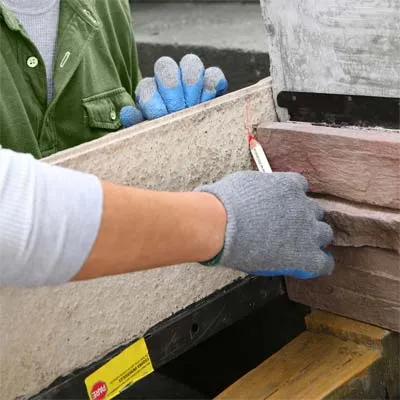
Cada execução começa em um canto, com a extremidade acabada de um canto universal sobrepondo-se à extremidade de um painel plano (com a aba removida). Primeiro, o canto universal é cortado em duas partes; a borda acabada de cada peça inicia um curso e a borda cortada termina em uma tela plana. Para estética, corte o canto universal de forma que cada peça tenha pelo menos 20 centímetros de comprimento. Ou, como no nosso caso, corte-o para caber no degrau da escada: coloque um painel plano no lado adjacente da faixa inicial, depois gire o canto universal de cabeça para baixo, coloque sua borda acabada contra o degrau da escada e trace uma linha de corte , como mostrado.
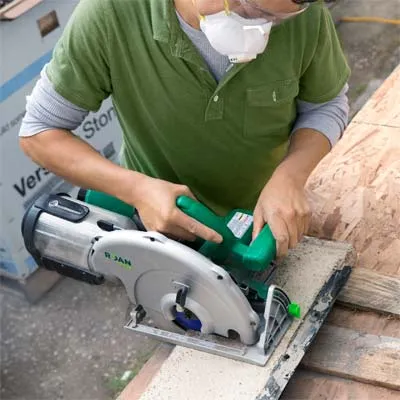
Descanse o painel marcado voltado para baixo em uma superfície de trabalho com tábuas de sucata abaixo dele em ambos os lados da linha de corte. Use uma régua para marcar uma linha de corte quadrada ao longo do ponto mais estreito da linha traçada. Encaixe a serra circular com disco diamantado segmentado e corte ao longo da linha, passando pelo concreto e também pela tira metálica de pregos. Certifique-se de usar óculos de segurança, máscara contra poeira e proteção auditiva.
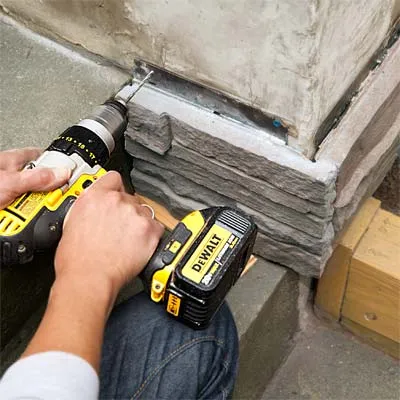
Hold the cut universal corner against the wall, bringing its finished end flush with the face of the adjacent flat panel so that the two pieces form a 90° outside corner. Level the universal corner, and drill pilot holes through the nailing strip, as shown, directly through the metal if necessary, in at least two places. Fasten the panel with 1¼-inch self-tapping masonry screws.
Dica: Mantenha a broca girando para remover a poeira enquanto você retira a broca do furo piloto, permitindo que o parafuso de alvenaria bata no concreto.
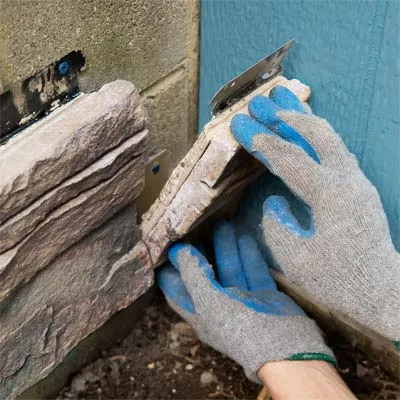
Continue instalando painéis planos de tamanho normal, avançando no curso. Quando estiver perto do final, meça e corte um painel parcial para preencher o final do percurso. Se a peça cortada tiver uma aba em ambos os lados, use a ferramenta 5 em 1 para retirá-la. Coloque a peça no lugar, faça furos piloto e parafuse-a na parede.

Use the cut half of the universal corner from the first course, positioned on the opposite side of the corner to stagger the joints. Slip the tongue on its bottom edge into the groove on top of the flat panel beneath. Position a flat panel, with its tab removed, atop the universal corner in the first course. Be sure it’s cut to a different length than the piece beneath, to offset the joints across the wall. Mark and drill pilot holes for the universal corner, secure it, and install the adjacent flat panel to complete the corner.
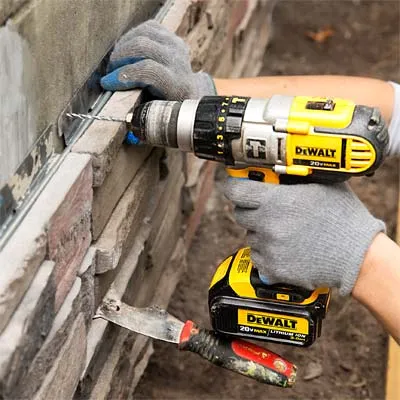
Work along the course, brushing out debris from the top groove to ensure that the panels fit together snugly. As you set each new panel, make sure that it’s aligned with the previous panel by nestling a ¼-inch metal rod in the groove along the top edge. The rod should lie flat and bridge the grooves in adjacent panels. If it doesn’t, use the 5-in-1 tool to shim the panel up, or back several screws out of the previous panel and adjust it. When the panels align, drill pilot holes and fasten them to the wall.

If the end of a panel falls in line with a joint on any of the previous courses, you’ll want to cut down its length slightly to maintain staggered joints. Hold the panel in place and mark the nailing strip at a different length. Transfer the mark to the back of the panel, cut it to size, and fasten it to the wall.
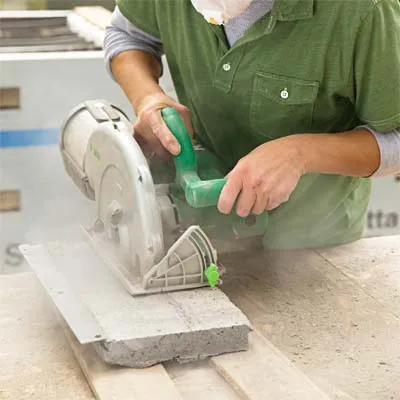
On the final course, you’ll need to cut down the height of the panels to fit, removing the nailing strip so that the stone reaches to the top of the wall. Rest a flat panel in place and scribe a cutline on the back at the height of the wall. Set the panel on a work surface, and use the circular saw to cut it to the proper height. You may want to cut your corner pieces to length first, then cut them to the proper height, as shown. Dry-fit the two pieces at the corner to check the fit.
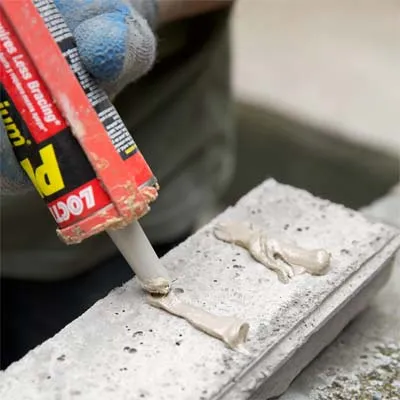
Remova os painéis de canto e aplique gotas retas de adesivo de construção na parte de trás de cada peça em movimentos verticais, conforme mostrado, para que a água possa fluir livremente atrás dos painéis e drenar adequadamente. Coloque os painéis na parede e ajuste-os para que se encaixem perfeitamente nos cantos.
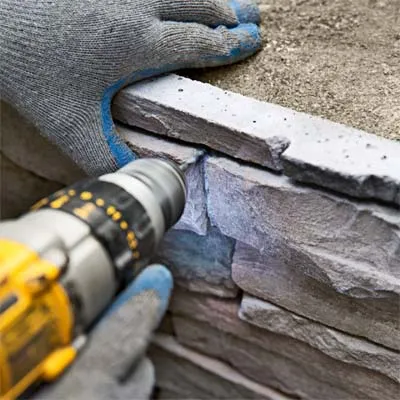
Para proteger ainda mais os painéis cortados, localize vários pontos em cada um onde você possa cravar um fixador discretamente nas juntas entre as pedras. Segurando a peça no lugar, faça um furo piloto no painel e na parede. Insira um parafuso de alvenaria, afundando a cabeça abaixo da superfície do painel. Cubra as cabeças dos parafusos com calafetagem, recolha um pouco de poeira da mesa de corte e sopre na calafetagem para camuflá-la. Você pode retocar quaisquer lacunas da mesma maneira. Conclua a instalação dos painéis no curso final.
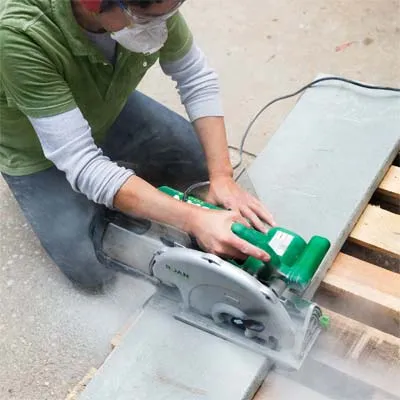
Selecione uma pedra angular vários centímetros mais larga que a profundidade da parede revestida para criar uma saliência. Meça e marque os cumes para caber no topo da parede. Use a serra circular e a lâmina diamantada segmentada para cortar no comprimento certo, conforme mostrado.
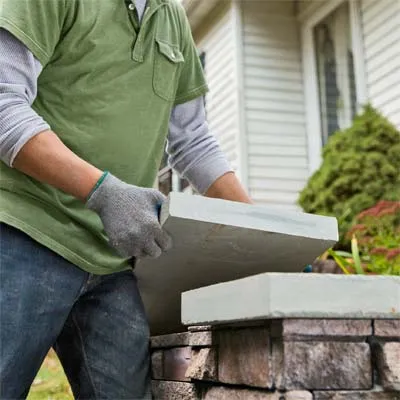
Trabalhando com um parceiro, levante os pilares e encaixe-os a seco no topo da parede. Retire-as e aplique cola de construção no topo da parede e nas bordas da folha antes de recolocar as pedras; ou, se preferir um visual ainda mais autêntico, coloque-os sobre uma base de argamassa rígida. Agora dê um passo para trás e maravilhe-se com a aparência perfeita.
 africano
  albanês
  amárico
  árabe
árabe  Armênio
  Azerbaijano
  Basco
Basco  Bielorrusso
  bengali
  Bósnio
  búlgaro
  catalão
  Cebuano
  China
China  China (Taiwan)
  Córsega
  croata
  Tcheco
  dinamarquês
  Holandês
  Inglês
  esperanto
  estoniano
  finlandês
  Francês
  Frísio
  Galego
  Georgiano
  Alemão
  grego
grego  Gujarati
  crioulo haitiano
  hauçá
hauçá  havaiano
  hebraico
  Não
Não  Miao
Miao  húngaro
  islandês
  igbo
igbo  indonésio
  irlandês
  italiano
  japonês
  Javanês
  Kannada
  cazaque
  Khmer
Khmer  Ruanda
  coreano
  curdo
curdo  Quirguistão
  tb
tb  Latim
Latim  letão
letão  lituano
  Luxemburguês
  Macedônio
  malgashi
  malaio
  Malaiala
  maltês
  maori
maori  Marathi
  mongol
  Mianmar
  nepalês
  norueguês
  norueguês
  Occitano
  pashto
  persa
persa  polonês
  Português
  punjabi
  romena
  russo
russo  samoano
  gaélico escocês
  sérvio
  Inglês
  Shona
Shona  Sindi
Sindi  Cingalês
  Eslovaco
  esloveno
  somali
  Espanhol
  Sudanês
  suaíli
  sueco
sueco  tagalo
  tadjique
  tâmil
tâmil  tártaro
  Telugu
  tailandês
  turco
turco  turcomano
  ucraniano
  urdu
urdu  Uigur
Uigur  Usbeque
  vietnamita
  galês
galês 




