

Rajoles rovellades
Vols construir el teu propi mur de contenció de pedra, però no saps com començar? Si tens un desnivell pati, un mur de contenció de pedra pot ajudar a prevenir l'erosió i ofereix un lloc agradable per plantar. Per aprendre a muntar els vostres, de principi a fi, continua llegint.
To figure out how much stone you’ll need, multiply your wall’s height times the depth times the length. If your wall is 2 feet high, 1-1/2 feet wide, and 20 feet long, you’ll need roughly 60 cubic feet of stone. Most stoneyards will deliver the stones for a slight charge; have them placed as close to the site of your retaining wall as possible.
Pel que fa a tools, you’ll need a shovel for digging your trench and backfilling, a matock for attacking the grade, and a small sledgehammer for tamping soil. For marking your site and leveling rocks, you’ll need a line level, a few tall stakes, string, some flour, and a 4- or 8-foot level.
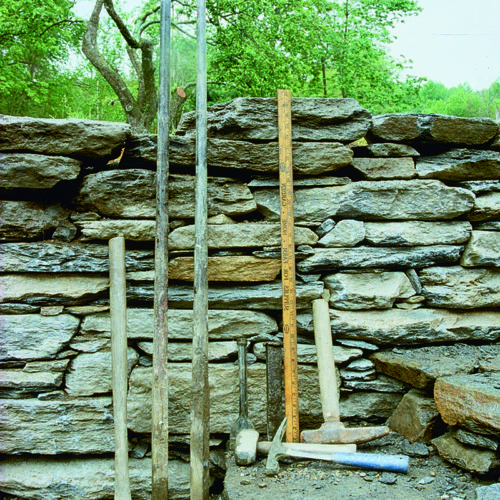
Now you can start digging. The easiest approach is to cut and fill—that is, dig into the slope where the wall will go and spread the earth below you to create a level terrace. When you cut and fill, the wall is backed by undisturbed soil, which is more stable than fill. For design reasons, however, you might choose to build a freestanding wall and fill behind it with soil from another site. Or you might do a partial cut and fill, which is somewhere between the two.
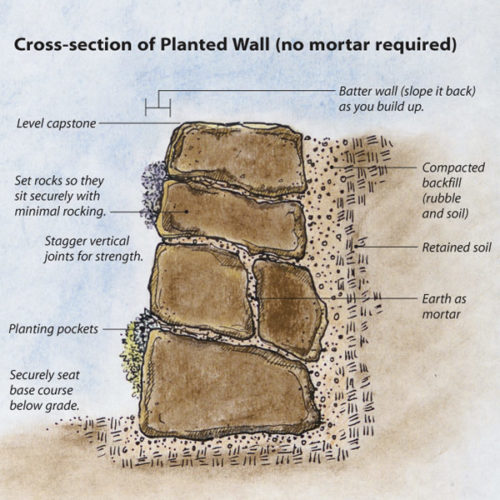
Les parets es construeixen en cursos. The base course is structurally the most important, while the final course, the capstone, is the most challenging. For stability, walls should be at least 20 inches wide at the base. They can taper slightly toward the top, but you’ll want a wall that is at least two rocks wide in most places. This can be accomplished by mixing stones of different sizes or by backfilling with a combination of two-thirds rubble to one-third soil.
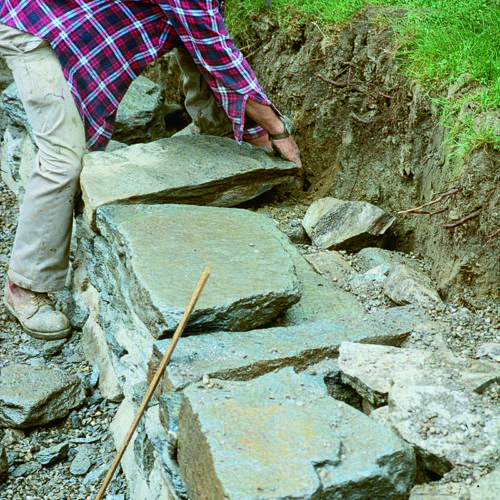
Cavar una rasa per al curs base
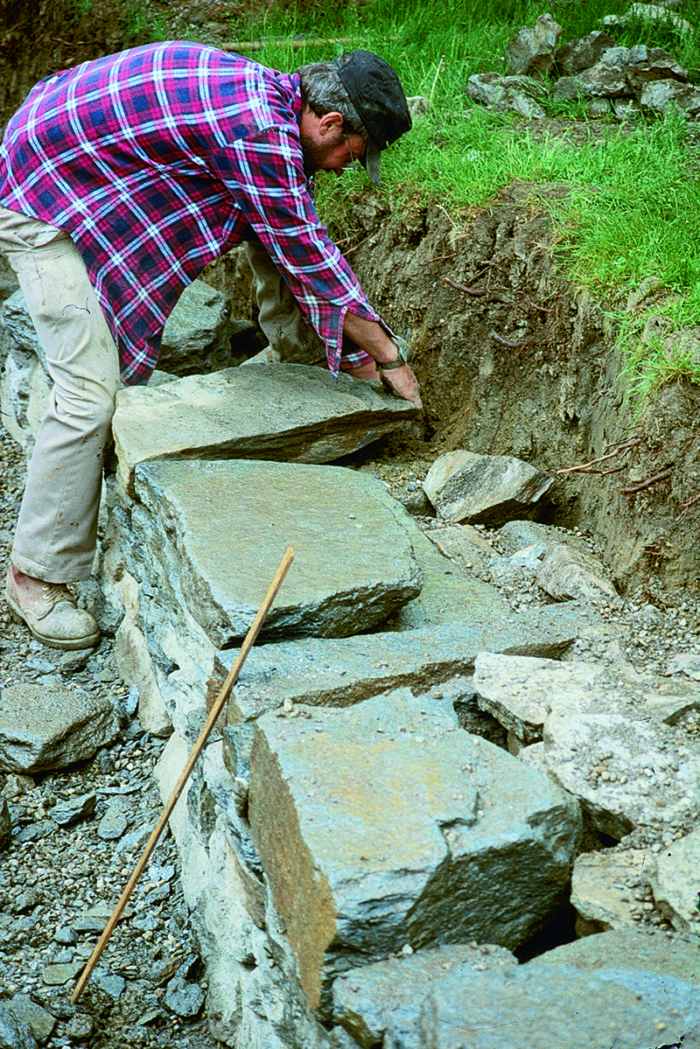
Start by digging a trench about 4 inches deep and at least 2 feet wide. A straightedged spade will give you a nice, even edge. The first course must be very solid and tightly fit because the weight of the wall will rest on it. Take the time to find rocks that lock into place, without leaving gaps. Randomly lay your largest rocks along the front edge of the trench. Set the first stone, shifting it around until it sits securely without being rocked easily, and then fill with the remaining stones. If you are using rectangular stones, you want the height of adjacent stones to be the same, or of a difference that can be made up with a smaller stone. If the rocks are irregular, then the stones will fit together leaving a triangular gap for the next course to fit into. I find irregular rocks easier to work with than flat ones; with flat rocks you have to be more precise. Find a stone that fits well and then continue for a few more feet. A rule of thumb, passed down from my wall-building teacher’s mentor, is to try a stone seven different ways. If it doesn’t fit by the seventh try, use another stone.
A continuació, pala la brutícia darrere de les pedres i aixafeu la terra als espais between, behind, and beneath the stones with top of the sledgehammer. This is an important step because the dirt becomes the mortar for the wall. I also recommend adding rubble (those stones you won’t use on the face of your wall) behind the face course to give greater strength to the wall. Pound the rubble and soil mix until you are satisfied that it is solid. Continue the first course until you reach the end of the wall. When you are done, test
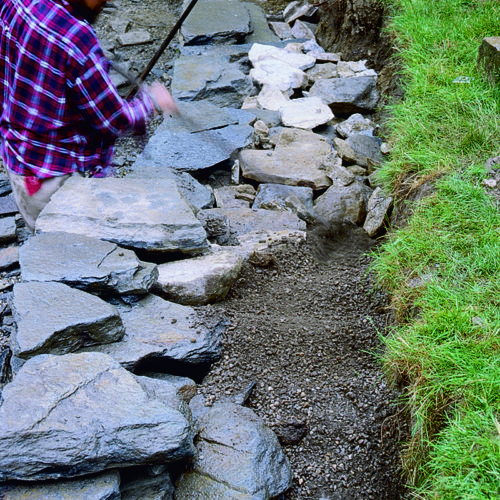
Per començar el segon curs, escolliu una pedra que unirà la primera unió del curs inferior. Avoid having joints run up the face of the wall, and angle (batter) the courses backward—approximately 1 inch per vertical foot. This creates a stable wall. For added strength, intermittently place single stones that run the full depth of the wall. This will only work with rectangular rocks. For irregular rocks, place a large rock behind a face rock every 3 feet or so. As you set a course, you will come to situations, probably quite a few of them, where the rock placement is perfect on all sides but one. These are the planting opportunities that give life to a stone wall.
Continue building in this manner until you are one course away from the finished height. Fitting stones will get easier as you go, and you’ll likely discover that there’s a certain magic moment when you’re building a wall: you hear a thump that signals you’ve placed a rock perfec
Feu que la vostra paret estigui a l'alçada
The ideal height for a dry-stacked retaining wall is 18 to 22 inches—so you can sit on it when your gardening chores are done. Even if
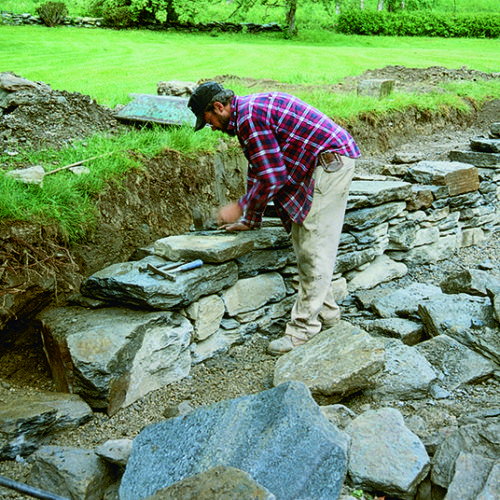
Poseu molta paciència al procés de col·locació de la làpida; és la culminació de l'habilitat que has desenvolupat fins a aquest punt. Hauria de tenir entre 15 i 18 polzades de profunditat, formada per una o tres pedres. Utilitzeu terra i una bona col·locació per fixar les pedres, i igual que amb les juntes de paret, eviteu les juntes llargues a la pedra capçalera. Si voleu seure a la paret, trieu pedres llises i planes. O, ompliu els buits amb terra i planteu herbes aromàtiques per als coixins. Una pedra capçalera plantada és un deliciós toc final a una paret viva.






 africana
 albanès
 amàric
 àrab
àrab armeni
 azerbaidjana
 basc
basc Bielorús
 bengalí
  bosnià
 búlgar
 català
 Cebuà
Cebuà Xina
Xina Xina (Taiwan)
 Cors
Cors croat
croat txec
txec danès
danès holandès
 Anglès
 esperanto
 estonià
 finès
finès francès
 frisó
frisó gallec
 georgiana
 alemany
 grec
grec Gujarati
 crioll haitiano
 hausa
hausa hawaià
 hebreu
 No
No Miao
Miao hongarès
 islandès
 igbo
igbo indonesi
 irlandesa
 italià
 japonès
 javanès
 Kannada
 kazakh
 Khmer
Khmer Ruandès
 coreà
coreà kurd
kurd kirguis
 TB
TB llatí
llatí letó
letó lituà
lituà luxemburguesa
 macedoni
 Malgashi
 Malai
Malai malayalam
 maltès
 Maori
Maori Marathi
 mongol
 Myanmar
 nepalí
 noruec
 noruec
 occità
 Pashto
 persa
persa polonès
 portuguès
  panjabi
 romanès
 rus
rus samoà
samoà Gaèlic escocès
 serbi
serbi Anglès
 Shona
Shona Sindhi
 Sinhala
 eslovac
 eslovè
 Somali
 espanyol
 Sundanès
 suahili
 suec
suec Tagalog
 Tadjik
 Tamil
Tamil tàrtar
 Telugu
 tailandès
 turc
turc turcomà
 Ucraïnès
 Urdú
Urdú uigur
uigur Uzbek
Uzbek vietnamita
 gal·lès