

녹슨 타일
나만의 돌 옹벽을 만들고 싶지만 어떻게 시작해야 할지 모르시나요? 고르지 못한 부분이 있는 경우 마당, 돌 옹벽은 침식을 방지하는 데 도움이 될 수 있으며 식물을 심기에 좋은 장소를 제공합니다. 처음부터 끝까지 자신만의 것을 구성하는 방법을 배우려면 계속 읽어보세요.
To figure out how much stone you’ll need, multiply your wall’s height times the depth times the length. If your wall is 2 feet high, 1-1/2 feet wide, and 20 feet long, you’ll need roughly 60 cubic feet of stone. Most stoneyards will deliver the stones for a slight charge; have them placed as close to the site of your retaining wall as possible.
에 관해서는 tools, you’ll need a shovel for digging your trench and backfilling, a 곡괭이 for attacking the grade, and a small sledgehammer for tamping soil. For marking your site and leveling rocks, you’ll need a line level, a few tall stakes, string, some flour, and a 4- or 8-foot level.
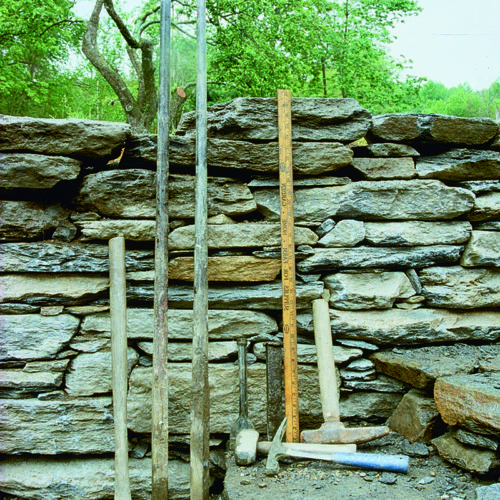
Now you can start digging. The easiest approach is to cut and fill—that is, dig into the slope where the wall will go and spread the earth below you to create a level terrace. When you cut and fill, the wall is backed by undisturbed soil, which is more stable than fill. For design reasons, however, you might choose to build a freestanding wall and fill behind it with soil from another site. Or you might do a partial cut and fill, which is somewhere between the two.
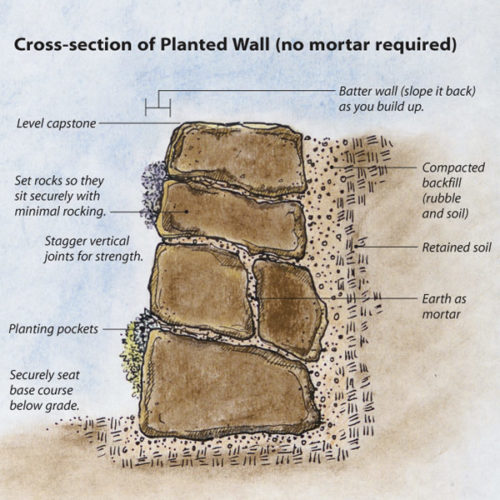
벽은 코스에 내장되어 있습니다. The base course is structurally the most important, while the final course, the capstone, is the most challenging. For stability, walls should be at least 20 inches wide at the base. They can taper slightly toward the top, but you’ll want a wall that is at least two rocks wide in most places. This can be accomplished by mixing stones of different sizes or by backfilling with a combination of two-thirds rubble to one-third soil.
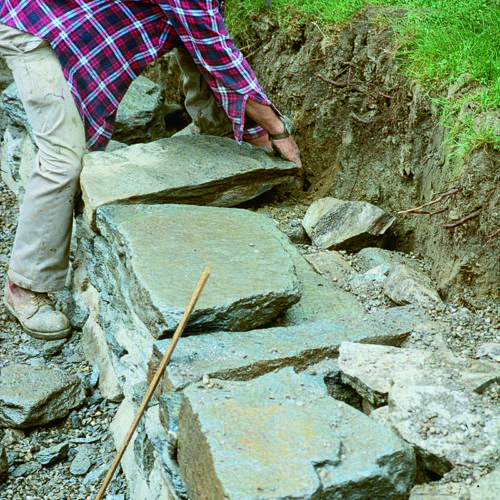
기본 코스를 위한 도랑을 파세요
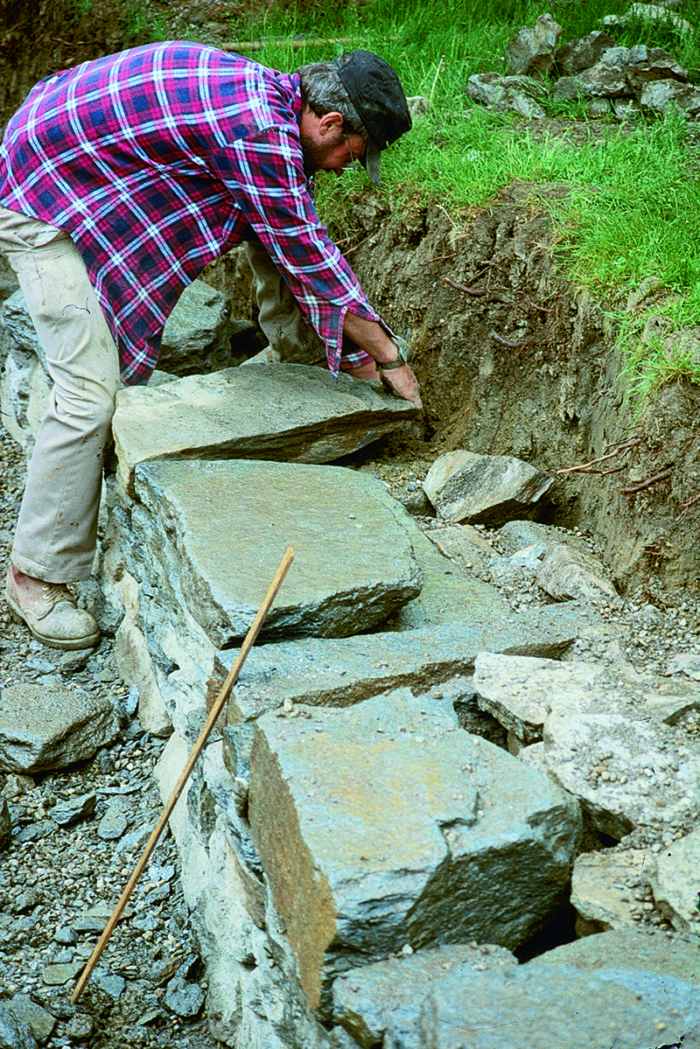
Start by digging a trench about 4 inches deep and at least 2 feet wide. A straightedged spade will give you a nice, even edge. The first course must be very solid and tightly fit because the weight of the wall will rest on it. Take the time to find rocks that lock into place, without leaving gaps. Randomly lay your largest rocks along the front edge of the trench. Set the first stone, shifting it around until it sits securely without being rocked easily, and then fill with the remaining stones. If you are using rectangular stones, you want the height of adjacent stones to be the same, or of a difference that can be made up with a smaller stone. If the rocks are irregular, then the stones will fit together leaving a triangular gap for the next course to fit into. I find irregular rocks easier to work with than flat ones; with flat rocks you have to be more precise. Find a stone that fits well and then continue for a few more feet. A rule of thumb, passed down from my wall-building teacher’s mentor, is to try a stone seven different ways. If it doesn’t fit by the seventh try, use another stone.
다음으로, 돌 뒤의 흙을 삽으로 퍼내고 공간에 흙을 다져 넣습니다. between, behind, and beneath the stones with top of the sledgehammer. This is an important step because the dirt becomes the mortar for the wall. I also recommend adding rubble (those stones you won’t use on the face of your wall) behind the face course to give greater strength to the wall. Pound the rubble and soil mix until you are satisfied that it is solid. Continue the first course until you reach the end of the wall. When you are done, test
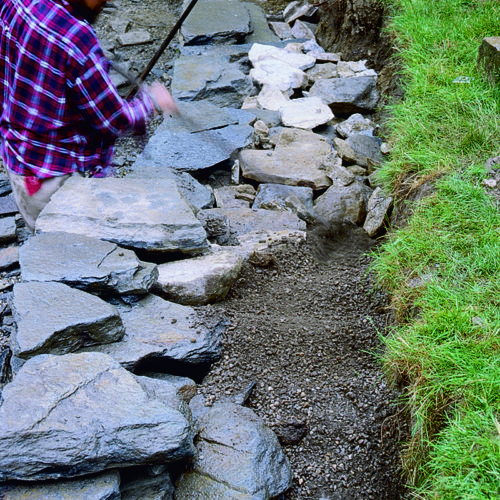
두 번째 코스를 시작하려면 맨 아래 코스의 첫 번째 연결부를 연결하는 돌을 선택하세요. Avoid having joints run up the face of the wall, and angle (batter) the courses backward—approximately 1 inch per vertical foot. This creates a stable wall. For added strength, intermittently place single stones that run the full depth of the wall. This will only work with rectangular rocks. For irregular rocks, place a large rock behind a face rock every 3 feet or so. As you set a course, you will come to situations, probably quite a few of them, where the rock placement is perfect on all sides but one. These are the planting opportunities that give life to a stone wall.
Continue building in this manner until you are one course away from the finished height. Fitting stones will get easier as you go, and you’ll likely discover that there’s a certain magic moment when you’re building a wall: you hear a thump that signals you’ve placed a rock perfec
벽 위치 높이를 만드세요.
The ideal height for a dry-stacked retaining wall is 18 to 22 inches—so you can sit on it when your gardening chores are done. Even if
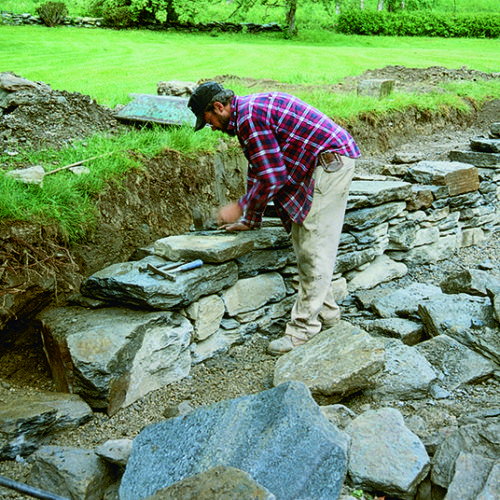
관석을 놓는 과정에는 많은 인내심이 필요합니다. 그것은 당신이 지금까지 개발한 기술의 정점입니다. 깊이는 약 15~18인치여야 하며, 1~3개의 돌로 구성되어야 합니다. 돌을 고정하려면 흙을 잘 사용하고, 벽의 줄눈과 마찬가지로 덮개돌의 줄눈이 길지 않도록 하세요. 벽에 앉고 싶다면 매끄럽고 평평한 돌을 선택하세요. 아니면 틈을 흙으로 메우고 향기로운 허브를 심어 쿠션을 만들어보세요. 심어진 관석은 살아있는 벽에 기분 좋은 마무리 터치입니다.
 아프리카 사람
 알바니아
알바니아 암하라어
암하라어 아라비아 말
 아르메니아 사람
 아제르바이잔
 바스크 사람
 벨로루시어
벨로루시어 벵골 사람
벵골 사람  보스니아어
보스니아어 불가리아 사람
 카탈로니아 사람
 세부아노어
세부아노어 중국
중국 중국(대만)
 코르시카어
코르시카어 크로아티아어
 체코 사람
체코 사람 덴마크 말
덴마크 말 네덜란드 사람
 영어
영어 에스페란토 말
 에스토니아 사람
 핀란드어
핀란드어 프랑스 국민
 프리지아어
프리지아어 갈리시아어
갈리시아어 그루지야 사람
 독일 사람
독일 사람 그리스 어
그리스 어 구자라트어
구자라트어 아이티 크리올어
 하우사
하우사 하와이 사람
 헤브라이 사람
 아니요
아니요 먀오족
먀오족 헝가리 인
헝가리 인 아이슬란드어
 이보
이보 인도네시아 인
 아일랜드의
아일랜드의 이탈리아 사람
 일본어
일본어 자바어
자바어 칸나다어
칸나다어 카자흐어
카자흐어 크메르어
크메르어 르완다
르완다 한국인
한국인 쿠르드어
쿠르드어 키르기스어
키르기스어 결핵
결핵 라틴어
라틴어 라트비아 사람
 리투아니아 사람
 룩셈부르크어
 마케도니아 어
 말가시
말가시 말레이 사람
 말라얄람어
말라얄람어 몰티즈
몰티즈 마오리족
마오리족 마라티어
마라티어 몽고 어
몽고 어 미얀마
미얀마 네팔어
네팔어 노르웨이 인
 노르웨이 인
 옥시탄
옥시탄 파슈토어
파슈토어 페르시아 인
 광택
광택 포르투갈 인
  펀자브어
펀자브어 루마니아 사람
 러시아인
러시아인 사모아어
사모아어 스코틀랜드 게일어
 세르비아 사람
 영어
영어 쇼나
쇼나 신디어
신디어 신할라어
신할라어 슬로바키아 사람
 슬로베니아
슬로베니아 소말리아어
소말리아어 스페인의
스페인의 순다어
순다어 스와힐리어
스와힐리어 스웨덴어
스웨덴어 타갈로그어
타갈로그어 타직어
타직어 타밀 사람
타밀 사람 타타르어
타타르어 텔루구어
텔루구어 태국어
태국어 터키어
터키어 투르크멘 말
 우크라이나 인
 우르두어
우르두어 위구르어
위구르어 우즈벡어
우즈벡어 베트남어
베트남어 웨일스 말
웨일스 말