

Zarjavele ploščice
Želite zgraditi lasten kamniti podporni zid, vendar niste prepričani, kako začeti? Če imate neenakomeren na dvorišču lahko kamnita podporna stena pomaga preprečiti erozijo in nudi prijeten prostor za sajenje. Če želite izvedeti, kako sestaviti svojega, od začetka do konca, berite naprej.
To figure out how much stone you’ll need, multiply your wall’s height times the depth times the length. If your wall is 2 feet high, 1-1/2 feet wide, and 20 feet long, you’ll need roughly 60 cubic feet of stone. Most stoneyards will deliver the stones for a slight charge; have them placed as close to the site of your retaining wall as possible.
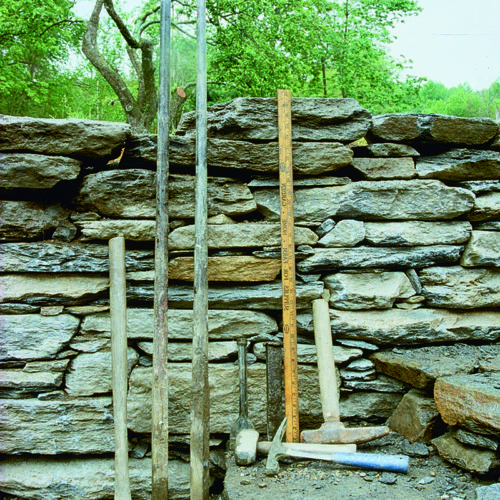
Kar zadeva tools, you’ll need a shovel for digging your trench and backfilling, a mattock for attacking the grade, and a small sledgehammer for tamping soil. For marking your site and leveling rocks, you’ll need a line level, a few tall stakes, string, some flour, and a 4- or 8-foot level.
Now you can start digging. The easiest approach is to cut and fill—that is, dig into the slope where the wall will go and spread the earth below you to create a level terrace. When you cut and fill, the wall is backed by undisturbed soil, which is more stable than fill. For design reasons, however, you might choose to build a freestanding wall and fill behind it with soil from another site. Or you might do a partial cut and fill, which is somewhere between the two.
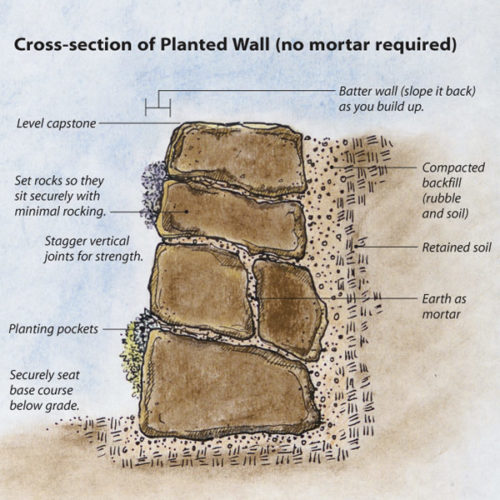
Stene so zgrajene v tečajih. The base course is structurally the most important, while the final course, the capstone, is the most challenging. For stability, walls should be at least 20 inches wide at the base. They can taper slightly toward the top, but you’ll want a wall that is at least two rocks wide in most places. This can be accomplished by mixing stones of different sizes or by backfilling with a combination of two-thirds rubble to one-third soil.
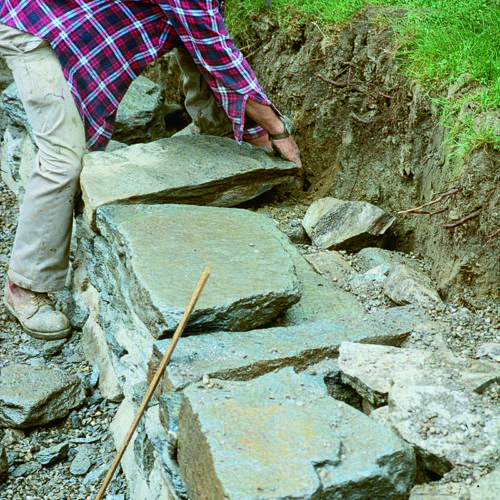
Izkopajte jarek za temeljni sloj
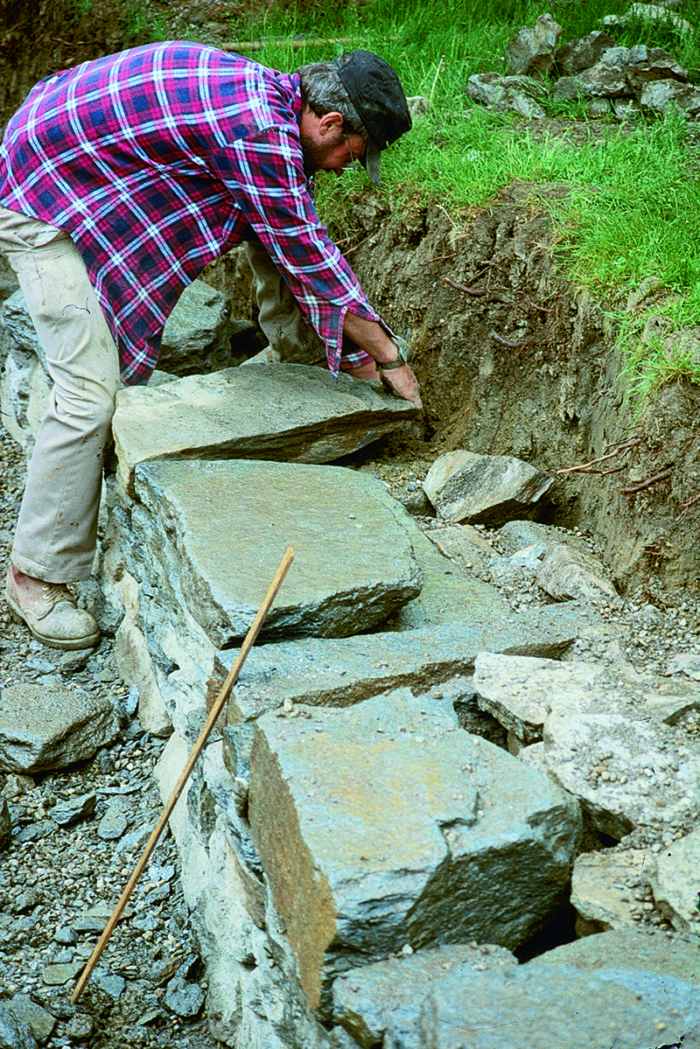
Start by digging a trench about 4 inches deep and at least 2 feet wide. A straightedged spade will give you a nice, even edge. The first course must be very solid and tightly fit because the weight of the wall will rest on it. Take the time to find rocks that lock into place, without leaving gaps. Randomly lay your largest rocks along the front edge of the trench. Set the first stone, shifting it around until it sits securely without being rocked easily, and then fill with the remaining stones. If you are using rectangular stones, you want the height of adjacent stones to be the same, or of a difference that can be made up with a smaller stone. If the rocks are irregular, then the stones will fit together leaving a triangular gap for the next course to fit into. I find irregular rocks easier to work with than flat ones; with flat rocks you have to be more precise. Find a stone that fits well and then continue for a few more feet. A rule of thumb, passed down from my wall-building teacher’s mentor, is to try a stone seven different ways. If it doesn’t fit by the seventh try, use another stone.
Nato z lopato pospravite umazanijo za kamne in v prostore vtlačite zemljo between, behind, and beneath the stones with top of the sledgehammer. This is an important step because the dirt becomes the mortar for the wall. I also recommend adding rubble (those stones you won’t use on the face of your wall) behind the face course to give greater strength to the wall. Pound the rubble and soil mix until you are satisfied that it is solid. Continue the first course until you reach the end of the wall. When you are done, test
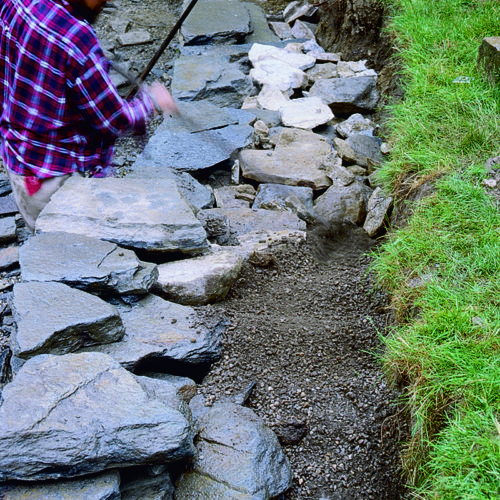
Za začetek drugega sloja izberite kamen, ki bo premostil prvi spoj spodnjega sloja. Avoid having joints run up the face of the wall, and angle (batter) the courses backward—approximately 1 inch per vertical foot. This creates a stable wall. For added strength, intermittently place single stones that run the full depth of the wall. This will only work with rectangular rocks. For irregular rocks, place a large rock behind a face rock every 3 feet or so. As you set a course, you will come to situations, probably quite a few of them, where the rock placement is perfect on all sides but one. These are the planting opportunities that give life to a stone wall.
Continue building in this manner until you are one course away from the finished height. Fitting stones will get easier as you go, and you’ll likely discover that there’s a certain magic moment when you’re building a wall: you hear a thump that signals you’ve placed a rock perfec
Postavite višino stene
The ideal height for a dry-stacked retaining wall is 18 to 22 inches—so you can sit on it when your gardening chores are done. Even if
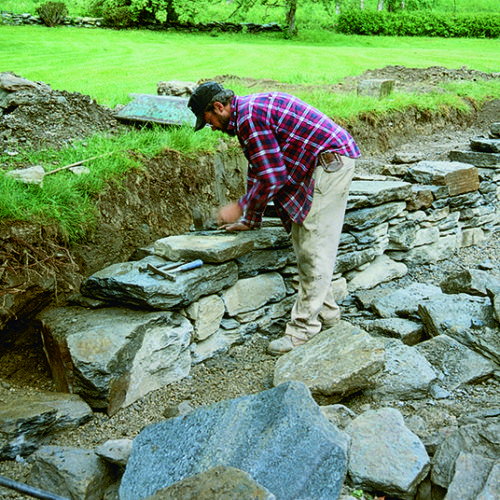
Prinesite veliko potrpljenja v postopek polaganja zaključnega kamna; to je vrhunec veščine, ki ste jo razvili do te točke. Globok mora biti približno 15 do 18 centimetrov, sestavljen iz enega do treh kamnov. Uporabite zemljo in dobro postavitev za pritrditev kamnov in tako kot pri stenskih spojih se izogibajte dolgim spojem v zaključnem kamnu. Če želite sedeti na steni, izberite gladke, ravne kamne. Ali pa vrzeli zapolnite z zemljo in posadite dišeča zelišča za blazine. Zasajen zaključni kamen je čudovit zaključek žive stene.
 Afriški
 albanski
 amharščina
 arabsko
 armenski
 azerbajdžanski
 baskovščina
 beloruski
 bengalščina
  bosanski
 bolgarščina
 katalonski
 Cebuano
 Kitajska
 Kitajska (Tajvan)
 korziški
 hrvaško
 češki
češki danščina
 nizozemščina
 angleščina
 Esperanto
 estonski
 finščina
 francosko
 frizijščina
 galicijski
 gruzijski
 nemški
 grški
grški gudžaratščina
 haitska kreolščina
 hiša
hiša havajski
 hebrejščina
 ne
ne Miao
Miao madžarski
 islandski
 igbo
igbo indonezijski
 irski
irski italijanščina
 japonska
 javanska
 kanadščina
 kazahstanski
 kmerski
 ruandski
 korejščina
 kurdski
 Kirgiz
 TB
TB latinščina
 latvijščina
 litovski
 luksemburški
 makedonski
 Malgaši
 malajščina
 malajalamščina
 malteški
 maorski
 maratščina
 mongolski
 Mjanmar
 nepalsko
 norveški
 norveški
 okcitanščina
 paštu
paštu perzijsko
 poljski
 portugalščina
  pandžabščina
 romunščina
 ruski
ruski samoanska
 škotska gelščina
 srbsko
 angleščina
 Shona
Shona Sindhi
 singalščina
 slovaški
 Slovenščina
 somalski
 španski
 sundanski
 svahili
 švedščina
 Tagalog
 tadžikistanski
 tamilščina
 tatarščina
 telugu
 tajska
 turško
 turkmenski
 ukrajinski
 urdu
urdu ujgurski
 Uzbek
Uzbek vietnamski
 valižanščina