

Zardzewiałe płytki
Chcesz zbudować własny kamienny mur oporowy, ale nie wiesz, jak zacząć? Jeśli masz nierówną podwórzu, kamienna ściana oporowa może pomóc w zapobieganiu erozji i zapewnia ładne miejsce do sadzenia. Aby dowiedzieć się, jak złożyć coś samodzielnie, od początku do końca, czytaj dalej.
To figure out how much stone you’ll need, multiply your wall’s height times the depth times the length. If your wall is 2 feet high, 1-1/2 feet wide, and 20 feet long, you’ll need roughly 60 cubic feet of stone. Most stoneyards will deliver the stones for a slight charge; have them placed as close to the site of your retaining wall as possible.
Jeśli chodzi o tools, you’ll need a shovel for digging your trench and backfilling, a graca for attacking the grade, and a small sledgehammer for tamping soil. For marking your site and leveling rocks, you’ll need a line level, a few tall stakes, string, some flour, and a 4- or 8-foot level.
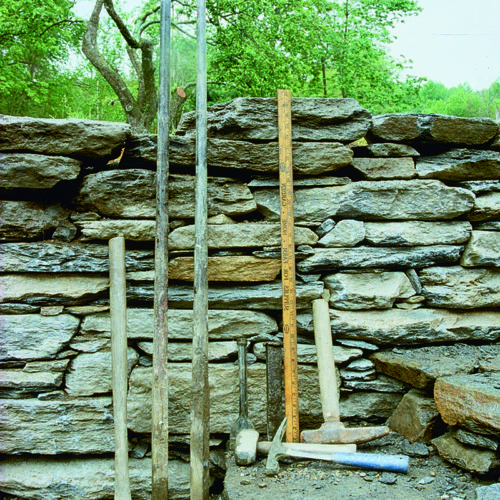
Now you can start digging. The easiest approach is to cut and fill—that is, dig into the slope where the wall will go and spread the earth below you to create a level terrace. When you cut and fill, the wall is backed by undisturbed soil, which is more stable than fill. For design reasons, however, you might choose to build a freestanding wall and fill behind it with soil from another site. Or you might do a partial cut and fill, which is somewhere between the two.
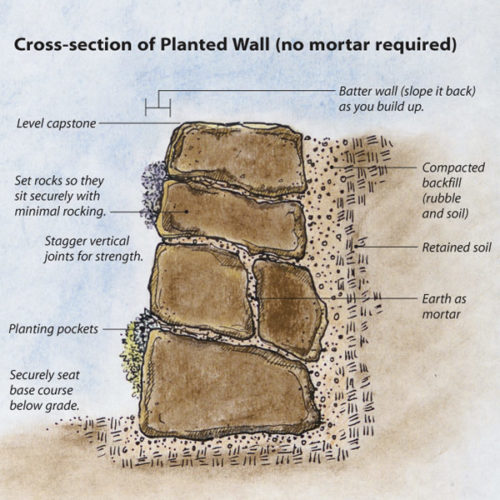
Ściany budowane są w kursach. The base course is structurally the most important, while the final course, the capstone, is the most challenging. For stability, walls should be at least 20 inches wide at the base. They can taper slightly toward the top, but you’ll want a wall that is at least two rocks wide in most places. This can be accomplished by mixing stones of different sizes or by backfilling with a combination of two-thirds rubble to one-third soil.
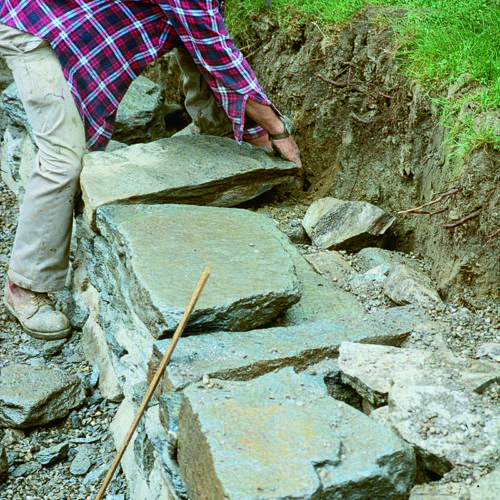
Wykop rów pod warstwę bazową
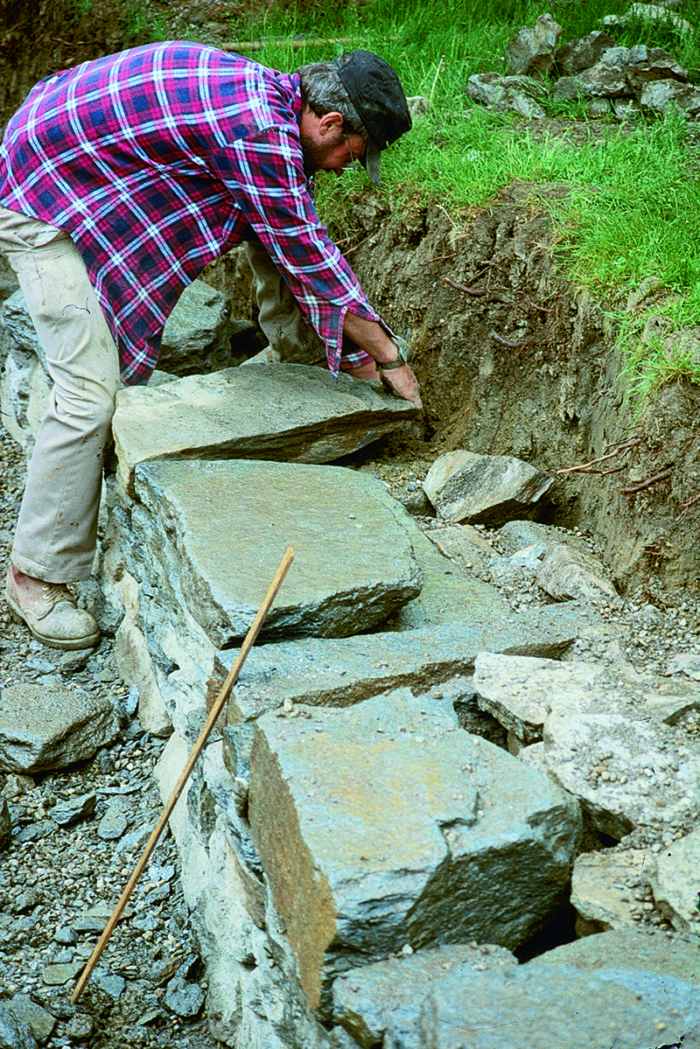
Start by digging a trench about 4 inches deep and at least 2 feet wide. A straightedged spade will give you a nice, even edge. The first course must be very solid and tightly fit because the weight of the wall will rest on it. Take the time to find rocks that lock into place, without leaving gaps. Randomly lay your largest rocks along the front edge of the trench. Set the first stone, shifting it around until it sits securely without being rocked easily, and then fill with the remaining stones. If you are using rectangular stones, you want the height of adjacent stones to be the same, or of a difference that can be made up with a smaller stone. If the rocks are irregular, then the stones will fit together leaving a triangular gap for the next course to fit into. I find irregular rocks easier to work with than flat ones; with flat rocks you have to be more precise. Find a stone that fits well and then continue for a few more feet. A rule of thumb, passed down from my wall-building teacher’s mentor, is to try a stone seven different ways. If it doesn’t fit by the seventh try, use another stone.
Następnie przerzuć ziemię za kamienie i wbij ziemię w wolne przestrzenie between, behind, and beneath the stones with top of the sledgehammer. This is an important step because the dirt becomes the mortar for the wall. I also recommend adding rubble (those stones you won’t use on the face of your wall) behind the face course to give greater strength to the wall. Pound the rubble and soil mix until you are satisfied that it is solid. Continue the first course until you reach the end of the wall. When you are done, test
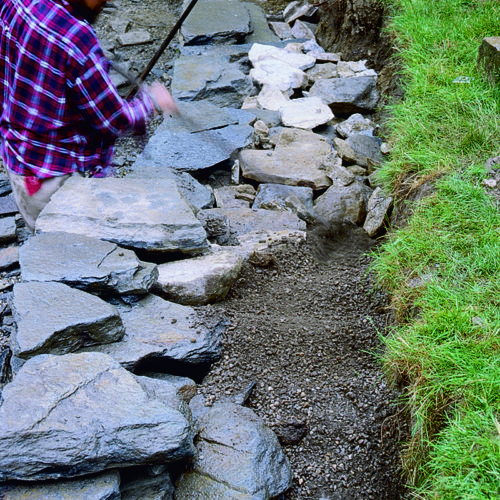
Aby rozpocząć drugi kurs, wybierz kamień, który połączy pierwsze połączenie dolnego kursu. Avoid having joints run up the face of the wall, and angle (batter) the courses backward—approximately 1 inch per vertical foot. This creates a stable wall. For added strength, intermittently place single stones that run the full depth of the wall. This will only work with rectangular rocks. For irregular rocks, place a large rock behind a face rock every 3 feet or so. As you set a course, you will come to situations, probably quite a few of them, where the rock placement is perfect on all sides but one. These are the planting opportunities that give life to a stone wall.
Continue building in this manner until you are one course away from the finished height. Fitting stones will get easier as you go, and you’ll likely discover that there’s a certain magic moment when you’re building a wall: you hear a thump that signals you’ve placed a rock perfec
Ustaw wysokość montażu na ścianie
The ideal height for a dry-stacked retaining wall is 18 to 22 inches—so you can sit on it when your gardening chores are done. Even if
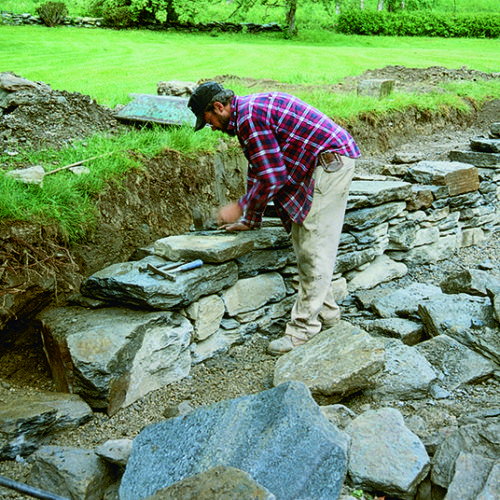
Włóż dużo cierpliwości w proces kładzenia zwieńczenia; jest to kulminacja umiejętności, które rozwinąłeś do tej pory. Powinien mieć głębokość około 15 do 18 cali i składać się z jednego do trzech kamieni. Aby zabezpieczyć kamienie, użyj gleby i dobrego rozmieszczenia i podobnie jak w przypadku spoin ściennych, unikaj długich spoin w zwieńczeniu. Jeśli chcesz usiąść na ścianie, wybierz gładkie, płaskie kamienie. Możesz też wypełnić luki ziemią i posadzić pachnące zioła na poduszki. Posadzony zwieńczenie jest wspaniałym wykończeniem żywej ściany.
 afrykanin
 albański
 amharski
 arabski
 ormiański
 azerbejdżański
 baskijski
 białoruski
 bengalski
  bośniacki
 bułgarski
 kataloński
 Cebuański
 Chiny
Chiny Chiny (Tajwan)
 korsykański
 chorwacki
 Czech
Czech duński
 Holenderski
 język angielski
 esperanto
 estoński
 fiński
 Francuski
 fryzyjski
 galicyjski
 gruziński
 Niemiecki
 grecki
 gudżarati
 Kreolski haitański
 hausa
hausa hawajski
 hebrajski
 Nie
Nie Miao
Miao język węgierski
 islandzki
 ibo
ibo indonezyjski
 Irlandczyk
 Włoski
 język japoński
 jawajski
 Kannada
 kazachski
 Khmer
Khmer Rwandyjski
 koreański
 kurdyjski
 Kirgiski
 gruźlica
 łacina
 łotewski
 litewski
 luksemburski
 macedoński
 Malgashi
 malajski
 malajalam
 Maltański
 Maoryski
 marathi
 mongolski
 Myanmar
 Nepalski
 norweski
 norweski
 oksytański
 paszto
 perski
 Polski
 portugalski
  Pendżabski
 rumuński
 Rosyjski
 Samoański
 szkocki gaelicki
 serbski
 język angielski
 Shona
Shona Sindhi
 syngaleski
 słowacki
 słoweński
 somalijski
 hiszpański
 Sundajczyk
 Suahili
 szwedzki
 tagalski
 tadżycki
 Tamil
Tamil Tatar
Tatar telugu
 tajski
 turecki
 Turkmeni
 ukraiński
 urdu
urdu Ujgur
Ujgur uzbecki
 wietnamski
 walijski