

Kothak karat
Pengin mbangun tembok penahan watu dhewe, nanging ora yakin carane miwiti? Yen sampeyan duwe ora rata pekarangan, tembok penahan watu bisa mbantu nyegah erosi lan nyedhiyakake papan sing apik kanggo nandur. Kanggo sinau carane nggawe dhewe, saka wiwitan nganti rampung, waca.
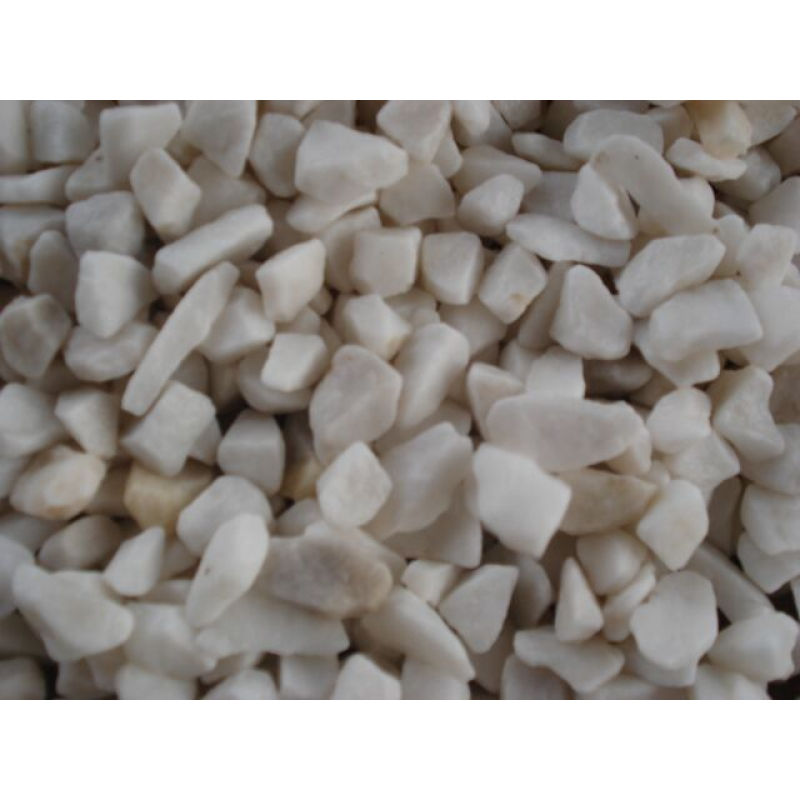
To figure out how much stone you’ll need, multiply your wall’s height times the depth times the length. If your wall is 2 feet high, 1-1/2 feet wide, and 20 feet long, you’ll need roughly 60 cubic feet of stone. Most stoneyards will deliver the stones for a slight charge; have them placed as close to the site of your retaining wall as possible.
Minangka kanggo tools, you’ll need a shovel for digging your trench and backfilling, a macak for attacking the grade, and a small sledgehammer for tamping soil. For marking your site and leveling rocks, you’ll need a line level, a few tall stakes, string, some flour, and a 4- or 8-foot level.
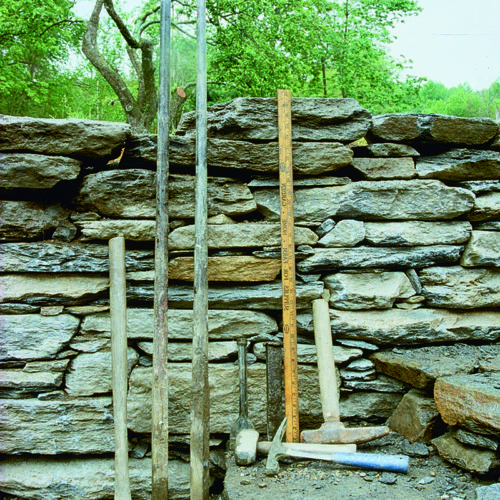
Now you can start digging. The easiest approach is to cut and fill—that is, dig into the slope where the wall will go and spread the earth below you to create a level terrace. When you cut and fill, the wall is backed by undisturbed soil, which is more stable than fill. For design reasons, however, you might choose to build a freestanding wall and fill behind it with soil from another site. Or you might do a partial cut and fill, which is somewhere between the two.
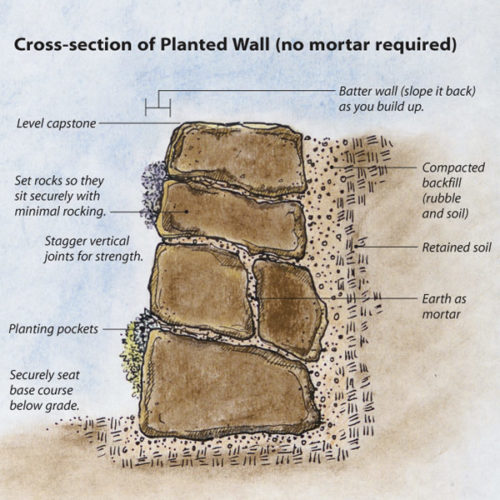
Tembok dibangun ing kursus. The base course is structurally the most important, while the final course, the capstone, is the most challenging. For stability, walls should be at least 20 inches wide at the base. They can taper slightly toward the top, but you’ll want a wall that is at least two rocks wide in most places. This can be accomplished by mixing stones of different sizes or by backfilling with a combination of two-thirds rubble to one-third soil.
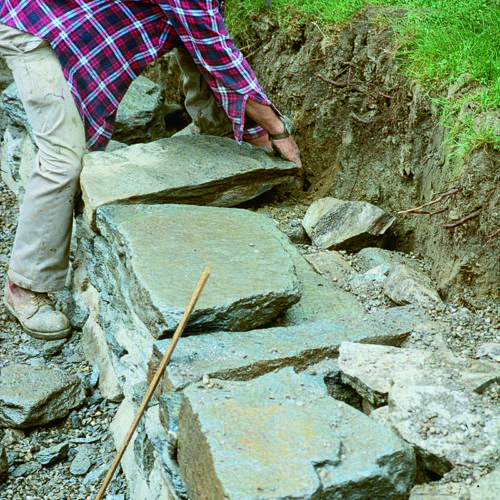
Dig trench kanggo kursus dhasar
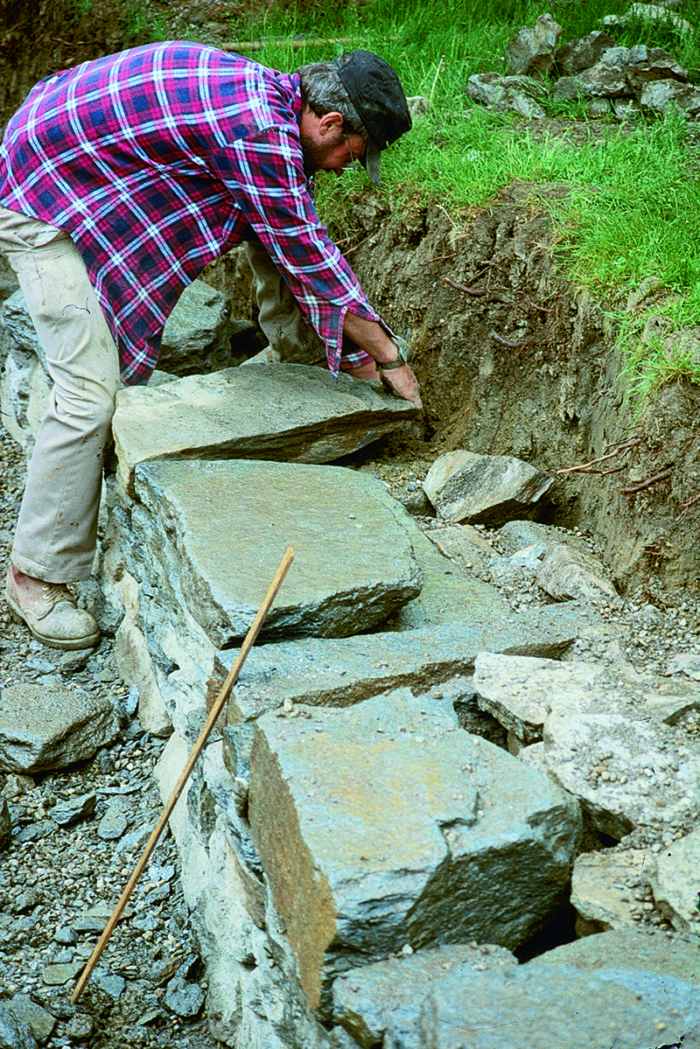
Start by digging a trench about 4 inches deep and at least 2 feet wide. A straightedged spade will give you a nice, even edge. The first course must be very solid and tightly fit because the weight of the wall will rest on it. Take the time to find rocks that lock into place, without leaving gaps. Randomly lay your largest rocks along the front edge of the trench. Set the first stone, shifting it around until it sits securely without being rocked easily, and then fill with the remaining stones. If you are using rectangular stones, you want the height of adjacent stones to be the same, or of a difference that can be made up with a smaller stone. If the rocks are irregular, then the stones will fit together leaving a triangular gap for the next course to fit into. I find irregular rocks easier to work with than flat ones; with flat rocks you have to be more precise. Find a stone that fits well and then continue for a few more feet. A rule of thumb, passed down from my wall-building teacher’s mentor, is to try a stone seven different ways. If it doesn’t fit by the seventh try, use another stone.
Sabanjure, sekop rereget ing mburi watu lan tamp bumi menyang spasi between, behind, and beneath the stones with top of the sledgehammer. This is an important step because the dirt becomes the mortar for the wall. I also recommend adding rubble (those stones you won’t use on the face of your wall) behind the face course to give greater strength to the wall. Pound the rubble and soil mix until you are satisfied that it is solid. Continue the first course until you reach the end of the wall. When you are done, test
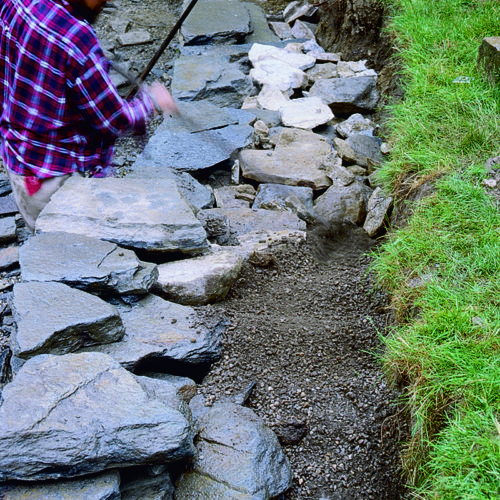
Kanggo miwiti kursus kapindho, pilih watu sing bakal nyambungake sendi pisanan saka dalan ngisor. Avoid having joints run up the face of the wall, and angle (batter) the courses backward—approximately 1 inch per vertical foot. This creates a stable wall. For added strength, intermittently place single stones that run the full depth of the wall. This will only work with rectangular rocks. For irregular rocks, place a large rock behind a face rock every 3 feet or so. As you set a course, you will come to situations, probably quite a few of them, where the rock placement is perfect on all sides but one. These are the planting opportunities that give life to a stone wall.
Continue building in this manner until you are one course away from the finished height. Fitting stones will get easier as you go, and you’ll likely discover that there’s a certain magic moment when you’re building a wall: you hear a thump that signals you’ve placed a rock perfec
Nggawe dhuwur tembok sampeyan
The ideal height for a dry-stacked retaining wall is 18 to 22 inches—so you can sit on it when your gardening chores are done. Even if
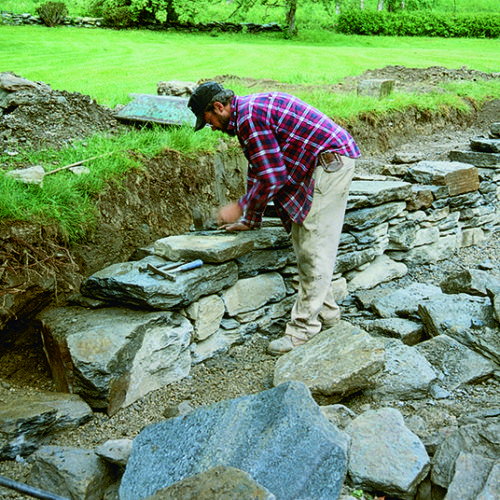
Nggawa akeh sabar kanggo proses laying capstone; iku culmination saka skill wis dikembangaké kanggo titik iki. Mesthine kira-kira 15 nganti 18 inci jero, digawe saka siji nganti telung watu. Gunakake lemah lan panggonan sing apik kanggo ngamanake watu, lan kayadene tembok tembok, aja nganti sambungan dawa ing capstone. Yen sampeyan pengin njagong ing tembok, pilih watu sing rata lan rata. Utawa, isi longkangan karo lemah lan tanduran jamu wangi kanggo bantal. Capstone sing ditanam minangka sentuhan pungkasan sing nyenengake kanggo tembok sing urip.
 Afrika
 basa Albania
 Amharic
 Arab
Arab wong Armenia
 Azerbaijan
 Basque
 Belarusia
 Bengali
  Bosnia
 basa Bulgaria
 Katalan
 Cebuano
 Cina
Cina China (Taiwan)
 Korsika
 basa Kroasia
 Ceko
Ceko Danish
 Walanda
 Inggris
 Esperanto
 basa Estonia
 basa Finlandia
 Prancis
 Frisian
 Galician
 Georgian
 Jerman
 Yunani
 Gujarati
 Kreol Haiti
 hausa
hausa hawaii
 basa Ibrani
 Ora
Ora Miao
Miao Hungaria
 basa Islandia
 igbo
igbo basa Indonesia
 irlandia
 basa Italia
 Jepang
 basa jawa
 Kannada
 kazakh
 Khmer
Khmer wong Rwanda
 Korea
Korea Kurdi
Kurdi Kyrgyz
 TB
TB latin
latin Latvia
 Lithuania
 Luksemburg
 Makedonia
 Malgashi
 Melayu
 Malayalam
 wong Malta
 Maori
Maori Marathi
 Mongolian
 Myanmar
 Nepali
 basa Norwegia
 basa Norwegia
 Occitan
 Pashto
 Persia
 Polandia
 Portugis
  Punjabi
 basa Rumania
 Rusian
 Samoan
 Gaelik Skotlandia
 basa Serbia
 Inggris
 Shona
Shona Sindhi
 Sinhala
 basa Slowakia
 basa Slovenia
 Somali
 Spanyol
 Sundha
 Swahili
 Swedia
 Tagalog
 Tajik
Tajik Tamil
Tamil Tatar
Tatar Telugu
 Thai
Thai basa Turki
 Turkmen
 Ukrainia
 Basa Urdu
 Uighur
 Uzbek
Uzbek Vietnam
 Welsh
Welsh