

Rustaj kaheloj
Ĉu vi volas konstrui vian propran ŝtonan apogmuron, sed ne certas kiel komenci? Se vi havas malebenaĵon korto, ŝtona apogmuro povas helpi malhelpi erozion kaj provizas belan lokon por planti. Por lerni kiel kunmeti vian propran, de komenco ĝis fino, legu plu.
To figure out how much stone you’ll need, multiply your wall’s height times the depth times the length. If your wall is 2 feet high, 1-1/2 feet wide, and 20 feet long, you’ll need roughly 60 cubic feet of stone. Most stoneyards will deliver the stones for a slight charge; have them placed as close to the site of your retaining wall as possible.
Kiel por tools, you’ll need a shovel for digging your trench and backfilling, a mattock for attacking the grade, and a small sledgehammer for tamping soil. For marking your site and leveling rocks, you’ll need a line level, a few tall stakes, string, some flour, and a 4- or 8-foot level.
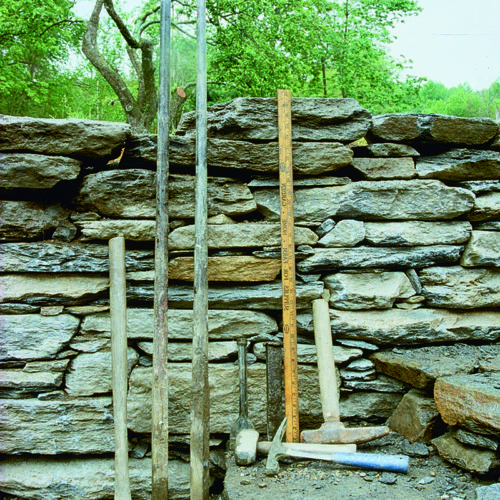
Now you can start digging. The easiest approach is to cut and fill—that is, dig into the slope where the wall will go and spread the earth below you to create a level terrace. When you cut and fill, the wall is backed by undisturbed soil, which is more stable than fill. For design reasons, however, you might choose to build a freestanding wall and fill behind it with soil from another site. Or you might do a partial cut and fill, which is somewhere between the two.
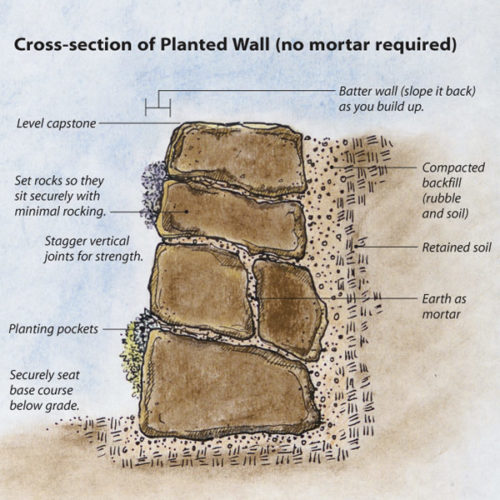
Muroj estas konstruitaj en kursoj. The base course is structurally the most important, while the final course, the capstone, is the most challenging. For stability, walls should be at least 20 inches wide at the base. They can taper slightly toward the top, but you’ll want a wall that is at least two rocks wide in most places. This can be accomplished by mixing stones of different sizes or by backfilling with a combination of two-thirds rubble to one-third soil.
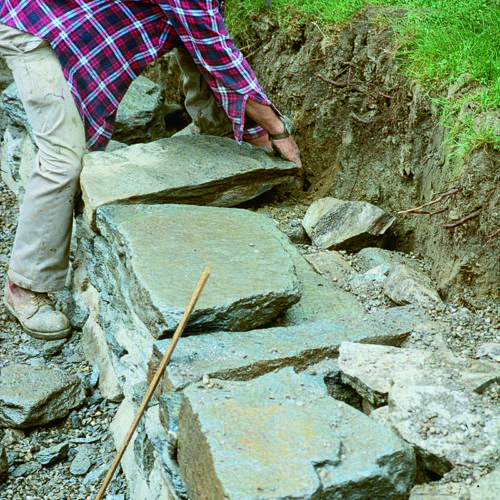
Fosu tranĉeon por la baza kurso
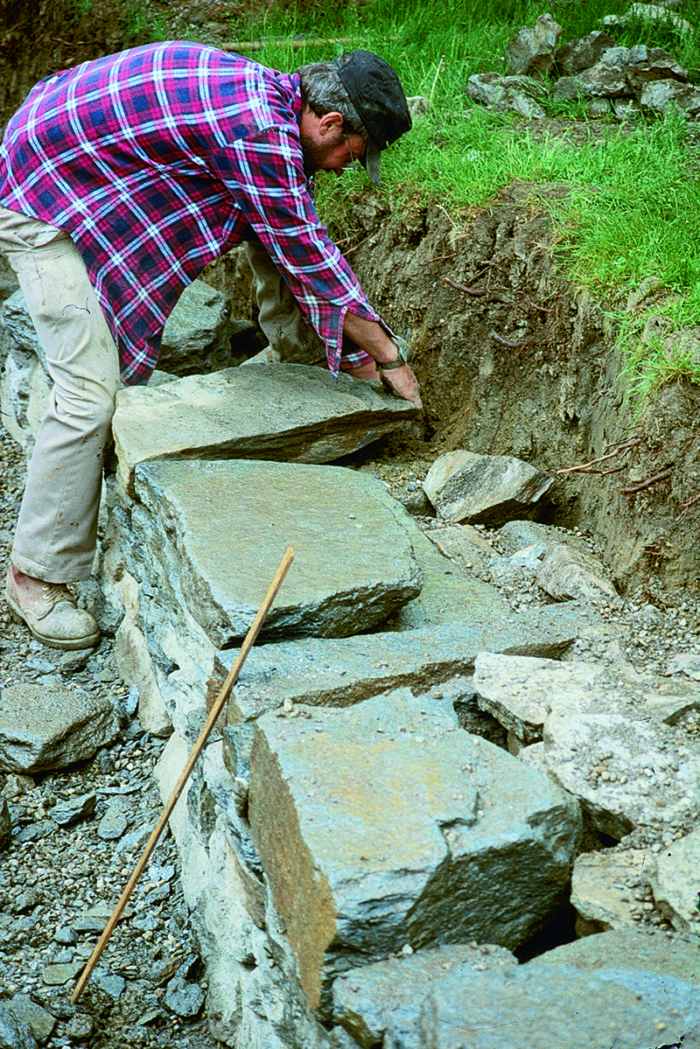
Start by digging a trench about 4 inches deep and at least 2 feet wide. A straightedged spade will give you a nice, even edge. The first course must be very solid and tightly fit because the weight of the wall will rest on it. Take the time to find rocks that lock into place, without leaving gaps. Randomly lay your largest rocks along the front edge of the trench. Set the first stone, shifting it around until it sits securely without being rocked easily, and then fill with the remaining stones. If you are using rectangular stones, you want the height of adjacent stones to be the same, or of a difference that can be made up with a smaller stone. If the rocks are irregular, then the stones will fit together leaving a triangular gap for the next course to fit into. I find irregular rocks easier to work with than flat ones; with flat rocks you have to be more precise. Find a stone that fits well and then continue for a few more feet. A rule of thumb, passed down from my wall-building teacher’s mentor, is to try a stone seven different ways. If it doesn’t fit by the seventh try, use another stone.
Poste, ŝovelu malpuraĵon malantaŭ la ŝtonoj kaj premu la teron en la spacojn between, behind, and beneath the stones with top of the sledgehammer. This is an important step because the dirt becomes the mortar for the wall. I also recommend adding rubble (those stones you won’t use on the face of your wall) behind the face course to give greater strength to the wall. Pound the rubble and soil mix until you are satisfied that it is solid. Continue the first course until you reach the end of the wall. When you are done, test
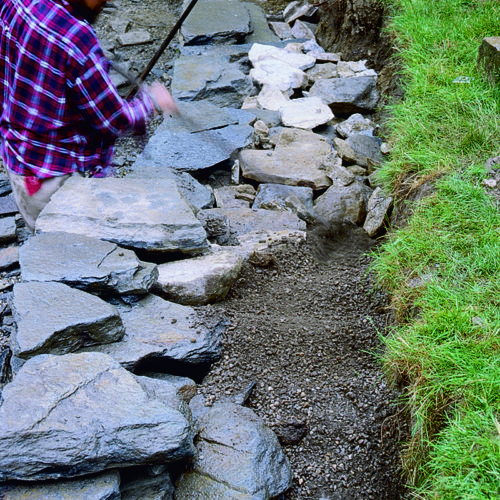
Por komenci la duan kurson, elektu ŝtonon, kiu transpontos la unuan junton de la malsupra kurso. Avoid having joints run up the face of the wall, and angle (batter) the courses backward—approximately 1 inch per vertical foot. This creates a stable wall. For added strength, intermittently place single stones that run the full depth of the wall. This will only work with rectangular rocks. For irregular rocks, place a large rock behind a face rock every 3 feet or so. As you set a course, you will come to situations, probably quite a few of them, where the rock placement is perfect on all sides but one. These are the planting opportunities that give life to a stone wall.
Continue building in this manner until you are one course away from the finished height. Fitting stones will get easier as you go, and you’ll likely discover that there’s a certain magic moment when you’re building a wall: you hear a thump that signals you’ve placed a rock perfec
Altu vian muran lokon
The ideal height for a dry-stacked retaining wall is 18 to 22 inches—so you can sit on it when your gardening chores are done. Even if
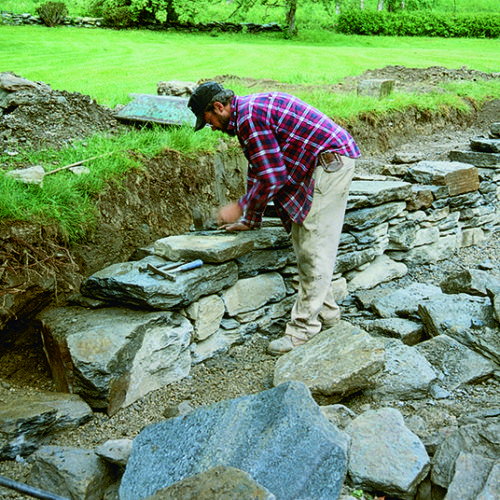
Alportu multe da pacienco al la procezo de metado de la ĉefŝtono; ĝi estas kulmino de la kapablo, kiun vi evoluigis ĝis ĉi tiu punkto. Ĝi devus esti proksimume 15 ĝis 18 colojn profunda, konsistanta el unu ĝis tri ŝtonoj. Uzu grundon kaj bonan lokigon por sekurigi la ŝtonojn, kaj same kiel ĉe murjuntoj, evitu longajn juntojn en la ĉefŝtono. Se vi volas sidi sur la muro, elektu glatajn, platajn ŝtonojn. Aŭ plenigu truojn per grundo kaj plantu bonodorajn herbojn por kusenoj. Plantita kapŝtono estas rava fina tuŝo al viva muro.






 afrikano
 albana
 Amhara
 la araba
 la armena
 Azerbajĝana
 eŭska
eŭska Belarusian
 bengala
  bosnia
 bulgaro
 kataluna
 Cebuano
 Ĉinio
Ĉinio Ĉinio (Tajvano)
 korsika
 kroata
 ĉeĥa
ĉeĥa dana
dana nederlanda
 la angla
 Esperanto
 estona
 finna
finna franca
 frisa
frisa galego
 kartvela
 germana
 greka
greka Gujaratio
 Haitian Creole
 hausa
hausa havajano
 la hebrea
 Ne
Ne Miao
Miao hungara
 islanda
 igbo
igbo indonezia
 irlandano
 itala
itala Japanoj
 la javano
 Kannada
 kazaĥo
 ĥmeroj
 Ruando
 korea
korea kurda
kurda Kirgizoj
 TB
TB la latina
 latva
latva litova
 luksemburga
 makedona
 Malgashi
 malaja
 la malajala
 malta
malta maoria
 Maratio
 mongola
 Mjanmao
 nepala
 norvega
 norvega
 okcitana
 Paŝto
Paŝto la persa
 pola
pola portugala
  panĝaba
 rumana
 rusa
rusa samoano
 Skotgaela
 serba
serba la angla
 Ŝona
Ŝona Sinda
Sinda Sinhala
 la slovaka
 sloveno
 Somalo
 hispana
 Sundanese
 Svahila
 sveda
sveda la tagaloga
 taĝiko
 la tamila
 tataro
 la telugua
 tajlanda
 Turka
Turka turkmenoj
 ukraina
 Urdu
Urdu ujgura
 uzbeko
 vjetnama
 kimra lingvo