

Gạch gỉ
Bạn muốn xây tường chắn bằng đá của riêng mình nhưng không biết bắt đầu như thế nào? Nếu bạn có một không đồng đều sân, một bức tường chắn bằng đá có thể giúp chống xói mòn và tạo ra một nơi tốt để trồng cây. Để tìm hiểu cách kết hợp của riêng bạn, từ đầu đến cuối, hãy đọc tiếp.
To figure out how much stone you’ll need, multiply your wall’s height times the depth times the length. If your wall is 2 feet high, 1-1/2 feet wide, and 20 feet long, you’ll need roughly 60 cubic feet of stone. Most stoneyards will deliver the stones for a slight charge; have them placed as close to the site of your retaining wall as possible.
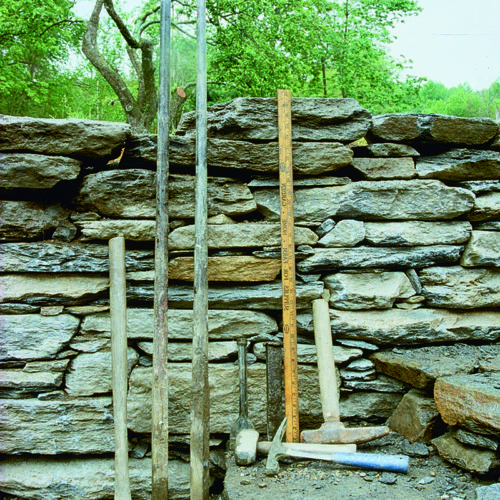
Đối với tools, you’ll need a shovel for digging your trench and backfilling, a cuốc for attacking the grade, and a small sledgehammer for tamping soil. For marking your site and leveling rocks, you’ll need a line level, a few tall stakes, string, some flour, and a 4- or 8-foot level.
Now you can start digging. The easiest approach is to cut and fill—that is, dig into the slope where the wall will go and spread the earth below you to create a level terrace. When you cut and fill, the wall is backed by undisturbed soil, which is more stable than fill. For design reasons, however, you might choose to build a freestanding wall and fill behind it with soil from another site. Or you might do a partial cut and fill, which is somewhere between the two.
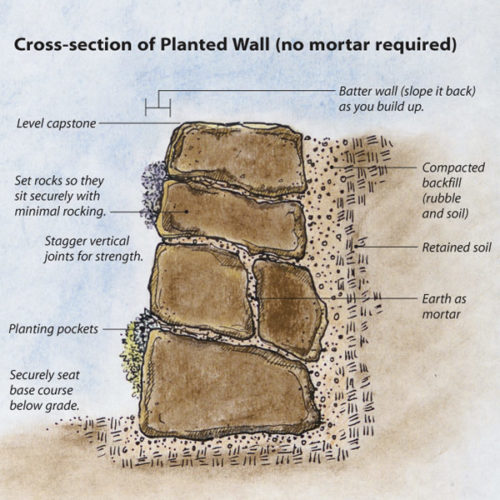
Các bức tường được xây dựng trong các khóa học. The base course is structurally the most important, while the final course, the capstone, is the most challenging. For stability, walls should be at least 20 inches wide at the base. They can taper slightly toward the top, but you’ll want a wall that is at least two rocks wide in most places. This can be accomplished by mixing stones of different sizes or by backfilling with a combination of two-thirds rubble to one-third soil.
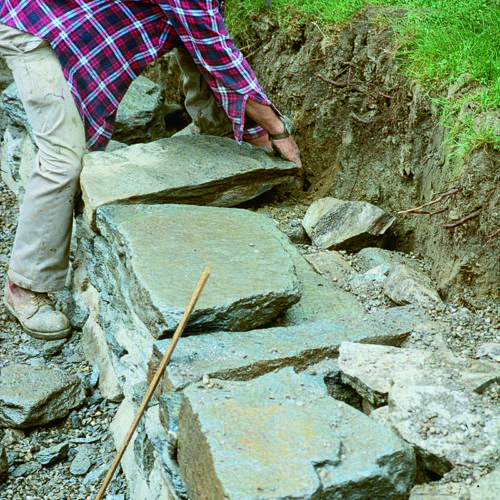
Đào một rãnh cho khóa học cơ sở
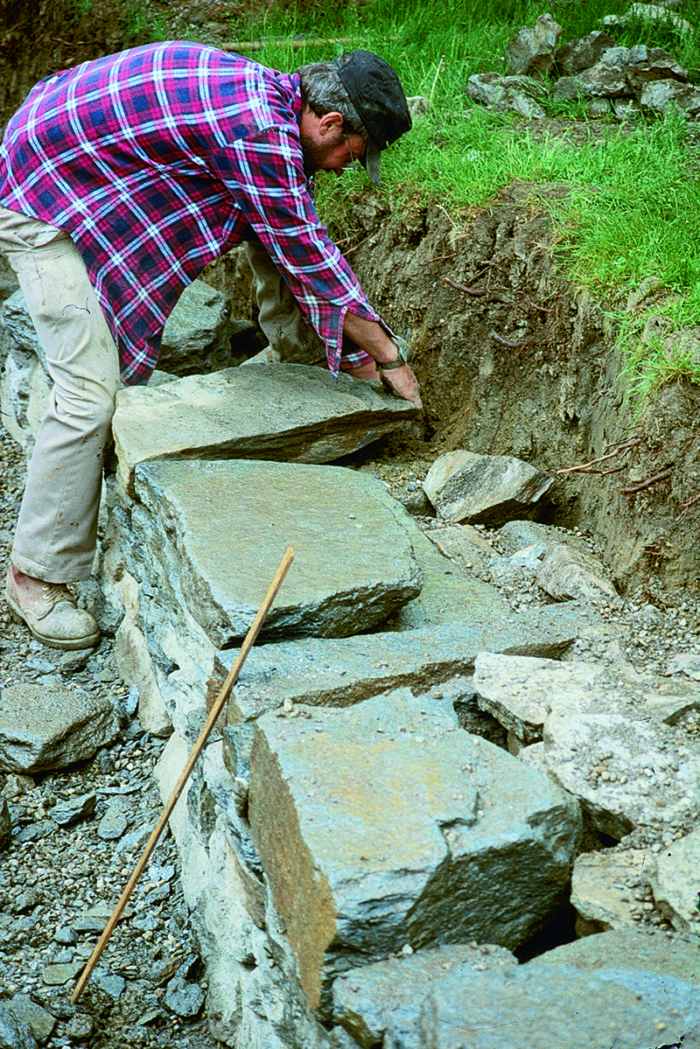
Start by digging a trench about 4 inches deep and at least 2 feet wide. A straightedged spade will give you a nice, even edge. The first course must be very solid and tightly fit because the weight of the wall will rest on it. Take the time to find rocks that lock into place, without leaving gaps. Randomly lay your largest rocks along the front edge of the trench. Set the first stone, shifting it around until it sits securely without being rocked easily, and then fill with the remaining stones. If you are using rectangular stones, you want the height of adjacent stones to be the same, or of a difference that can be made up with a smaller stone. If the rocks are irregular, then the stones will fit together leaving a triangular gap for the next course to fit into. I find irregular rocks easier to work with than flat ones; with flat rocks you have to be more precise. Find a stone that fits well and then continue for a few more feet. A rule of thumb, passed down from my wall-building teacher’s mentor, is to try a stone seven different ways. If it doesn’t fit by the seventh try, use another stone.
Tiếp theo, xúc đất phía sau những viên đá và nén đất vào các khoảng trống between, behind, and beneath the stones with top of the sledgehammer. This is an important step because the dirt becomes the mortar for the wall. I also recommend adding rubble (those stones you won’t use on the face of your wall) behind the face course to give greater strength to the wall. Pound the rubble and soil mix until you are satisfied that it is solid. Continue the first course until you reach the end of the wall. When you are done, test
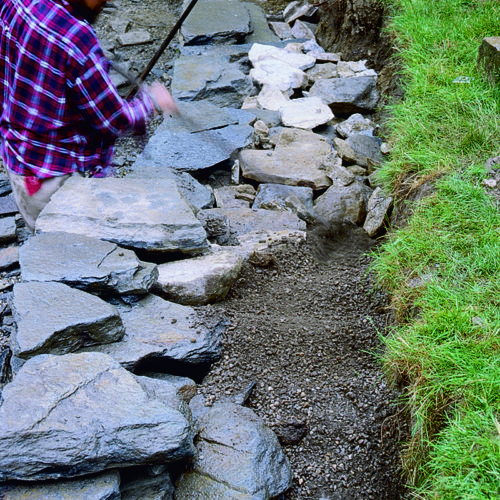
Để bắt đầu khóa thứ hai, hãy chọn một hòn đá sẽ bắc cầu nối đầu tiên của khóa dưới cùng. Avoid having joints run up the face of the wall, and angle (batter) the courses backward—approximately 1 inch per vertical foot. This creates a stable wall. For added strength, intermittently place single stones that run the full depth of the wall. This will only work with rectangular rocks. For irregular rocks, place a large rock behind a face rock every 3 feet or so. As you set a course, you will come to situations, probably quite a few of them, where the rock placement is perfect on all sides but one. These are the planting opportunities that give life to a stone wall.
Continue building in this manner until you are one course away from the finished height. Fitting stones will get easier as you go, and you’ll likely discover that there’s a certain magic moment when you’re building a wall: you hear a thump that signals you’ve placed a rock perfec
Tạo chiều cao cho bức tường của bạn
The ideal height for a dry-stacked retaining wall is 18 to 22 inches—so you can sit on it when your gardening chores are done. Even if
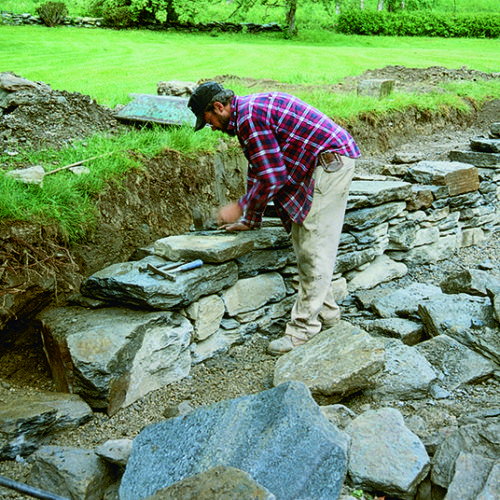
Hãy kiên nhẫn trong quá trình đặt viên đá; đó là đỉnh cao của kỹ năng bạn đã phát triển cho đến thời điểm này. Nó phải sâu khoảng 15 đến 18 inch, được tạo thành từ một đến ba viên đá. Sử dụng đất và vị trí tốt để cố định các viên đá, đồng thời cũng giống như các mối nối trên tường, tránh các mối nối dài ở phần đá chóp. Nếu bạn muốn ngồi trên tường, hãy chọn những viên đá nhẵn, phẳng. Hoặc lấp đầy những khoảng trống bằng đất và trồng các loại thảo mộc thơm để làm đệm. Một viên đá hình chóp được trồng là một nét hoàn thiện thú vị cho bức tường sống.






 Người châu Phi
 tiếng Albania
 tiếng Amharic
 tiếng Ả Rập
 tiếng Armenia
 Tiếng Azerbaijan
 Tiếng Basque
 Người Belarus
 tiếng Bengali
  tiếng Bosnia
 tiếng Bungari
 tiếng Catalan
 Cebuano
 Trung Quốc
 Trung Quốc (Đài Loan)
 Corsican
 tiếng Croatia
 tiếng Séc
 người Đan Mạch
 tiếng Hà Lan
 Tiếng Anh
 Quốc tế ngữ
 tiếng Estonia
 tiếng Phần Lan
 người Pháp
 tiếng Frisia
 tiếng Galicia
 tiếng Gruzia
 tiếng Đức
 người Hy Lạp
 Gujarati
 Tiếng Creole Haiti
 hausa
hausa người Hawaii
 tiếng Do Thái
 Không
Không Miêu
Miêu người Hungary
 tiếng Iceland
 igbo
igbo tiếng Indonesia
 người Ailen
 người Ý
 tiếng Nhật
 tiếng Java
 tiếng Kannada
 tiếng Kazakhstan
 tiếng Khmer
 người Rwanda
 Hàn Quốc
 người Kurd
 Tiếng Kyrgyzstan
 Lao
Lao Latin
Latin tiếng Latvia
 tiếng Litva
 Tiếng Luxembourg
 Tiếng Macedonia
 Malgashi
 Mã Lai
 Mã Lai
 cây nho
 người Maori
 Tiếng Marathi
 tiếng Mông Cổ
 Myanmar
 tiếng Nepal
 người Na Uy
 người Na Uy
 tiếng Occitan
 Tiếng Pa-tô
 tiếng Ba Tư
 Đánh bóng
 tiếng Bồ Đào Nha
  Tiếng Punjab
 người Rumani
 tiếng Nga
 Tiếng Samoa
 Tiếng Gaelic của Scotland
 tiếng Serbia
 Tiếng Anh
 Shona
Shona tiếng Sindhi
 Sinhala
 Tiếng Slovak
 tiếng Slovenia
 tiếng Somali
 người Tây Ban Nha
 Tiếng Sundan
 tiếng Swahili
 tiếng Thụy Điển
 Tagalog
 Tiếng Tajik
 Tiếng Tamil
 Tatar
Tatar tiếng Telugu
 tiếng Thái
 tiếng Thổ Nhĩ Kỳ
 người Thổ Nhĩ Kỳ
 tiếng Ukraina
 tiếng Urdu
 người Duy Ngô Nhĩ
 tiếng Uzbek
 Tiếng Việt
 người xứ Wales