

Teils rhydlyd
Eisiau adeiladu eich wal gynnal garreg eich hun, ond yn ansicr sut i ddechrau? Os oes gennych anwastad iard, gall wal gynnal garreg helpu i atal erydiad ac mae'n darparu lle braf i blannu. I ddysgu sut i roi eich un chi at ei gilydd, o'r dechrau i'r diwedd, darllenwch ymlaen.
To figure out how much stone you’ll need, multiply your wall’s height times the depth times the length. If your wall is 2 feet high, 1-1/2 feet wide, and 20 feet long, you’ll need roughly 60 cubic feet of stone. Most stoneyards will deliver the stones for a slight charge; have them placed as close to the site of your retaining wall as possible.
Fel ar gyfer tools, you’ll need a shovel for digging your trench and backfilling, a matog for attacking the grade, and a small sledgehammer for tamping soil. For marking your site and leveling rocks, you’ll need a line level, a few tall stakes, string, some flour, and a 4- or 8-foot level.
Now you can start digging. The easiest approach is to cut and fill—that is, dig into the slope where the wall will go and spread the earth below you to create a level terrace. When you cut and fill, the wall is backed by undisturbed soil, which is more stable than fill. For design reasons, however, you might choose to build a freestanding wall and fill behind it with soil from another site. Or you might do a partial cut and fill, which is somewhere between the two.
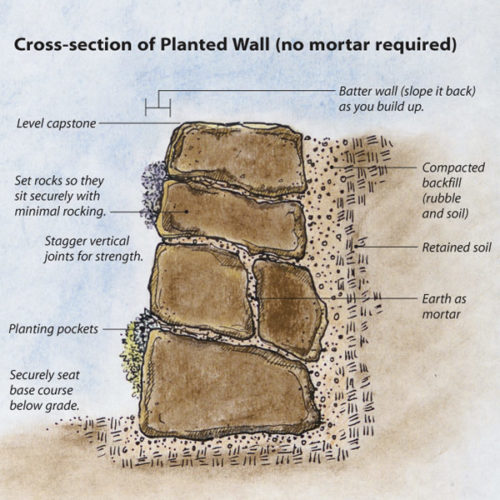
Mae waliau'n cael eu hadeiladu mewn cyrsiau. The base course is structurally the most important, while the final course, the capstone, is the most challenging. For stability, walls should be at least 20 inches wide at the base. They can taper slightly toward the top, but you’ll want a wall that is at least two rocks wide in most places. This can be accomplished by mixing stones of different sizes or by backfilling with a combination of two-thirds rubble to one-third soil.
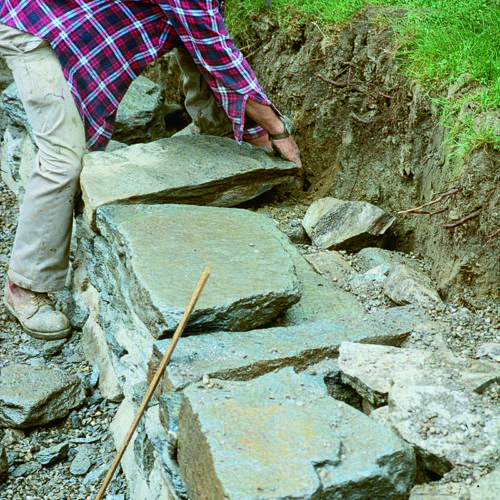
Cloddiwch ffos ar gyfer y cwrs sylfaenol
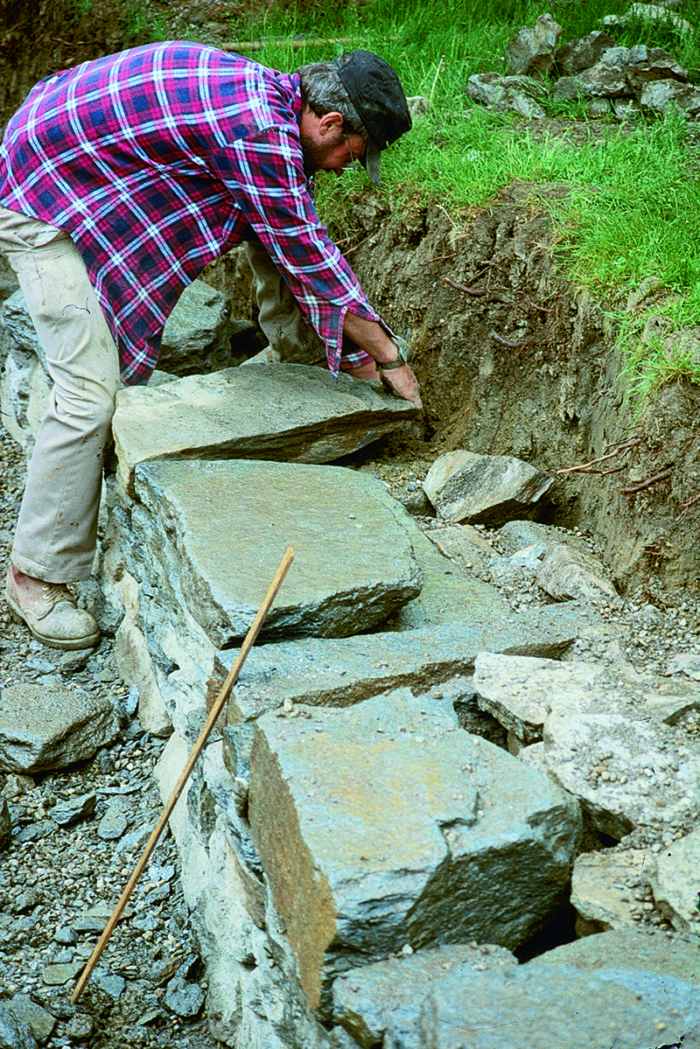
Start by digging a trench about 4 inches deep and at least 2 feet wide. A straightedged spade will give you a nice, even edge. The first course must be very solid and tightly fit because the weight of the wall will rest on it. Take the time to find rocks that lock into place, without leaving gaps. Randomly lay your largest rocks along the front edge of the trench. Set the first stone, shifting it around until it sits securely without being rocked easily, and then fill with the remaining stones. If you are using rectangular stones, you want the height of adjacent stones to be the same, or of a difference that can be made up with a smaller stone. If the rocks are irregular, then the stones will fit together leaving a triangular gap for the next course to fit into. I find irregular rocks easier to work with than flat ones; with flat rocks you have to be more precise. Find a stone that fits well and then continue for a few more feet. A rule of thumb, passed down from my wall-building teacher’s mentor, is to try a stone seven different ways. If it doesn’t fit by the seventh try, use another stone.
Nesaf, baw rhaw y tu ôl i'r cerrig a thampiwch y ddaear i'r bylchau between, behind, and beneath the stones with top of the sledgehammer. This is an important step because the dirt becomes the mortar for the wall. I also recommend adding rubble (those stones you won’t use on the face of your wall) behind the face course to give greater strength to the wall. Pound the rubble and soil mix until you are satisfied that it is solid. Continue the first course until you reach the end of the wall. When you are done, test
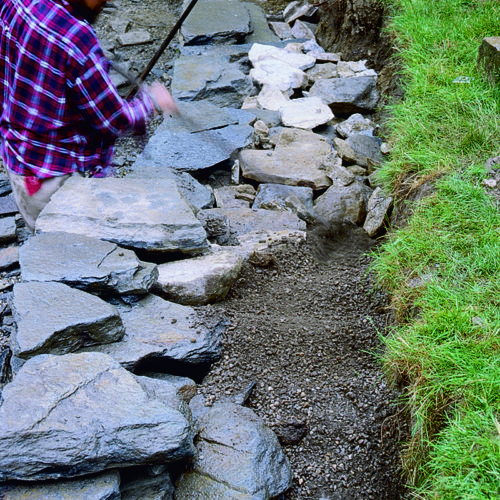
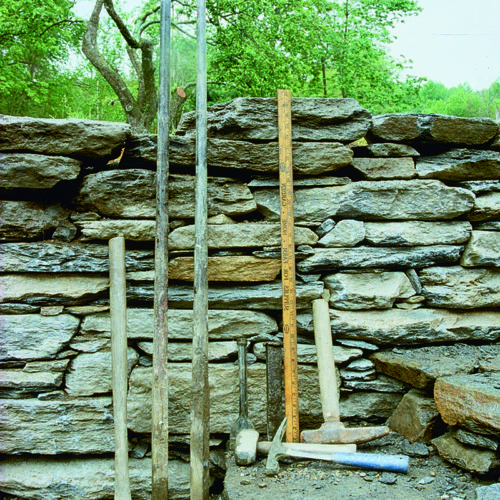
I ddechrau'r ail gwrs, dewiswch garreg a fydd yn pontio uniad cyntaf y cwrs gwaelod. Avoid having joints run up the face of the wall, and angle (batter) the courses backward—approximately 1 inch per vertical foot. This creates a stable wall. For added strength, intermittently place single stones that run the full depth of the wall. This will only work with rectangular rocks. For irregular rocks, place a large rock behind a face rock every 3 feet or so. As you set a course, you will come to situations, probably quite a few of them, where the rock placement is perfect on all sides but one. These are the planting opportunities that give life to a stone wall.
Continue building in this manner until you are one course away from the finished height. Fitting stones will get easier as you go, and you’ll likely discover that there’s a certain magic moment when you’re building a wall: you hear a thump that signals you’ve placed a rock perfec
Gwnewch uchder gosod eich wal
The ideal height for a dry-stacked retaining wall is 18 to 22 inches—so you can sit on it when your gardening chores are done. Even if
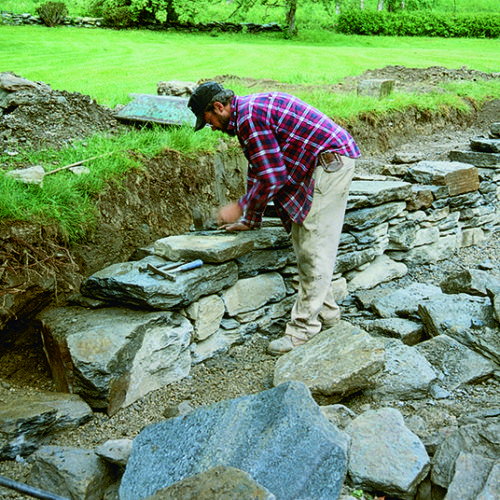
Dewch â digon o amynedd i'r broses o osod y capfaen; mae'n benllanw'r sgil rydych chi wedi'i ddatblygu hyd at y pwynt hwn. Dylai fod tua 15 i 18 modfedd o ddyfnder, wedi'i wneud o un i dair carreg. Defnyddiwch bridd a lleoliad da i ddiogelu'r cerrig, ac yn union fel gydag uniadau wal, ceisiwch osgoi uniadau hir yn y capfaen. Os ydych chi eisiau eistedd ar y wal, dewiswch gerrig llyfn, gwastad. Neu, llenwch fylchau â phridd a phlannwch berlysiau persawrus ar gyfer clustogau. Mae capfaen wedi'i blannu yn gyffyrddiad olaf hyfryd i wal fyw.
 Affricanaidd
 Albaneg
 Amhareg
 Arabeg
 Armenaidd
 Azerbaijani
 Basgeg
 Belarwseg
 Bengali
  Bosnieg
 Bwlgareg
 Catalaneg
 Cebuano
 Tsieina
 Tsieina (Taiwan)
 Corseg
 Croateg
 Tsiec
Tsiec Daneg
Daneg Iseldireg
 Saesneg
 Esperanto
 Estoneg
 Ffinneg
 Ffrangeg
 Ffriseg
 Galiseg
 Sioraidd
 Almaeneg
 Groeg
Groeg Gwjarati
 Creol Haitaidd
 hausa
hausa hawaiian
 Hebraeg
 Naddo
Naddo Miao
Miao Hwngareg
 Islandeg
 igbo
igbo Indoneseg
 gwyddelig
 Eidaleg
 Japaneaidd
 Jafaneg
 Kannada
 kazakh
 Khmer
Khmer Rwanda
 Corëeg
 Cwrdaidd
 Kyrgyz
 TB
TB Lladin
 Latfieg
 Lithwaneg
 Lwcsembwrgaidd
 Macedoneg
 Malgashi
 Maleieg
 Malayalam
 Malteg
 Maori
Maori Marathi
 Mongoleg
 Myanmar
 Nepali
 Norwyaidd
 Norwyaidd
 Ocsitaneg
 Pashto
 Perseg
 Pwyleg
 Portiwgaleg
  Pwnjabi
 Rwmania
 Rwsieg
 Samoaidd
 Gaeleg yr Alban
 Serbeg
 Saesneg
 Shona
Shona Sindhi
 Sinhala
 Slofaceg
 Slofeneg
 Somalïaidd
 Sbaeneg
 Sundanaidd
 Swahili
 Swedeg
 Tagalog
 Tajiceg
 Tamil
Tamil Tatar
Tatar Telugu
 Thai
Thai Twrceg
 Tyrcmeniaid
 Wcrain
 Wrdw
Wrdw Uighur
 Wsbeceg
 Fietnameg
 Cymraeg