

Piastrelle arrugginite
Vuoi costruire il tuo muro di contenimento in pietra, ma non sai come iniziare? Se hai un irregolare cortile, un muro di contenimento in pietra può aiutare a prevenire l'erosione e fornisce un bel posto dove piantare. Per imparare a mettere insieme il tuo, dall'inizio alla fine, continua a leggere.
To figure out how much stone you’ll need, multiply your wall’s height times the depth times the length. If your wall is 2 feet high, 1-1/2 feet wide, and 20 feet long, you’ll need roughly 60 cubic feet of stone. Most stoneyards will deliver the stones for a slight charge; have them placed as close to the site of your retaining wall as possible.
Quanto a tools, you’ll need a shovel for digging your trench and backfilling, a zappa for attacking the grade, and a small sledgehammer for tamping soil. For marking your site and leveling rocks, you’ll need a line level, a few tall stakes, string, some flour, and a 4- or 8-foot level.
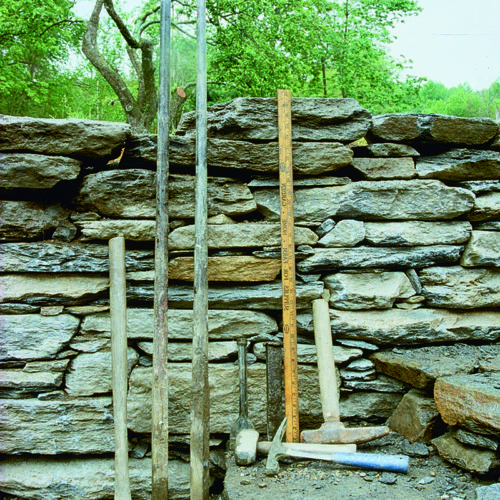
Now you can start digging. The easiest approach is to cut and fill—that is, dig into the slope where the wall will go and spread the earth below you to create a level terrace. When you cut and fill, the wall is backed by undisturbed soil, which is more stable than fill. For design reasons, however, you might choose to build a freestanding wall and fill behind it with soil from another site. Or you might do a partial cut and fill, which is somewhere between the two.
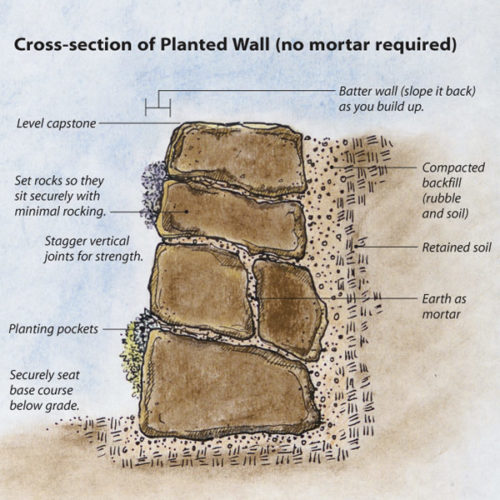
Le pareti sono costruite in corsi. The base course is structurally the most important, while the final course, the capstone, is the most challenging. For stability, walls should be at least 20 inches wide at the base. They can taper slightly toward the top, but you’ll want a wall that is at least two rocks wide in most places. This can be accomplished by mixing stones of different sizes or by backfilling with a combination of two-thirds rubble to one-third soil.
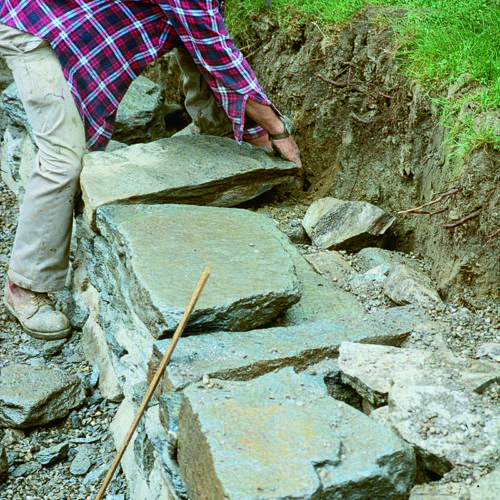
Scava una trincea per il corso base
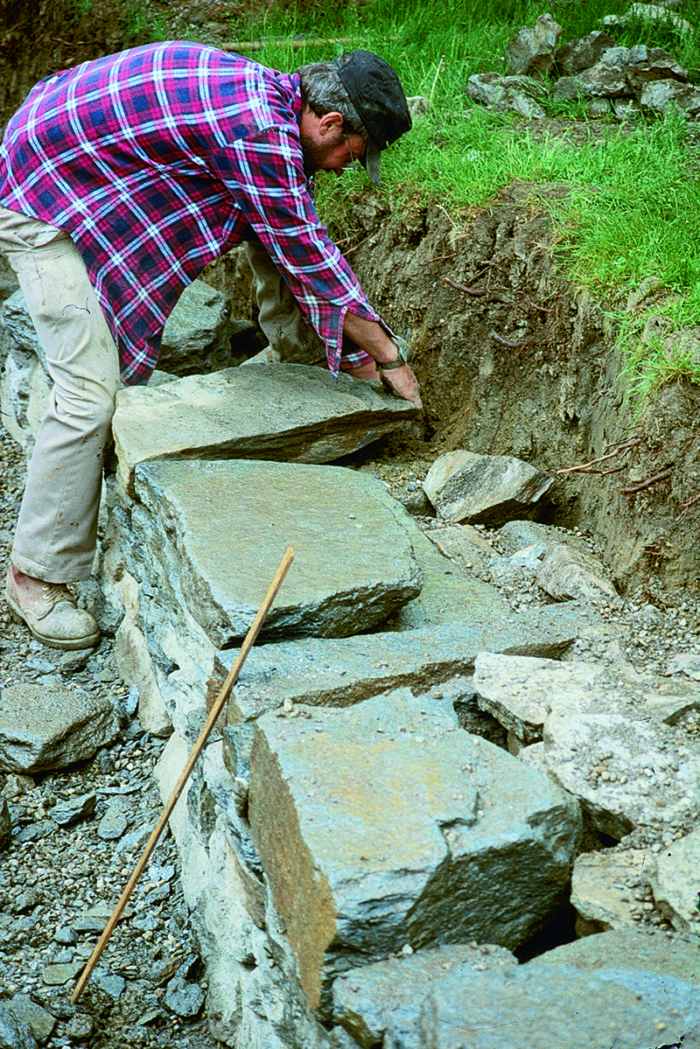
Start by digging a trench about 4 inches deep and at least 2 feet wide. A straightedged spade will give you a nice, even edge. The first course must be very solid and tightly fit because the weight of the wall will rest on it. Take the time to find rocks that lock into place, without leaving gaps. Randomly lay your largest rocks along the front edge of the trench. Set the first stone, shifting it around until it sits securely without being rocked easily, and then fill with the remaining stones. If you are using rectangular stones, you want the height of adjacent stones to be the same, or of a difference that can be made up with a smaller stone. If the rocks are irregular, then the stones will fit together leaving a triangular gap for the next course to fit into. I find irregular rocks easier to work with than flat ones; with flat rocks you have to be more precise. Find a stone that fits well and then continue for a few more feet. A rule of thumb, passed down from my wall-building teacher’s mentor, is to try a stone seven different ways. If it doesn’t fit by the seventh try, use another stone.
Successivamente, spala la terra dietro le pietre e comprimi la terra negli spazi between, behind, and beneath the stones with top of the sledgehammer. This is an important step because the dirt becomes the mortar for the wall. I also recommend adding rubble (those stones you won’t use on the face of your wall) behind the face course to give greater strength to the wall. Pound the rubble and soil mix until you are satisfied that it is solid. Continue the first course until you reach the end of the wall. When you are done, test
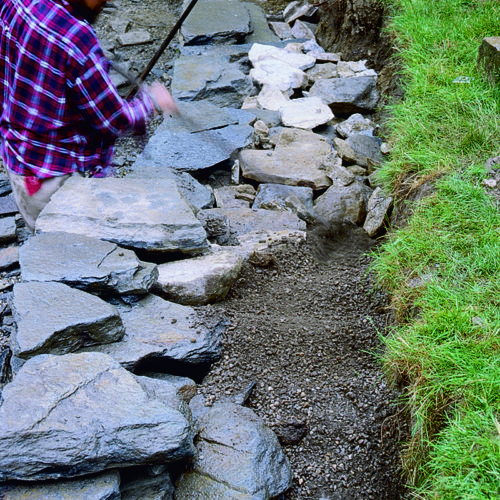
Per iniziare il secondo corso, scegli una pietra che colmerà il primo giunto del corso inferiore. Avoid having joints run up the face of the wall, and angle (batter) the courses backward—approximately 1 inch per vertical foot. This creates a stable wall. For added strength, intermittently place single stones that run the full depth of the wall. This will only work with rectangular rocks. For irregular rocks, place a large rock behind a face rock every 3 feet or so. As you set a course, you will come to situations, probably quite a few of them, where the rock placement is perfect on all sides but one. These are the planting opportunities that give life to a stone wall.
Continue building in this manner until you are one course away from the finished height. Fitting stones will get easier as you go, and you’ll likely discover that there’s a certain magic moment when you’re building a wall: you hear a thump that signals you’ve placed a rock perfec
Crea l'altezza di ubicazione del muro
The ideal height for a dry-stacked retaining wall is 18 to 22 inches—so you can sit on it when your gardening chores are done. Even if
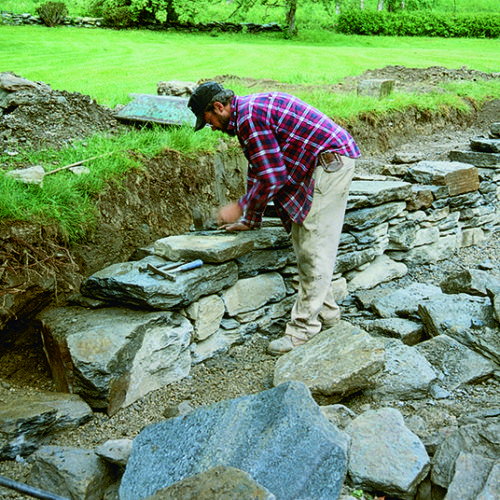
Porta molta pazienza nel processo di posa della pietra di copertura; è il culmine dell'abilità che hai sviluppato fino a questo punto. Dovrebbe essere profondo circa 15-18 pollici e composto da una a tre pietre. Usa il terreno e un buon posizionamento per fissare le pietre e, proprio come con i giunti delle pareti, evita giunti lunghi nella pietra di copertura. Se vuoi sederti sul muro, scegli pietre lisce e piatte. Oppure riempi gli spazi vuoti con terra e pianta erbe profumate per i cuscini. Una pietra di copertura piantata è un delizioso tocco finale per un muro vivente.
 africano
 albanese
 Amarico
 Arabo
Arabo armeno
 Azero
Azero Basco
Basco bielorusso
 bengalese
  Bosniaco
 bulgaro
 catalano
 Cebuano
 Cina
Cina Cina (Taiwan)
 Corso
Corso croato
 ceco
ceco danese
 Olandese
 Inglese
 esperanto
 Estone
 finlandese
 francese
 Frisone
 galiziano
 georgiano
 Tedesco
 greco
greco Gujarati
 Creolo haitiano
 haussa
 hawaiano
 ebraico
 No
No Miao
Miao ungherese
 islandese
 igbo
igbo indonesiano
 irlandesi
 Italiano
 giapponese
 giavanese
 Kannada
 kazako
 Khmer
Khmer Ruandese
 coreano
 curdo
curdo Kirghizistan
 TBC
TBC latino
 lettone
 lituano
 lussemburghese
 macedone
 Malgasci
 malese
 Malayalam
 maltese
 Maori
Maori Marathi
 mongolo
 Myanmar
 nepalese
 norvegese
 norvegese
 occitano
 Pashtu
 persiano
 Polacco
 portoghese
  Punjabi
 rumeno
 russo
russo Samoano
 Gaelico Scozzese
 serbo
serbo Inglese
 Shona
Shona Sindhi
 Singalese
 slovacco
 sloveno
 Somalo
 spagnolo
 Sundanese
 Swahili
 svedese
 Tagalog
 Tagico
 Tamil
Tamil Tartaro
 Telugu
 tailandese
 Turco
Turco turkmeno
 ucraino
 Urdu
Urdu Uiguro
 Uzbeco
 vietnamita
 gallese