

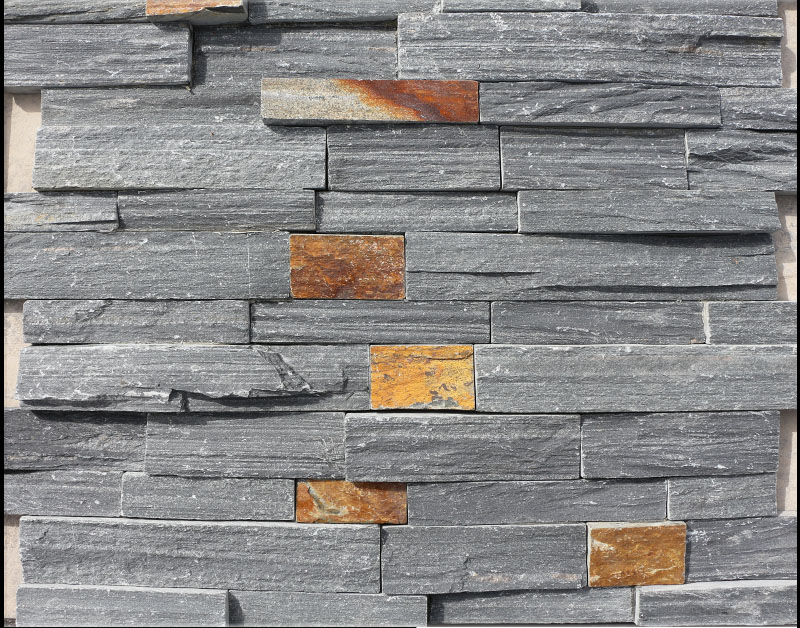
Rusty mozayik
Vle konstwi pwòp wòch kenbe miray ou, men ou pa sèten ki jan yo kòmanse? Si ou gen yon inegal lakou, yon miray kenbe wòch ka ede anpeche ewozyon epi li bay yon bèl kote pou plante. Pou aprann kijan pou mete pwòp tèt ou ansanm, depi nan kòmansman rive nan fini, kontinye li.
To figure out how much stone you’ll need, multiply your wall’s height times the depth times the length. If your wall is 2 feet high, 1-1/2 feet wide, and 20 feet long, you’ll need roughly 60 cubic feet of stone. Most stoneyards will deliver the stones for a slight charge; have them placed as close to the site of your retaining wall as possible.
Tankou tools, you’ll need a shovel for digging your trench and backfilling, a matt for attacking the grade, and a small sledgehammer for tamping soil. For marking your site and leveling rocks, you’ll need a line level, a few tall stakes, string, some flour, and a 4- or 8-foot level.
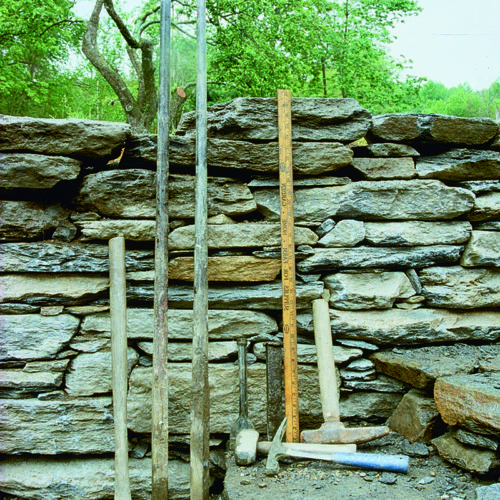
Now you can start digging. The easiest approach is to cut and fill—that is, dig into the slope where the wall will go and spread the earth below you to create a level terrace. When you cut and fill, the wall is backed by undisturbed soil, which is more stable than fill. For design reasons, however, you might choose to build a freestanding wall and fill behind it with soil from another site. Or you might do a partial cut and fill, which is somewhere between the two.
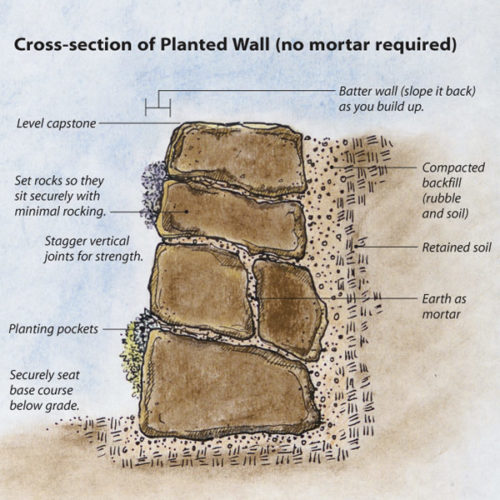
Mi yo bati nan kou. The base course is structurally the most important, while the final course, the capstone, is the most challenging. For stability, walls should be at least 20 inches wide at the base. They can taper slightly toward the top, but you’ll want a wall that is at least two rocks wide in most places. This can be accomplished by mixing stones of different sizes or by backfilling with a combination of two-thirds rubble to one-third soil.
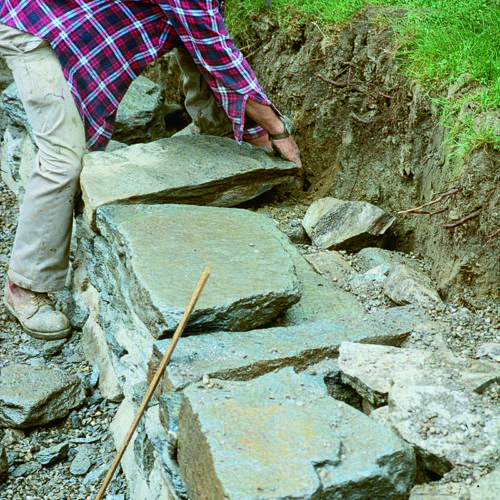
Fouye yon tranche pou kou debaz la
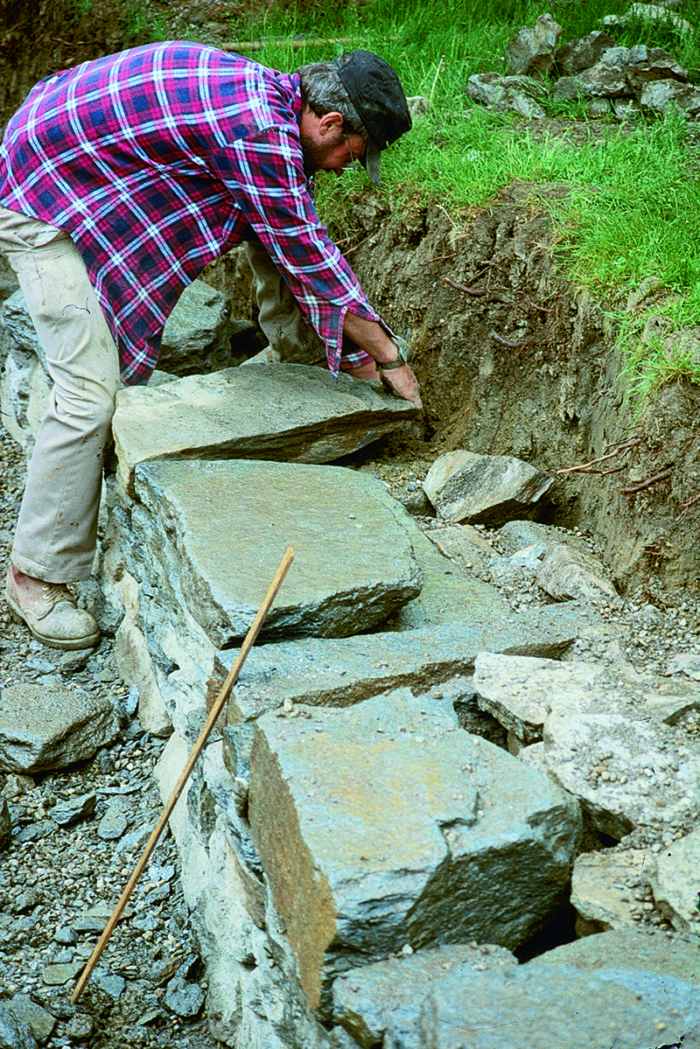
Start by digging a trench about 4 inches deep and at least 2 feet wide. A straightedged spade will give you a nice, even edge. The first course must be very solid and tightly fit because the weight of the wall will rest on it. Take the time to find rocks that lock into place, without leaving gaps. Randomly lay your largest rocks along the front edge of the trench. Set the first stone, shifting it around until it sits securely without being rocked easily, and then fill with the remaining stones. If you are using rectangular stones, you want the height of adjacent stones to be the same, or of a difference that can be made up with a smaller stone. If the rocks are irregular, then the stones will fit together leaving a triangular gap for the next course to fit into. I find irregular rocks easier to work with than flat ones; with flat rocks you have to be more precise. Find a stone that fits well and then continue for a few more feet. A rule of thumb, passed down from my wall-building teacher’s mentor, is to try a stone seven different ways. If it doesn’t fit by the seventh try, use another stone.
Apre sa, pèl pousyè tè dèyè wòch yo epi peze tè a nan espas yo between, behind, and beneath the stones with top of the sledgehammer. This is an important step because the dirt becomes the mortar for the wall. I also recommend adding rubble (those stones you won’t use on the face of your wall) behind the face course to give greater strength to the wall. Pound the rubble and soil mix until you are satisfied that it is solid. Continue the first course until you reach the end of the wall. When you are done, test
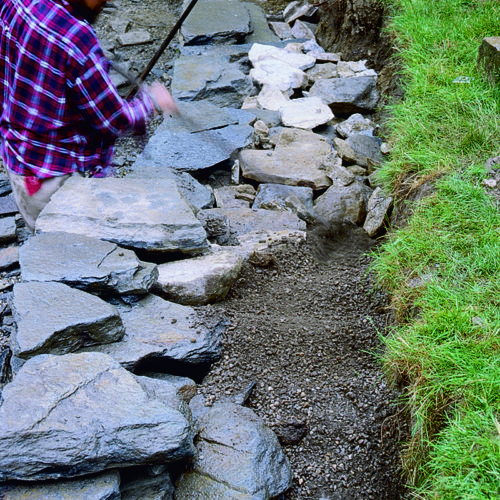
Pou kòmanse dezyèm kou a, chwazi yon wòch ki pral pon premye jwenti nan kou anba a. Avoid having joints run up the face of the wall, and angle (batter) the courses backward—approximately 1 inch per vertical foot. This creates a stable wall. For added strength, intermittently place single stones that run the full depth of the wall. This will only work with rectangular rocks. For irregular rocks, place a large rock behind a face rock every 3 feet or so. As you set a course, you will come to situations, probably quite a few of them, where the rock placement is perfect on all sides but one. These are the planting opportunities that give life to a stone wall.
Continue building in this manner until you are one course away from the finished height. Fitting stones will get easier as you go, and you’ll likely discover that there’s a certain magic moment when you’re building a wall: you hear a thump that signals you’ve placed a rock perfec
Fè wotè miray ranpa w la
The ideal height for a dry-stacked retaining wall is 18 to 22 inches—so you can sit on it when your gardening chores are done. Even if
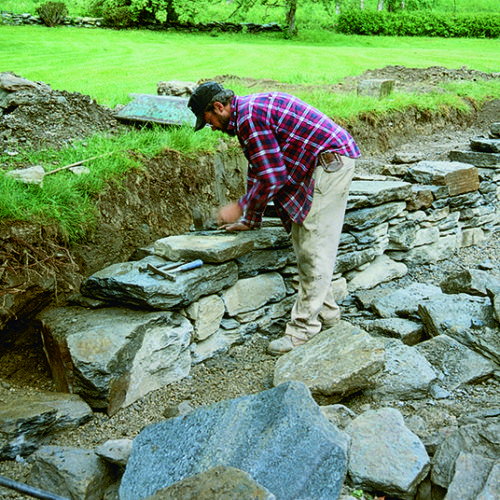
Pote anpil pasyans nan pwosesis la nan mete tèt la; li se yon akimilasyon nan konpetans ou te devlope nan pwen sa a. Li ta dwe apeprè 15 a 18 pous pwofondè, ki te fòme ak youn a twa wòch. Sèvi ak tè ak bon plasman an sekirite wòch yo, epi menm jan ak jwenti miray, evite jwenti long nan capstone la. Si ou vle chita sou miray la, chwazi lis, wòch plat. Oswa, ranpli twou vid ki genyen yo ak tè epi plante remèd fèy santi bon pou kousen. Yon capstone plante se yon bèl manyen fini nan yon miray k ap viv.
 Afriken
 Albanè
 Amarik
 Arab
Arab Amenyen
 Azerbaydjan
 Basque
 Belarisyen
 Bengali
  Bosnyen
 Bulgarian
 Catalan
 Cebuano
 Lachin
 Lachin (Taiwan)
 Kors
Kors Kwoasyen
 Czech
Czech Danwa
Danwa Olandè
 angle
angle Esperanto
 Estonyen
 Finnish
 franse
 Frisyen
 Galisyen
 Jòjyen
 Alman
Alman grèk
grèk Gujarati
 Kreyòl ayisyen
 hausa
hausa Hawaiian
 ebre
ebre Non
Non Miao
Miao Ongwa
Ongwa Icelandic
 igbo
igbo Endonezyen
 Ilandè
 Italyen
 Japonè
 Javanèz
 Kannada
 kazak
kazak Khmer
Khmer Rwandan
 Koreyen
 Kurdish
 Kyrgyz
 TB
TB Latin
Latin Latvian
 Lityanyen
 Luxembourgish
 Masedwan
 Malgashi
 Malay
Malay Malayalam
 Maltese
 Maori
Maori Marathi
 Mongolyen
 Myanma
 Nepali
 Nòvejyen
 Nòvejyen
 Occitan
 Pashto
 Pèsik
Pèsik Polonè
 Pòtigè
  Punjabi
 Woumen
 Ris
Ris Samoan
 Scottish Gaelic
 Sèb
Sèb angle
angle Shona
Shona Sindhi
 Sinhala
 Slovak
 Sloveni
 Somalyen
 Panyòl
 Sundanese
 Swahili
 Swedish
 Tagalog
 Tajik
Tajik Tamil
Tamil Tatar
Tatar Telugu
 Thai
Thai Tik
Tik Tirkmen
 Ukrainian
 Oudou
Oudou Ouygur
 Ouzbek
 Vyetnamyen
 Welsh
Welsh