

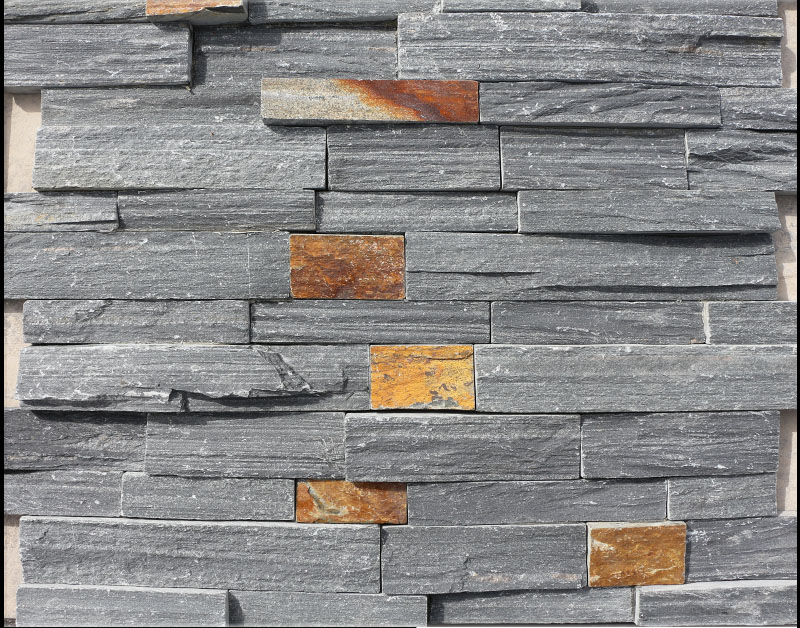
Rusty tiles
Kuna so ku gina bangon bangon dutsen ku, amma ba ku san yadda za ku fara ba? Idan kuna da rashin daidaituwa yadi, bangon da ke riƙe da dutse zai iya taimakawa hana yashwa kuma yana ba da wuri mai kyau don shuka. Don koyon yadda ake haɗa naku, daga farko har ƙarshe, karanta a gaba.
To figure out how much stone you’ll need, multiply your wall’s height times the depth times the length. If your wall is 2 feet high, 1-1/2 feet wide, and 20 feet long, you’ll need roughly 60 cubic feet of stone. Most stoneyards will deliver the stones for a slight charge; have them placed as close to the site of your retaining wall as possible.
Amma game da tools, you’ll need a shovel for digging your trench and backfilling, a matsi for attacking the grade, and a small sledgehammer for tamping soil. For marking your site and leveling rocks, you’ll need a line level, a few tall stakes, string, some flour, and a 4- or 8-foot level.
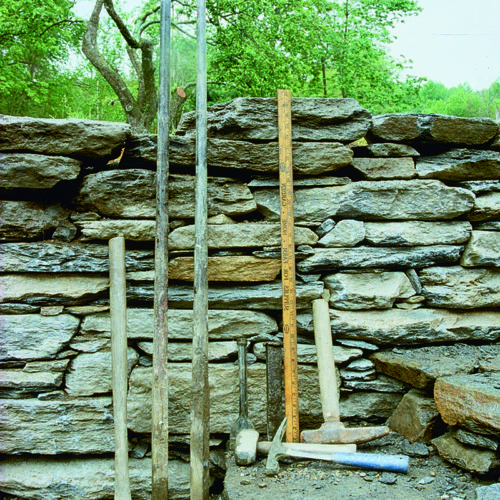
Now you can start digging. The easiest approach is to cut and fill—that is, dig into the slope where the wall will go and spread the earth below you to create a level terrace. When you cut and fill, the wall is backed by undisturbed soil, which is more stable than fill. For design reasons, however, you might choose to build a freestanding wall and fill behind it with soil from another site. Or you might do a partial cut and fill, which is somewhere between the two.
Ana gina bango a cikin darussa. The base course is structurally the most important, while the final course, the capstone, is the most challenging. For stability, walls should be at least 20 inches wide at the base. They can taper slightly toward the top, but you’ll want a wall that is at least two rocks wide in most places. This can be accomplished by mixing stones of different sizes or by backfilling with a combination of two-thirds rubble to one-third soil.
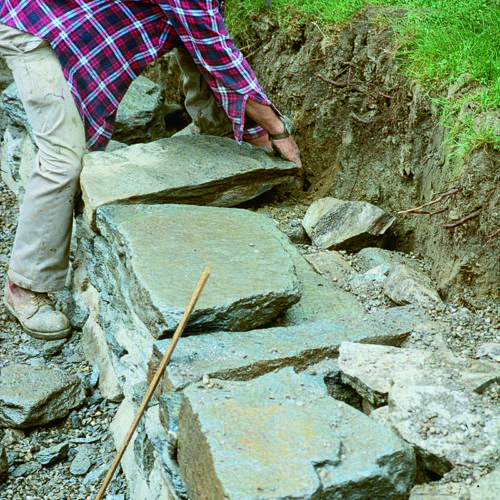
Tona rami don kwas ɗin tushe
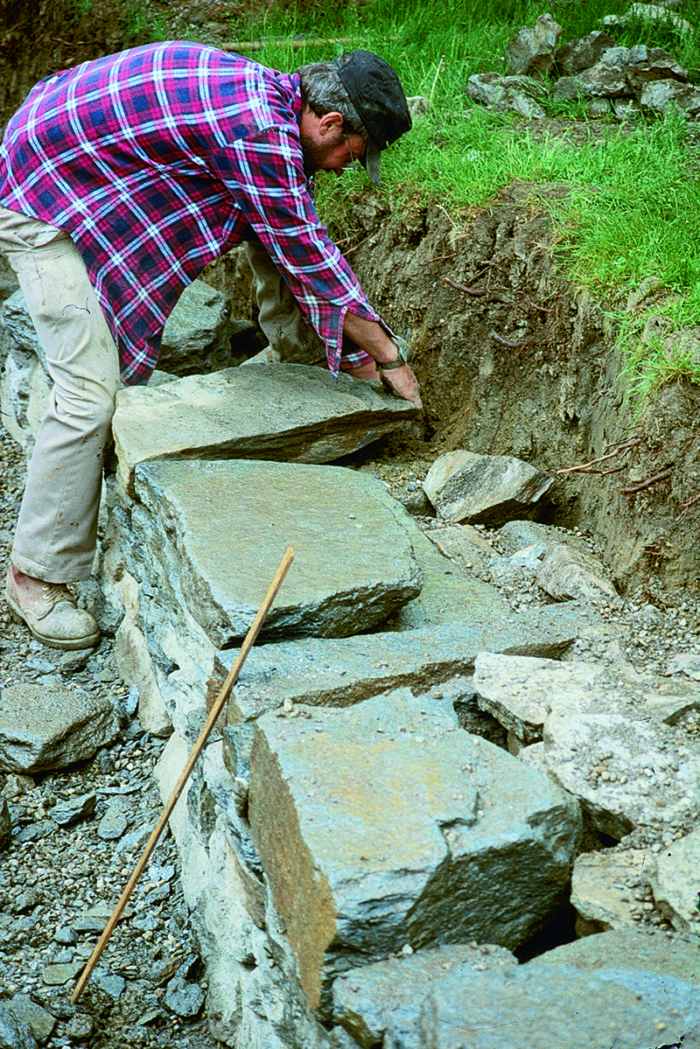
Start by digging a trench about 4 inches deep and at least 2 feet wide. A straightedged spade will give you a nice, even edge. The first course must be very solid and tightly fit because the weight of the wall will rest on it. Take the time to find rocks that lock into place, without leaving gaps. Randomly lay your largest rocks along the front edge of the trench. Set the first stone, shifting it around until it sits securely without being rocked easily, and then fill with the remaining stones. If you are using rectangular stones, you want the height of adjacent stones to be the same, or of a difference that can be made up with a smaller stone. If the rocks are irregular, then the stones will fit together leaving a triangular gap for the next course to fit into. I find irregular rocks easier to work with than flat ones; with flat rocks you have to be more precise. Find a stone that fits well and then continue for a few more feet. A rule of thumb, passed down from my wall-building teacher’s mentor, is to try a stone seven different ways. If it doesn’t fit by the seventh try, use another stone.
Bayan haka, a zubar da datti a bayan duwatsun kuma a tsoma kasa cikin sararin samaniya between, behind, and beneath the stones with top of the sledgehammer. This is an important step because the dirt becomes the mortar for the wall. I also recommend adding rubble (those stones you won’t use on the face of your wall) behind the face course to give greater strength to the wall. Pound the rubble and soil mix until you are satisfied that it is solid. Continue the first course until you reach the end of the wall. When you are done, test
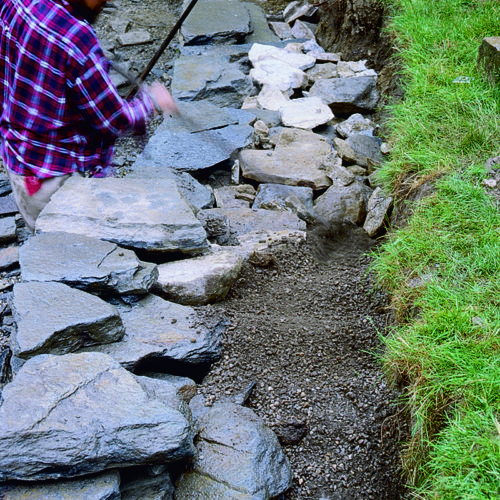
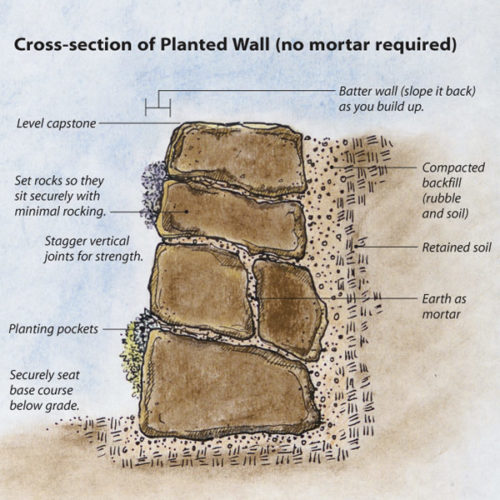
Don fara hanya ta biyu, zaɓi dutse wanda zai haɗu da haɗin gwiwa na farko na hanya ta ƙasa. Avoid having joints run up the face of the wall, and angle (batter) the courses backward—approximately 1 inch per vertical foot. This creates a stable wall. For added strength, intermittently place single stones that run the full depth of the wall. This will only work with rectangular rocks. For irregular rocks, place a large rock behind a face rock every 3 feet or so. As you set a course, you will come to situations, probably quite a few of them, where the rock placement is perfect on all sides but one. These are the planting opportunities that give life to a stone wall.
Continue building in this manner until you are one course away from the finished height. Fitting stones will get easier as you go, and you’ll likely discover that there’s a certain magic moment when you’re building a wall: you hear a thump that signals you’ve placed a rock perfec
Yi tsayin wurin wurin bangon ku
The ideal height for a dry-stacked retaining wall is 18 to 22 inches—so you can sit on it when your gardening chores are done. Even if
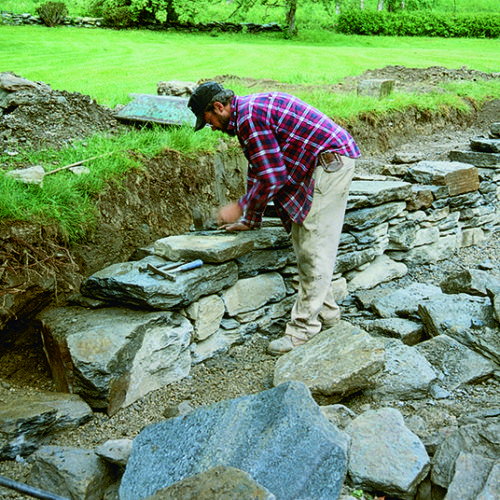
Ku kawo haƙuri mai yawa ga tsarin shimfida dutsen; shi ne ƙarshen fasaha da kuka haɓaka har zuwa wannan lokacin. Ya kamata ya zama zurfin inci 15 zuwa 18, wanda aka yi shi da dutse ɗaya zuwa uku. Yi amfani da ƙasa da wuri mai kyau don amintar da duwatsun, kuma kamar yadda tare da haɗin ginin bango, guje wa doguwar haɗin gwiwa a cikin babban dutse. Idan kana so ka zauna a bango, zabi duwatsu masu santsi, lebur. Ko kuma, cike giɓi da ƙasa kuma a dasa ganyaye masu ƙamshi don matashin kai. Dutsen dutse da aka dasa yana da daɗin ƙarewa ga bango mai rai.
 Afirka
 Albaniya
 Amharic
 Larabci
 Armenian
 Azabaijan
 Basque
 Belarushiyanci
 Bengali
  Bosniya
 Bulgarian
 Catalan
 Cebuano
 China
China China (Taiwan)
 Corsican
 Croatian
 Czech
Czech Danish
 Yaren mutanen Holland
 Turanci
 Esperanto
 Estoniya
 Finnish
 Faransanci
 Farisa
 Galiciyan
 Jojin
Jojin Jamusanci
 Girkanci
 Gujarati
 Haitian Creole
 hausa
hausa hawayi
 Ibrananci
 A'a
A'a Miya
Miya Harshen Hungary
 Icelandic
 igbo
igbo Indonesiya
 Irish
Irish Italiyanci
 Jafananci
 Yawanci
 Kannada
 kazakh
 Khmer
Khmer Ruwanda
 Yaren Koriya
 Kurdish
 Kyrgyzstan
 TB
TB Latin
Latin Latvia
 Lithuaniyanci
 Luxembourg
 Makidoniya
 Malgashi
 Malay
Malay Malayalam
 Maltase
 Maori
Maori Marathi
 Mongolian
 Myanmar
 Nepali
 Yaren mutanen Norway
 Yaren mutanen Norway
 Occitan
 Pashto
 Farisa
 Yaren mutanen Poland
 Fotigal
  Punjabi
 Romanian
 Rashanci
 Samoan
 Scottish Gaelic
 Serbian
 Turanci
 Shona
Shona Sindhi
 Sinhala
 Slovak
 Harshen Sloveniya
 Somaliya
 Mutanen Espanya
 Sundanci
 Harshen Swahili
 Yaren mutanen Sweden
 Tagalog
 Tajik
Tajik Tamil
Tamil Tatar
Tatar Telugu
 Thai
Thai Baturke
 Turkmen
 Ukrainian
 Urdu
Urdu Uighur
 Uzbek
Uzbek Vietnamese
 Welsh
Welsh