

Madum Rusty
Trid tibni l-ħajt ta 'żamma tal-ġebel tiegħek stess, imma mhux ċert kif tibda? Jekk għandek irregolari tarzna, ħajt ta 'żamma tal-ġebel jista' jgħin biex jipprevjeni l-erożjoni u jipprovdi post sabiħ biex tħawwel. Biex titgħallem kif tgħaqqad tiegħek, mill-bidu sat-tmiem, kompli aqra.
To figure out how much stone you’ll need, multiply your wall’s height times the depth times the length. If your wall is 2 feet high, 1-1/2 feet wide, and 20 feet long, you’ll need roughly 60 cubic feet of stone. Most stoneyards will deliver the stones for a slight charge; have them placed as close to the site of your retaining wall as possible.
Fir-rigward tools, you’ll need a shovel for digging your trench and backfilling, a mattock for attacking the grade, and a small sledgehammer for tamping soil. For marking your site and leveling rocks, you’ll need a line level, a few tall stakes, string, some flour, and a 4- or 8-foot level.
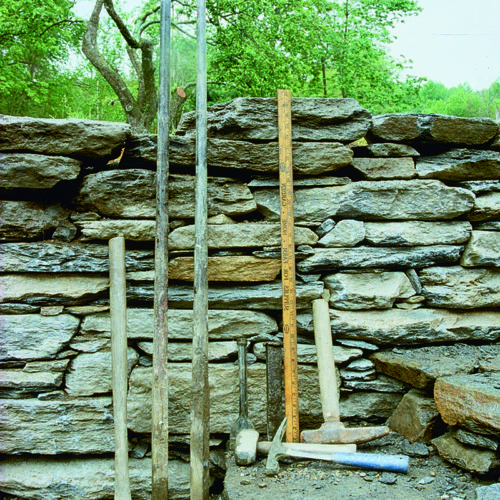
Now you can start digging. The easiest approach is to cut and fill—that is, dig into the slope where the wall will go and spread the earth below you to create a level terrace. When you cut and fill, the wall is backed by undisturbed soil, which is more stable than fill. For design reasons, however, you might choose to build a freestanding wall and fill behind it with soil from another site. Or you might do a partial cut and fill, which is somewhere between the two.
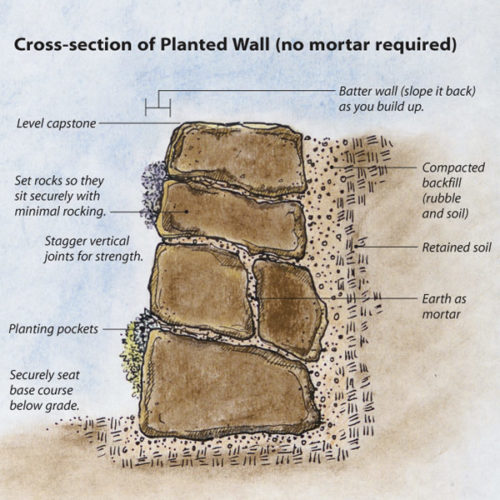
Il-ħitan huma mibnija fil-korsijiet. The base course is structurally the most important, while the final course, the capstone, is the most challenging. For stability, walls should be at least 20 inches wide at the base. They can taper slightly toward the top, but you’ll want a wall that is at least two rocks wide in most places. This can be accomplished by mixing stones of different sizes or by backfilling with a combination of two-thirds rubble to one-third soil.
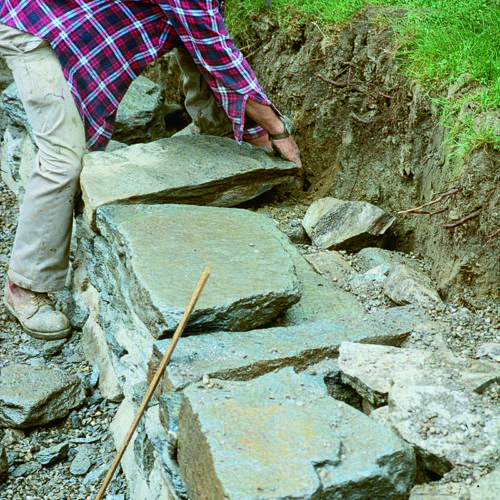
Ħaffer trinka għall-korsa bażi
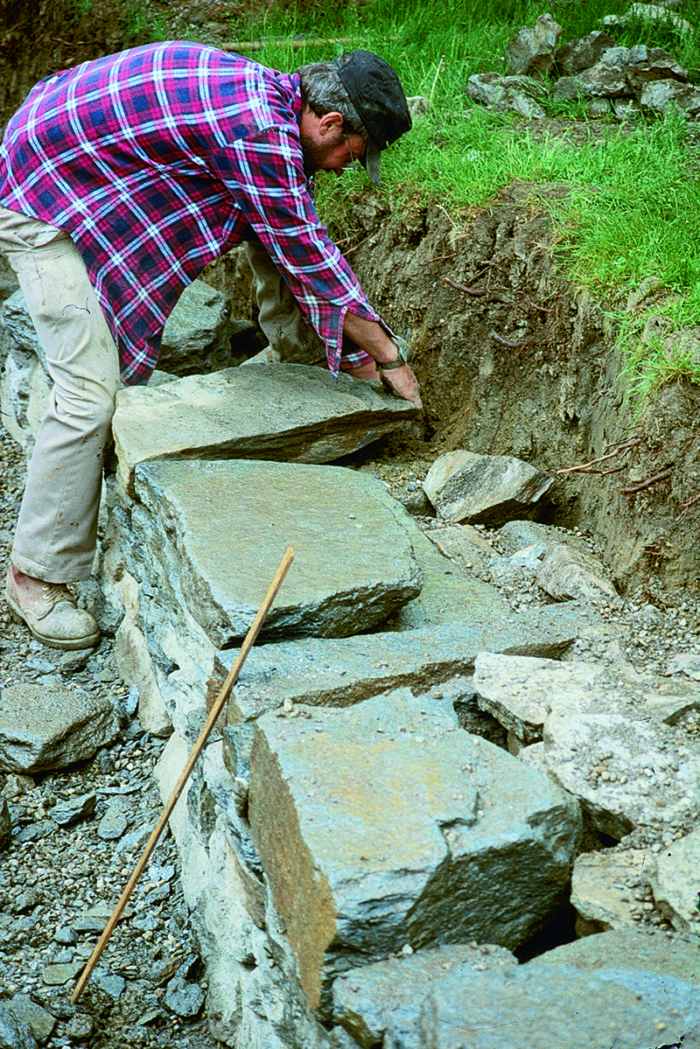
Start by digging a trench about 4 inches deep and at least 2 feet wide. A straightedged spade will give you a nice, even edge. The first course must be very solid and tightly fit because the weight of the wall will rest on it. Take the time to find rocks that lock into place, without leaving gaps. Randomly lay your largest rocks along the front edge of the trench. Set the first stone, shifting it around until it sits securely without being rocked easily, and then fill with the remaining stones. If you are using rectangular stones, you want the height of adjacent stones to be the same, or of a difference that can be made up with a smaller stone. If the rocks are irregular, then the stones will fit together leaving a triangular gap for the next course to fit into. I find irregular rocks easier to work with than flat ones; with flat rocks you have to be more precise. Find a stone that fits well and then continue for a few more feet. A rule of thumb, passed down from my wall-building teacher’s mentor, is to try a stone seven different ways. If it doesn’t fit by the seventh try, use another stone.
Sussegwentement, pala l-ħmieġ wara l-ġebel u ttamp id-dinja fl-ispazji between, behind, and beneath the stones with top of the sledgehammer. This is an important step because the dirt becomes the mortar for the wall. I also recommend adding rubble (those stones you won’t use on the face of your wall) behind the face course to give greater strength to the wall. Pound the rubble and soil mix until you are satisfied that it is solid. Continue the first course until you reach the end of the wall. When you are done, test
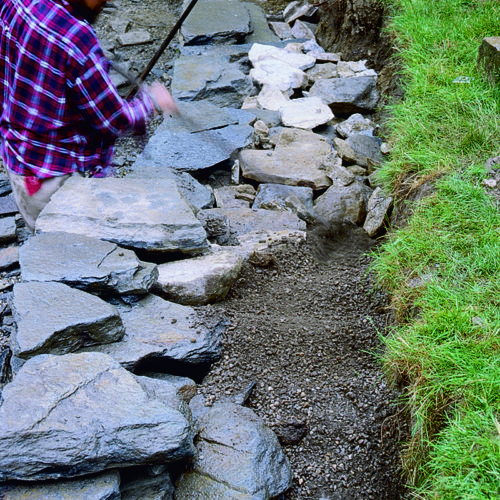
Biex tibda t-tieni korsa, agħżel ġebla li tgħaqqad l-ewwel ġonta tal-korsa tal-qiegħ. Avoid having joints run up the face of the wall, and angle (batter) the courses backward—approximately 1 inch per vertical foot. This creates a stable wall. For added strength, intermittently place single stones that run the full depth of the wall. This will only work with rectangular rocks. For irregular rocks, place a large rock behind a face rock every 3 feet or so. As you set a course, you will come to situations, probably quite a few of them, where the rock placement is perfect on all sides but one. These are the planting opportunities that give life to a stone wall.
Continue building in this manner until you are one course away from the finished height. Fitting stones will get easier as you go, and you’ll likely discover that there’s a certain magic moment when you’re building a wall: you hear a thump that signals you’ve placed a rock perfec
Agħmel l-għoli tas-sit tal-ħajt tiegħek
The ideal height for a dry-stacked retaining wall is 18 to 22 inches—so you can sit on it when your gardening chores are done. Even if
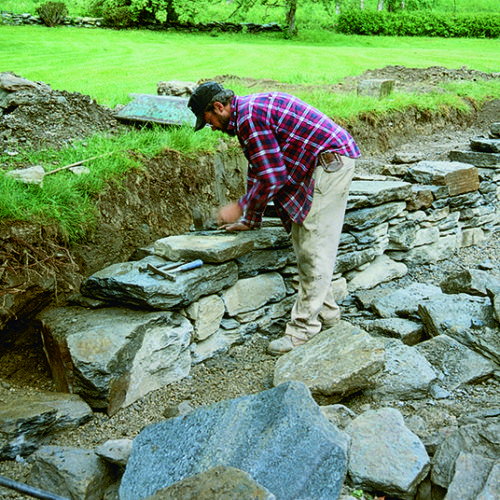
Ġib ħafna paċenzja għall-proċess tat-tqegħid tal-capstone; huwa l-qofol tal-ħila li żviluppajt sa dan il-punt. Għandu jkun madwar 15 sa 18-il pulzier fond, magħmul minn wieħed sa tliet ġebel. Uża l-ħamrija u t-tqegħid tajjeb biex tassigura l-ġebel, u bħal fil-ġonot tal-ħajt, evita ġonot twal fil-capstone. Jekk trid toqgħod fuq il-ħajt, agħżel ġebel lixx u ċatt. Jew, imla l-vojt bil-ħamrija u pjanti ħwawar fragranti għall-kuxxini. A capstone mħawla hija touch finishing delightful għal ħajt ħaj.
 Afrikan
 Albaniż
 Amhariku
 Għarbi
 Armenjan
 Ażerbajġani
 Bask
Bask Belarussu
 Bengali
  Bosnijan
 Bulgaru
 Katalan
 Cebuano
 Iċ-Ċina
 Iċ-Ċina (Tajwan)
 Korsiku
 Kroat
Kroat Ċek
Ċek Daniż
Daniż Olandiż
 Ingliż
 Esperanto
 Estonjan
 Finlandiż
 Franċiż
 Friżjan
 Galizjan
 Ġorġjan
 Ġermaniż
 Grieg
Grieg Guġarati
 Kreol Ħaitjan
 hausa
hausa Ħawajjan
 Ebrajk
 Le
Le Miao
Miao Ungeriż
 Iżlandiż
 igbo
igbo Indoneżjan
 Irlandiż
 Taljan
 Ġappuniż
 Ġavaniż
 Kannada
 każak
każak Khmer
Khmer Rwandan
 Korean
 Kurdi
Kurdi Kirgiż
 TB
TB Latin
Latin Latvjan
 Litwan
 Lussemburgiż
 Maċedonjan
 Malgashi
 Malajan
 Malajalam
 Malti
Malti Maori
Maori Marathi
 Mongoljan
 Il-Mjanmar
 Nepaliż
 Norveġiż
 Norveġiż
 Oċċitan
 Pashto
 Persjan
 Pollakk
 Portugiż
  Punġabi
 Rumen
Rumen Russu
Russu Samoan
 Galliku Skoċċiż
 Serb
Serb Ingliż
 Shona
Shona Sindhi
 Sinħaliż
 Slovakk
 Sloven
 Somali
 Spanjol
 Sundaniż
 Swaħili
 Svediż
 Tagalog
 Taġik
Taġik Tamil
Tamil Tatar
Tatar Telugu
 Tajlandiż
 Tork
Tork Turkmeni
 Ukrain
 Urdu
Urdu Uighur
 Użbek
Użbek Vjetnamiż
 Welsh
Welsh