

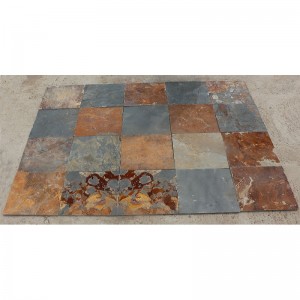
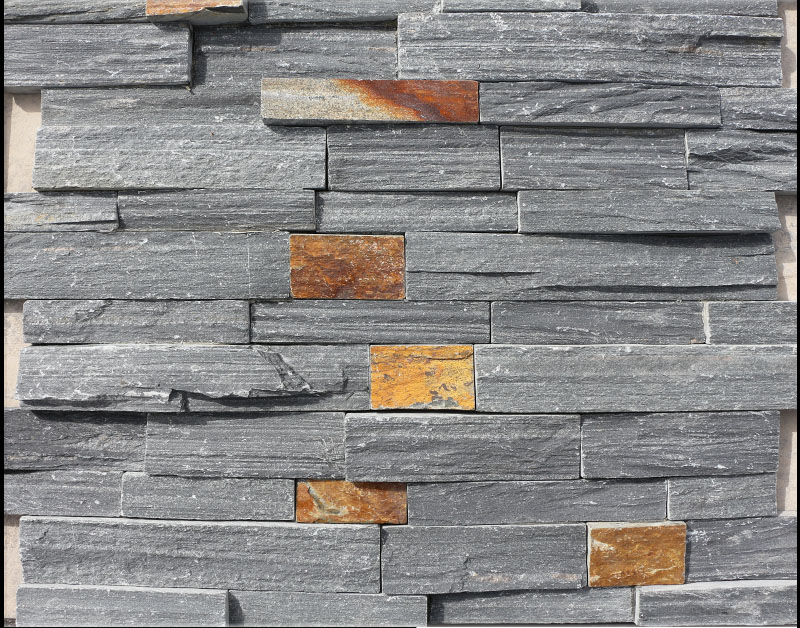
Azulejos oxidados
¿Quiere construir su propio muro de contención de piedra, pero no está seguro de cómo empezar? Si tienes un desigual jardín, un muro de contención de piedra puede ayudar a prevenir la erosión y proporciona un lugar agradable para plantar. Para aprender a crear el tuyo propio, de principio a fin, sigue leyendo.
To figure out how much stone you’ll need, multiply your wall’s height times the depth times the length. If your wall is 2 feet high, 1-1/2 feet wide, and 20 feet long, you’ll need roughly 60 cubic feet of stone. Most stoneyards will deliver the stones for a slight charge; have them placed as close to the site of your retaining wall as possible.
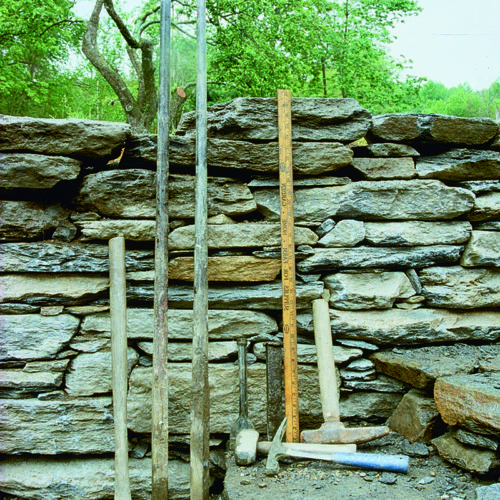
Como para tools, you’ll need a shovel for digging your trench and backfilling, a azadón for attacking the grade, and a small sledgehammer for tamping soil. For marking your site and leveling rocks, you’ll need a line level, a few tall stakes, string, some flour, and a 4- or 8-foot level.
Now you can start digging. The easiest approach is to cut and fill—that is, dig into the slope where the wall will go and spread the earth below you to create a level terrace. When you cut and fill, the wall is backed by undisturbed soil, which is more stable than fill. For design reasons, however, you might choose to build a freestanding wall and fill behind it with soil from another site. Or you might do a partial cut and fill, which is somewhere between the two.
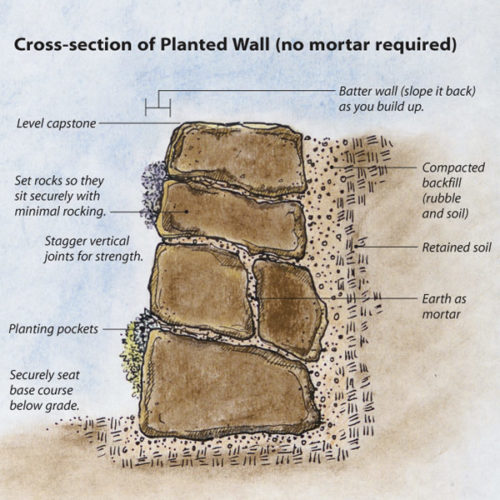
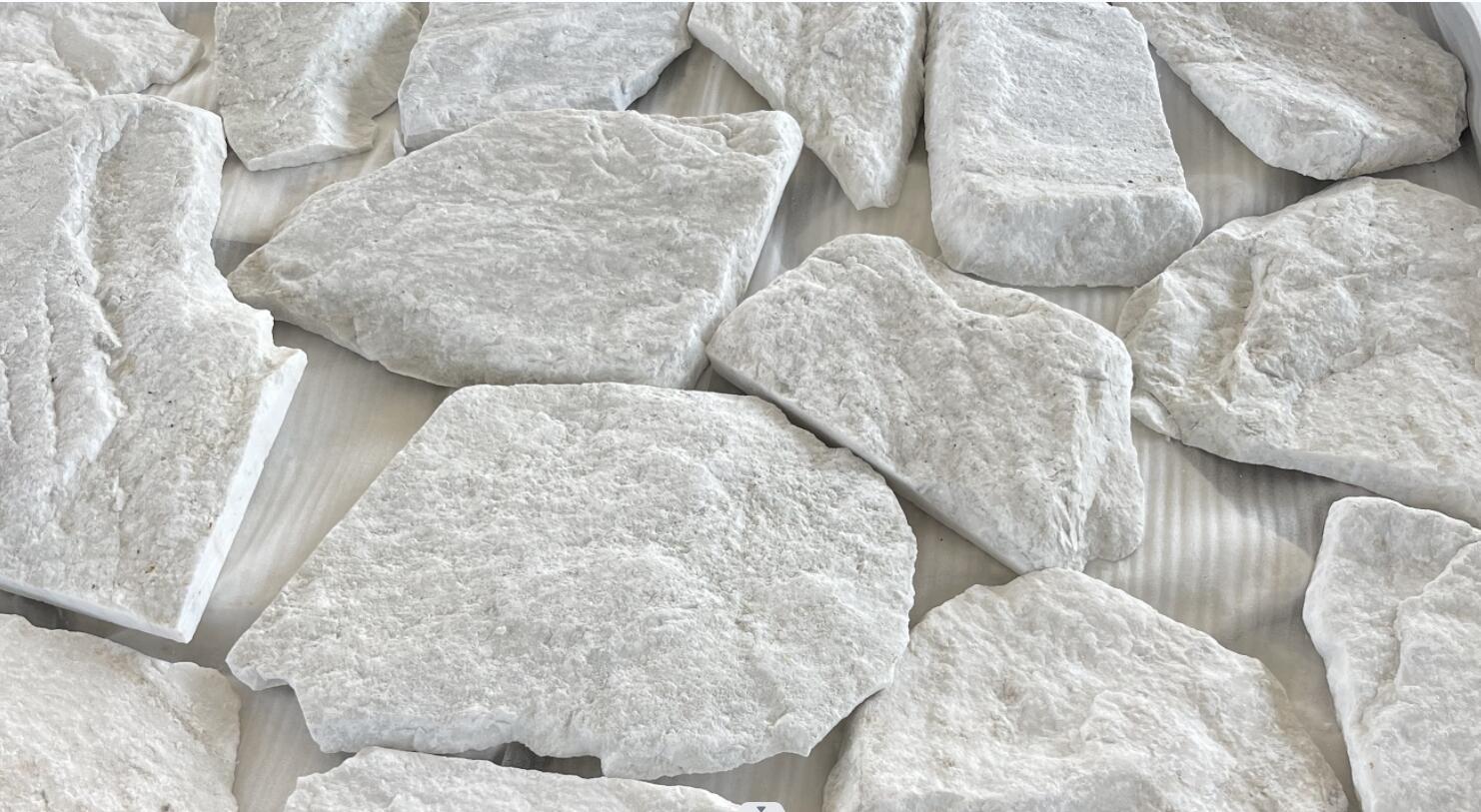
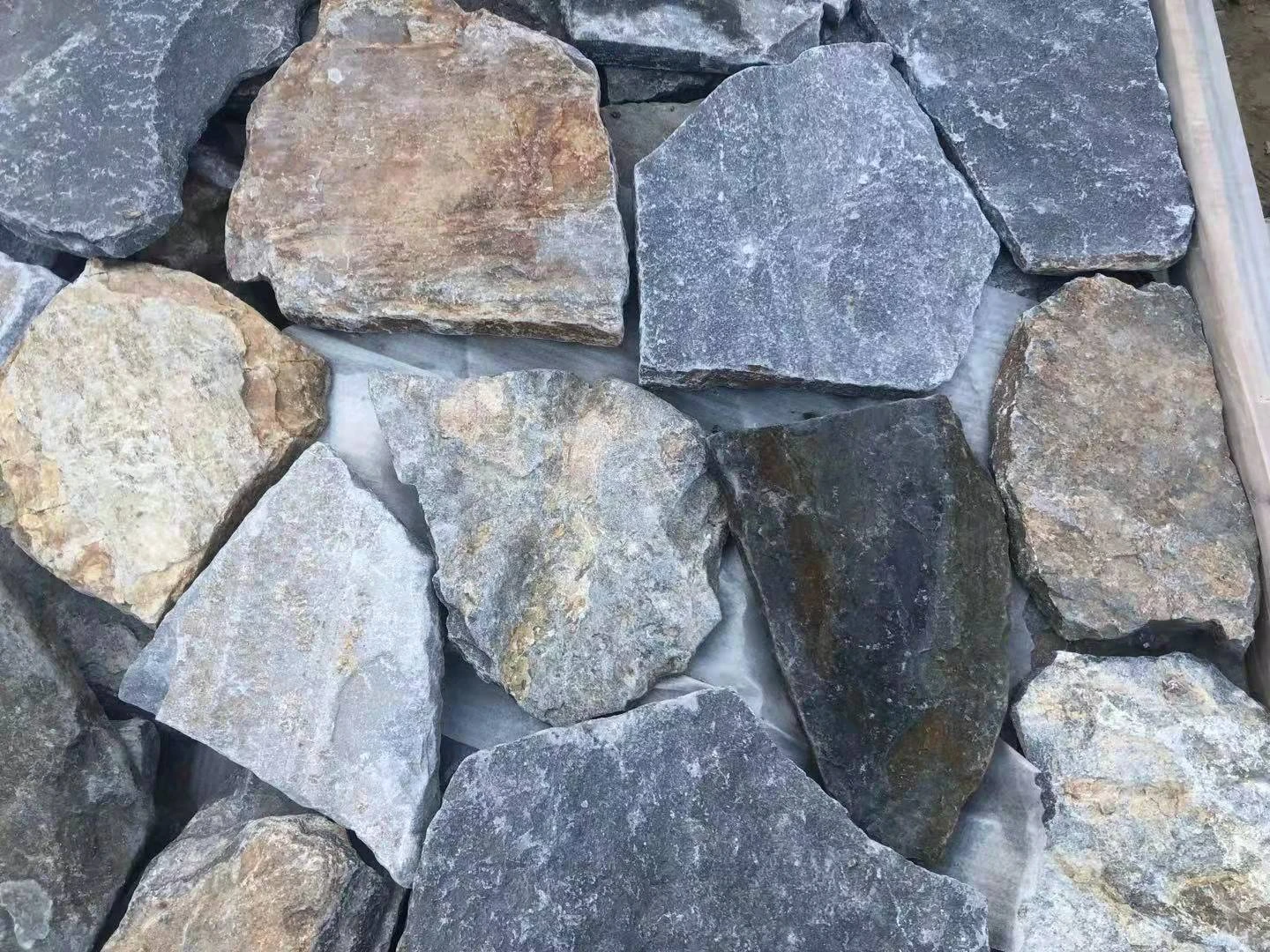
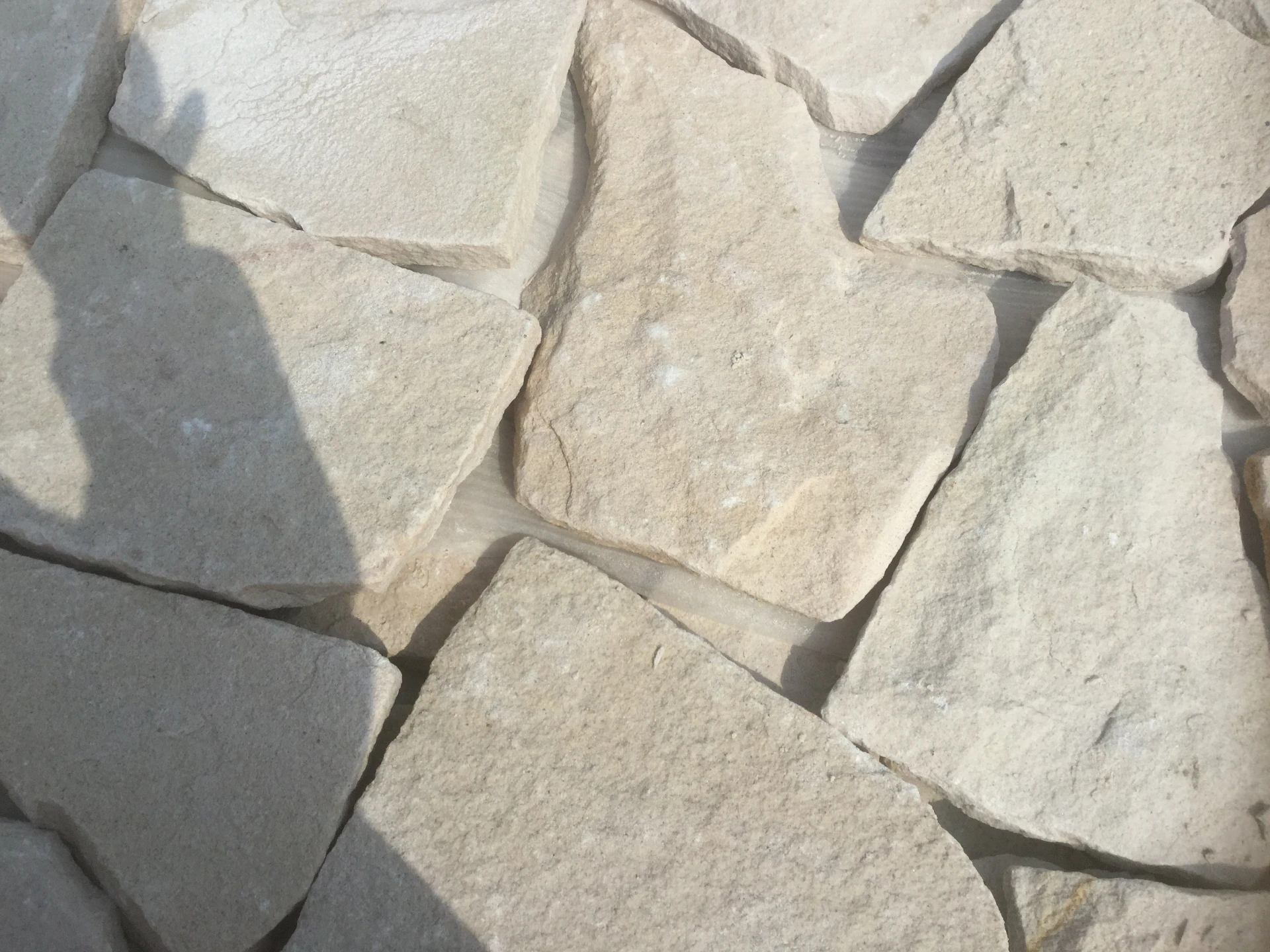
Los muros se construyen en hileras. The base course is structurally the most important, while the final course, the capstone, is the most challenging. For stability, walls should be at least 20 inches wide at the base. They can taper slightly toward the top, but you’ll want a wall that is at least two rocks wide in most places. This can be accomplished by mixing stones of different sizes or by backfilling with a combination of two-thirds rubble to one-third soil.
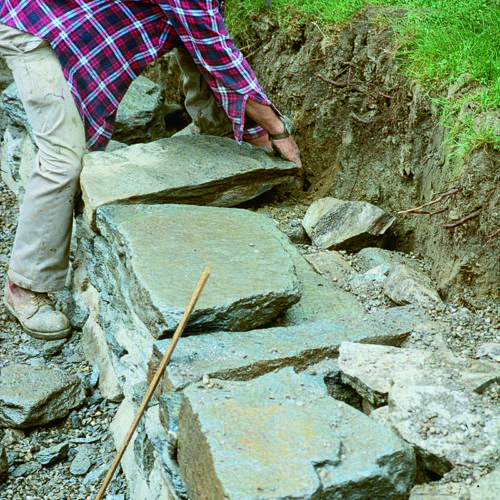
Cava una zanja para la base.
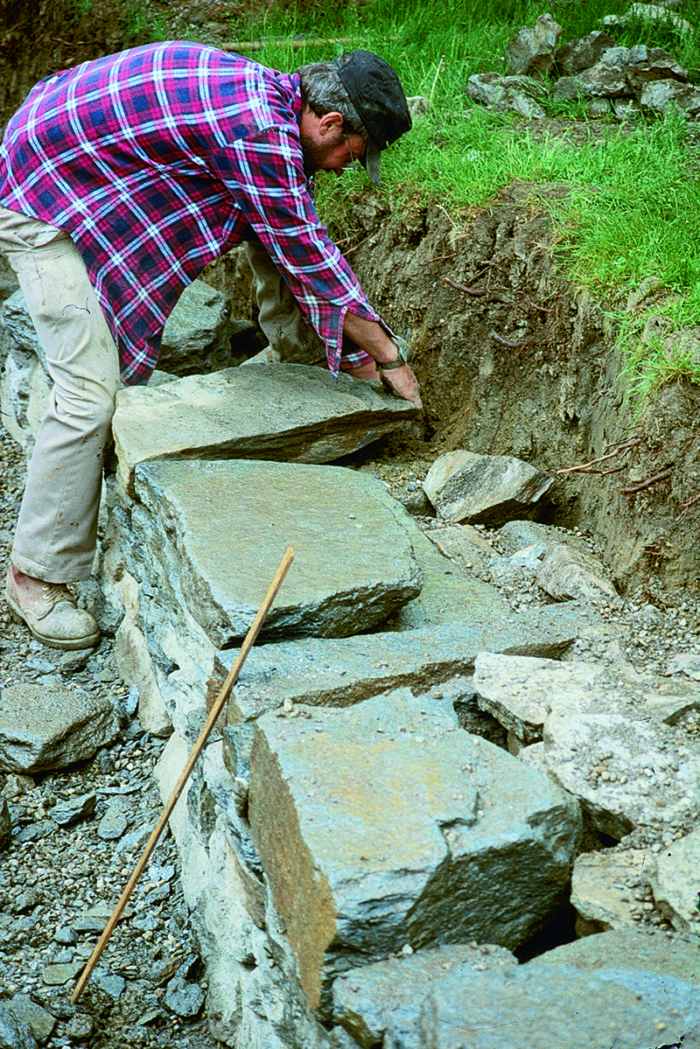
Start by digging a trench about 4 inches deep and at least 2 feet wide. A straightedged spade will give you a nice, even edge. The first course must be very solid and tightly fit because the weight of the wall will rest on it. Take the time to find rocks that lock into place, without leaving gaps. Randomly lay your largest rocks along the front edge of the trench. Set the first stone, shifting it around until it sits securely without being rocked easily, and then fill with the remaining stones. If you are using rectangular stones, you want the height of adjacent stones to be the same, or of a difference that can be made up with a smaller stone. If the rocks are irregular, then the stones will fit together leaving a triangular gap for the next course to fit into. I find irregular rocks easier to work with than flat ones; with flat rocks you have to be more precise. Find a stone that fits well and then continue for a few more feet. A rule of thumb, passed down from my wall-building teacher’s mentor, is to try a stone seven different ways. If it doesn’t fit by the seventh try, use another stone.
Luego, palee tierra detrás de las piedras y apisone la tierra en los espacios between, behind, and beneath the stones with top of the sledgehammer. This is an important step because the dirt becomes the mortar for the wall. I also recommend adding rubble (those stones you won’t use on the face of your wall) behind the face course to give greater strength to the wall. Pound the rubble and soil mix until you are satisfied that it is solid. Continue the first course until you reach the end of the wall. When you are done, test
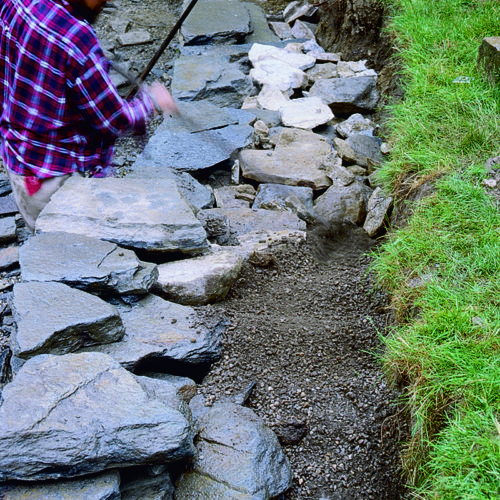
Para comenzar la segunda hilera, elija una piedra que unirá la primera junta de la hilera inferior. Avoid having joints run up the face of the wall, and angle (batter) the courses backward—approximately 1 inch per vertical foot. This creates a stable wall. For added strength, intermittently place single stones that run the full depth of the wall. This will only work with rectangular rocks. For irregular rocks, place a large rock behind a face rock every 3 feet or so. As you set a course, you will come to situations, probably quite a few of them, where the rock placement is perfect on all sides but one. These are the planting opportunities that give life to a stone wall.
Continue building in this manner until you are one course away from the finished height. Fitting stones will get easier as you go, and you’ll likely discover that there’s a certain magic moment when you’re building a wall: you hear a thump that signals you’ve placed a rock perfec
Haga la altura de ubicación de su pared
The ideal height for a dry-stacked retaining wall is 18 to 22 inches—so you can sit on it when your gardening chores are done. Even if
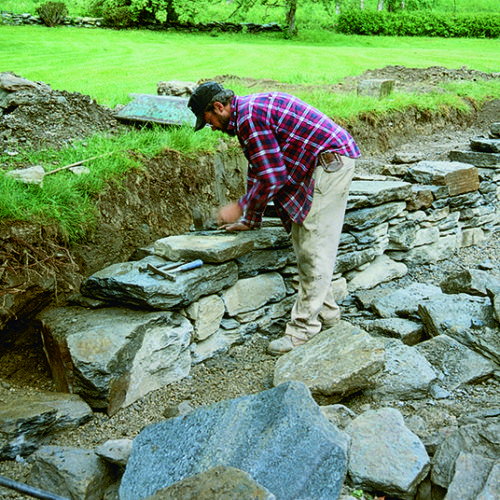
Traiga mucha paciencia al proceso de colocación de la piedra angular; es la culminación de la habilidad que has desarrollado hasta este punto. Debe tener entre 15 y 18 pulgadas de profundidad y estar compuesto de una a tres piedras. Utilice tierra y una buena ubicación para asegurar las piedras y, al igual que con las juntas de las paredes, evite las juntas largas en la piedra angular. Si quieres sentarte en la pared, elige piedras lisas y planas. O rellene los huecos con tierra y plante hierbas aromáticas a modo de cojines. Una piedra angular plantada es un delicioso toque final para una pared viva.
 africano
 albanés
 amárico
 Arábica
 armenio
 azerbaiyano
 vasco
vasco bielorruso
 bengalí
  bosnio
 búlgaro
 catalán
 cebuano
 Porcelana
 China (Taiwán)
 corso
corso croata
 checo
checo danés
danés Holandés
 Inglés
 esperanto
 estonio
 finlandés
 Francés
 frisio
 gallego
 georgiano
 Alemán
 Griego
 gujarati
 criollo haitiano
 hausa
hausa hawaiano
 hebreo
 No
No Miao
Miao húngaro
 islandés
 igbo
igbo indonesio
 irlandesa
 italiano
 japonés
 javanés
 canarés
 kazajo
 jemer
jemer ruandés
 coreano
 kurdo
kurdo Kirguistán
 tuberculosis
 latín
latín letón
letón lituano
 luxemburgués
 macedónio
 Malgashi
 malayo
 malayalam
 maltés
 maorí
maorí marathi
 mongol
 Birmania
 nepalí
 noruego
 noruego
 occitano
 pastún
 persa
persa Polaco
 portugués
  punjabi
 rumano
 ruso
ruso samoano
 gaélico escocés
 serbio
 Inglés
 Shona
Shona Sindhi
 cingalés
 eslovaco
 esloveno
 somalí
 Español
 sundanés
 swahili
 sueco
sueco tagalo
 tayiko
 Tamil
Tamil tártaro
 telugu
 tailandés
 turco
turco turcomano
 ucranio
 urdu
urdu uigur
uigur uzbeko
 vietnamita
 galés
galés