

Matailosi adzimbiri
Mukufuna kumanga khoma lanu lotsekera miyala, koma simukudziwa kuti mungayambire bwanji? Ngati muli ndi kusiyana Pabwalo, khoma lotchingira miyala lingathandize kupewa kukokoloka ndikupereka malo abwino obzala. Kuti mudziwe momwe mungayikitsire zanu, kuyambira koyambira mpaka kumapeto, werengani.
To figure out how much stone you’ll need, multiply your wall’s height times the depth times the length. If your wall is 2 feet high, 1-1/2 feet wide, and 20 feet long, you’ll need roughly 60 cubic feet of stone. Most stoneyards will deliver the stones for a slight charge; have them placed as close to the site of your retaining wall as possible.
Koma tools, you’ll need a shovel for digging your trench and backfilling, a mattock for attacking the grade, and a small sledgehammer for tamping soil. For marking your site and leveling rocks, you’ll need a line level, a few tall stakes, string, some flour, and a 4- or 8-foot level.
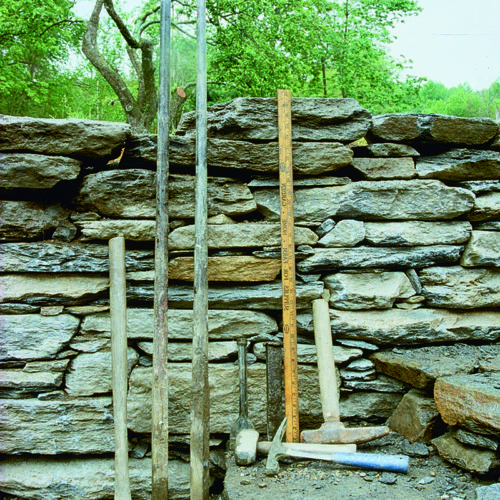
Now you can start digging. The easiest approach is to cut and fill—that is, dig into the slope where the wall will go and spread the earth below you to create a level terrace. When you cut and fill, the wall is backed by undisturbed soil, which is more stable than fill. For design reasons, however, you might choose to build a freestanding wall and fill behind it with soil from another site. Or you might do a partial cut and fill, which is somewhere between the two.
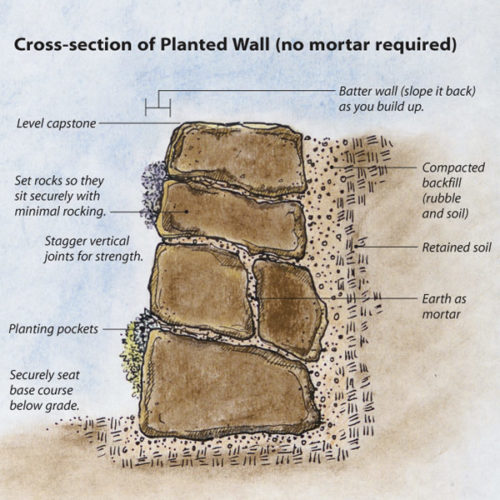
Makoma amamangidwa mu maphunziro. The base course is structurally the most important, while the final course, the capstone, is the most challenging. For stability, walls should be at least 20 inches wide at the base. They can taper slightly toward the top, but you’ll want a wall that is at least two rocks wide in most places. This can be accomplished by mixing stones of different sizes or by backfilling with a combination of two-thirds rubble to one-third soil.
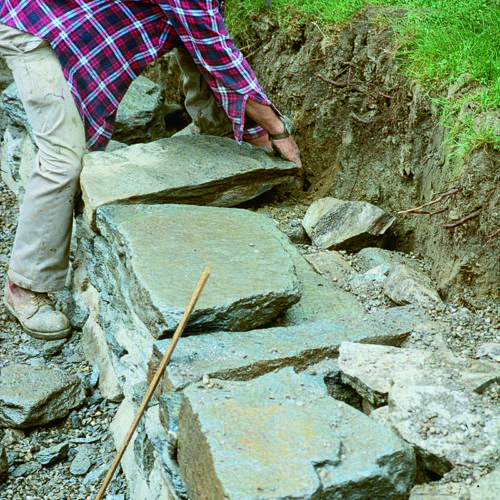
Kumba ngalande yoyambira maphunziro
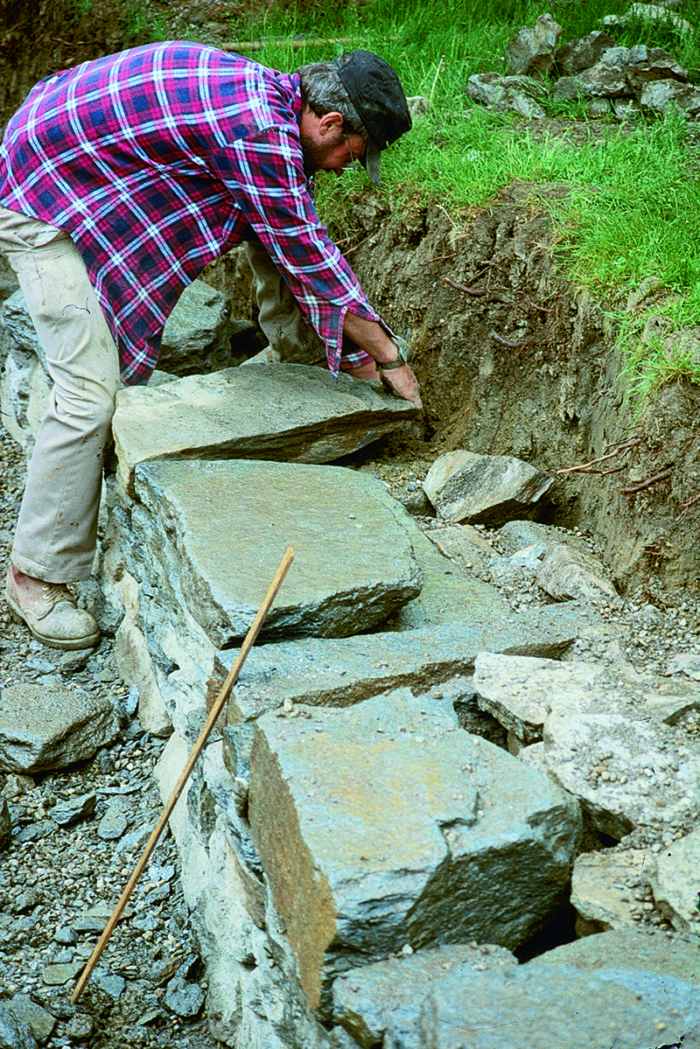
Start by digging a trench about 4 inches deep and at least 2 feet wide. A straightedged spade will give you a nice, even edge. The first course must be very solid and tightly fit because the weight of the wall will rest on it. Take the time to find rocks that lock into place, without leaving gaps. Randomly lay your largest rocks along the front edge of the trench. Set the first stone, shifting it around until it sits securely without being rocked easily, and then fill with the remaining stones. If you are using rectangular stones, you want the height of adjacent stones to be the same, or of a difference that can be made up with a smaller stone. If the rocks are irregular, then the stones will fit together leaving a triangular gap for the next course to fit into. I find irregular rocks easier to work with than flat ones; with flat rocks you have to be more precise. Find a stone that fits well and then continue for a few more feet. A rule of thumb, passed down from my wall-building teacher’s mentor, is to try a stone seven different ways. If it doesn’t fit by the seventh try, use another stone.
Kenako, chotsani dothi kuseri kwa miyalayo ndi kuponda pansi m'mipata between, behind, and beneath the stones with top of the sledgehammer. This is an important step because the dirt becomes the mortar for the wall. I also recommend adding rubble (those stones you won’t use on the face of your wall) behind the face course to give greater strength to the wall. Pound the rubble and soil mix until you are satisfied that it is solid. Continue the first course until you reach the end of the wall. When you are done, test
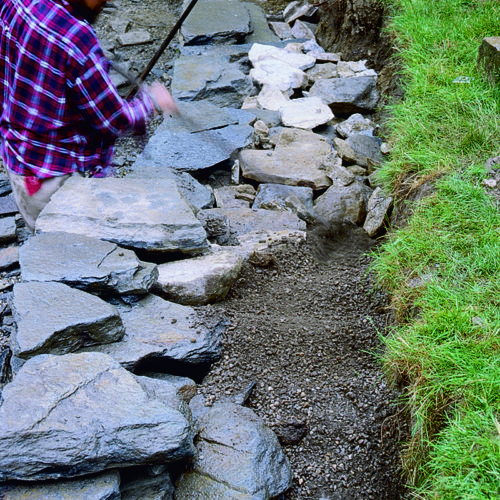
Kuti muyambitse maphunziro achiwiri, sankhani mwala womwe ungalumikizane ndi mfundo yoyamba. Avoid having joints run up the face of the wall, and angle (batter) the courses backward—approximately 1 inch per vertical foot. This creates a stable wall. For added strength, intermittently place single stones that run the full depth of the wall. This will only work with rectangular rocks. For irregular rocks, place a large rock behind a face rock every 3 feet or so. As you set a course, you will come to situations, probably quite a few of them, where the rock placement is perfect on all sides but one. These are the planting opportunities that give life to a stone wall.
Continue building in this manner until you are one course away from the finished height. Fitting stones will get easier as you go, and you’ll likely discover that there’s a certain magic moment when you’re building a wall: you hear a thump that signals you’ve placed a rock perfec
Pangani kutalika kwa khoma lanu
The ideal height for a dry-stacked retaining wall is 18 to 22 inches—so you can sit on it when your gardening chores are done. Even if
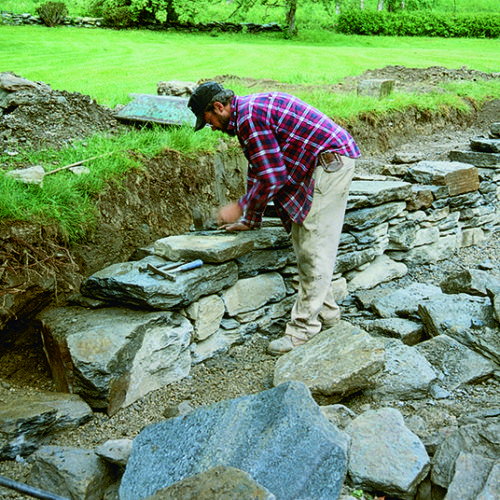
Bweretsani chipiriro chochuluka ku ndondomeko yoyika mwala wapamutu; ndi chimaliziro cha luso lomwe mwakulitsa mpaka pano. Ayenera kukhala pafupifupi mainchesi 15 mpaka 18, opangidwa ndi mwala umodzi kapena atatu. Gwiritsani ntchito dothi ndikuyika bwino kuti muteteze miyala, ndipo monga momwe zimakhalira ndi khoma, pewani mfundo zazitali pamwala wapamutu. Ngati mukufuna kukhala pakhoma, sankhani miyala yosalala, yosalala. Kapena, lembani mipata ndi dothi ndikubzala zitsamba zonunkhira za ma cushion. Mwala wobzalidwa pamwamba ndi njira yosangalatsa yomaliza pakhoma lamoyo.






 Afirika
 Chialubaniya
 Chiamharic
 Chiarabu
 Chiameniya
 Chiazerbaijani
 Basque
 Chibelarusi
 Chibengali
  Chibosnia
 Chibugariya
 Chikatalani
 Cebuano
 China
China China (Taiwan)
 Chikosikani
 Chikroatia
 Chicheki
 Chidanishi
 Chidatchi
 Chingerezi
 Chiesperanto
 Chiestonia
 Chifinishi
 Chifalansa
 Chifrisian
 Chigalikiya
 Chijojiya
 Chijeremani
 Chigriki
 Chigujarati
 Chikiliyo cha ku Haiti
 hausa
hausa Hawaii
 Chiheberi
 Ayi
Ayi Miao
Miao Chihangare
 Chi Icelandic
 igbo
igbo Chi Indonesian
 ayi
ayi Chitaliyana
 Chijapani
 Chijavani
 Kanada
 kazakh
 Khmer
Khmer Rwanda
 Chikorea
 Chikurdi
 Kyrgyz
 TB
TB Chilatini
 Chilativiya
 Chilithuania
 ChiLuxembourgish
 Chimakedoniya
 Malgashi
 Chimalayi
 Malayalam
 Chimalta
 Chimaori
 Chimarathi
 Chimongoliya
 Myanmar
 Chinepali
 Chinorwe
 Chinorwe
 Occitan
 Pashto
 Chiperisi
 Chipolishi
 Chipwitikizi
  Chipunjabi
 Chiromania
 Chirasha
 Chisamoa
 Scottish Gaelic
 Chisebiya
 Chingerezi
 Chishona
 Sindi
Sindi Sinhala
 Chisilovaki
 Chisiloveniya
 Somalia
 Chisipanishi
 Chisundanese
 Swahili
 Chiswidishi
 Chitagalogi
 Tajiki
 Tamil
Tamil Chitata
 Telugu
 Thai
Thai Turkey
 Turkmen
 Chiyukireniya
 Chiurdu
 Uighur
 Chiuzbeki
 Vietnamese
 Chiwelesi