

Sarūsējušas flīzes
Vai vēlaties izveidot savu akmens atbalsta sienu, bet nezināt, kā sākt? Ja jums ir nevienmērīga pagalmā akmens atbalsta siena var palīdzēt novērst eroziju un nodrošināt jauku vietu stādīšanai. Lai uzzinātu, kā no sākuma līdz beigām izveidot savu, lasiet tālāk.
To figure out how much stone you’ll need, multiply your wall’s height times the depth times the length. If your wall is 2 feet high, 1-1/2 feet wide, and 20 feet long, you’ll need roughly 60 cubic feet of stone. Most stoneyards will deliver the stones for a slight charge; have them placed as close to the site of your retaining wall as possible.
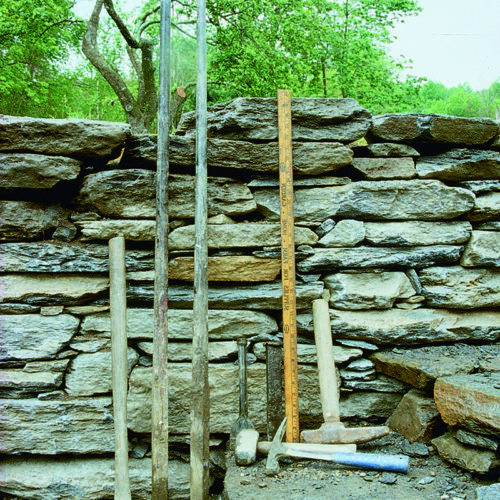
Kas attiecas uz tools, you’ll need a shovel for digging your trench and backfilling, a kapoks for attacking the grade, and a small sledgehammer for tamping soil. For marking your site and leveling rocks, you’ll need a line level, a few tall stakes, string, some flour, and a 4- or 8-foot level.
Now you can start digging. The easiest approach is to cut and fill—that is, dig into the slope where the wall will go and spread the earth below you to create a level terrace. When you cut and fill, the wall is backed by undisturbed soil, which is more stable than fill. For design reasons, however, you might choose to build a freestanding wall and fill behind it with soil from another site. Or you might do a partial cut and fill, which is somewhere between the two.
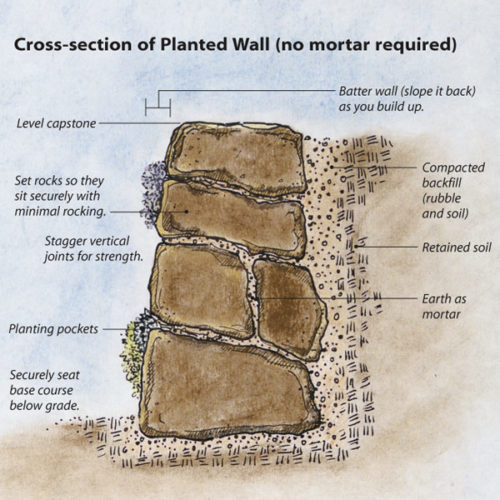
Sienas būvē kursos. The base course is structurally the most important, while the final course, the capstone, is the most challenging. For stability, walls should be at least 20 inches wide at the base. They can taper slightly toward the top, but you’ll want a wall that is at least two rocks wide in most places. This can be accomplished by mixing stones of different sizes or by backfilling with a combination of two-thirds rubble to one-third soil.
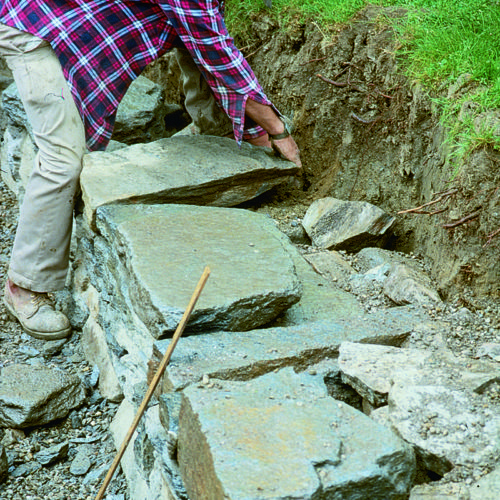
Izrakt tranšeju pamatkārtai
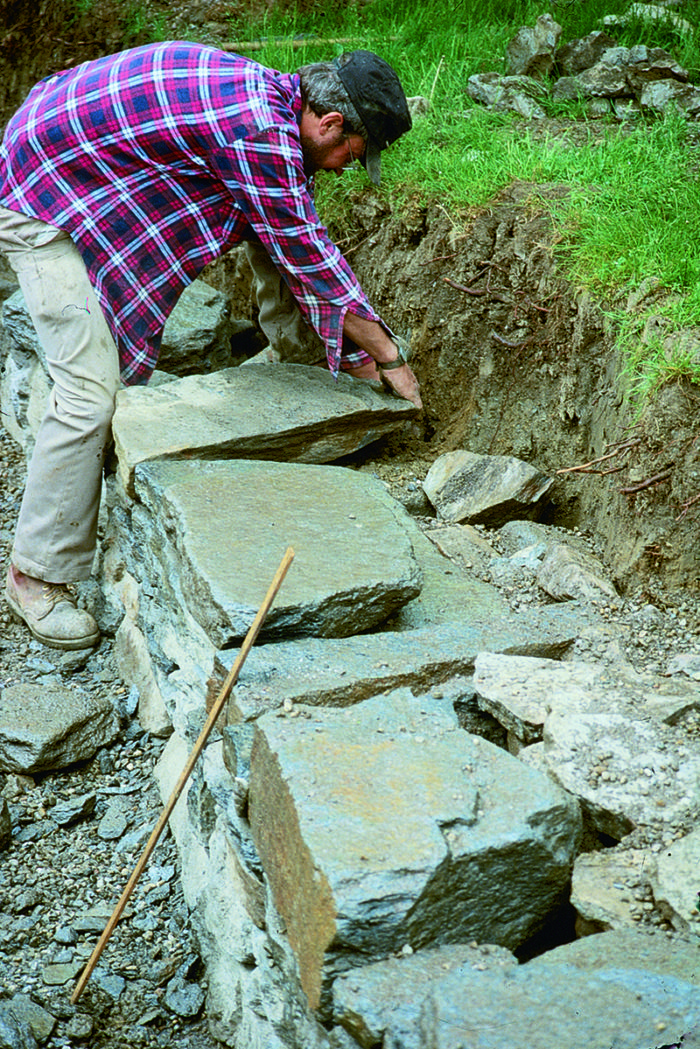
Start by digging a trench about 4 inches deep and at least 2 feet wide. A straightedged spade will give you a nice, even edge. The first course must be very solid and tightly fit because the weight of the wall will rest on it. Take the time to find rocks that lock into place, without leaving gaps. Randomly lay your largest rocks along the front edge of the trench. Set the first stone, shifting it around until it sits securely without being rocked easily, and then fill with the remaining stones. If you are using rectangular stones, you want the height of adjacent stones to be the same, or of a difference that can be made up with a smaller stone. If the rocks are irregular, then the stones will fit together leaving a triangular gap for the next course to fit into. I find irregular rocks easier to work with than flat ones; with flat rocks you have to be more precise. Find a stone that fits well and then continue for a few more feet. A rule of thumb, passed down from my wall-building teacher’s mentor, is to try a stone seven different ways. If it doesn’t fit by the seventh try, use another stone.
Pēc tam notīriet netīrumus aiz akmeņiem un iespiediet zemi telpās between, behind, and beneath the stones with top of the sledgehammer. This is an important step because the dirt becomes the mortar for the wall. I also recommend adding rubble (those stones you won’t use on the face of your wall) behind the face course to give greater strength to the wall. Pound the rubble and soil mix until you are satisfied that it is solid. Continue the first course until you reach the end of the wall. When you are done, test
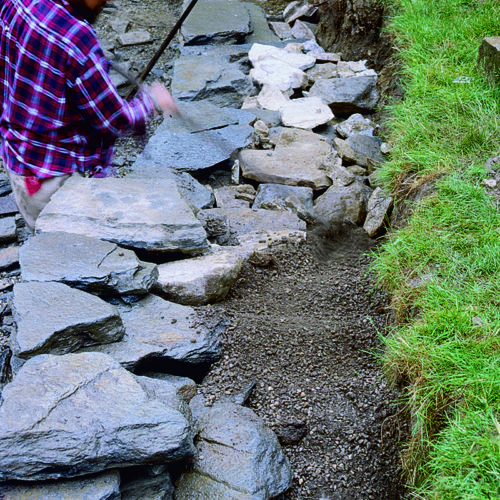
Lai sāktu otro kārtu, izvēlieties akmeni, kas savienos apakšējā slāņa pirmo savienojumu. Avoid having joints run up the face of the wall, and angle (batter) the courses backward—approximately 1 inch per vertical foot. This creates a stable wall. For added strength, intermittently place single stones that run the full depth of the wall. This will only work with rectangular rocks. For irregular rocks, place a large rock behind a face rock every 3 feet or so. As you set a course, you will come to situations, probably quite a few of them, where the rock placement is perfect on all sides but one. These are the planting opportunities that give life to a stone wall.
Continue building in this manner until you are one course away from the finished height. Fitting stones will get easier as you go, and you’ll likely discover that there’s a certain magic moment when you’re building a wall: you hear a thump that signals you’ve placed a rock perfec
Padariet savu sienas augstumu
The ideal height for a dry-stacked retaining wall is 18 to 22 inches—so you can sit on it when your gardening chores are done. Even if
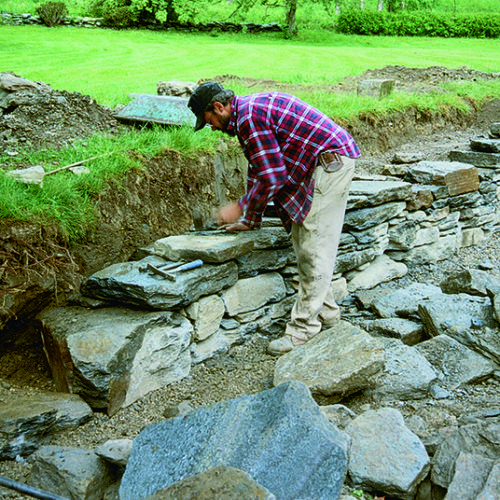
Nodrošiniet pamatakmens likšanas procesā daudz pacietības; tā ir jūsu līdz šim attīstītās prasmes kulminācija. Tam jābūt apmēram 15 līdz 18 collu dziļam, un tas sastāv no viena līdz trim akmeņiem. Izmantojiet augsni un labu novietojumu, lai nostiprinātu akmeņus, un, tāpat kā ar sienu savienojumiem, izvairieties no gariem savienojumiem pamatakmenī. Ja vēlaties sēdēt uz sienas, izvēlieties gludus, plakanus akmeņus. Vai arī aizpildiet spraugas ar augsni un iestādiet smaržīgus augus spilveniem. Apstādīts virsakmens ir apburošs pieskāriens dzīvai sienai.
 Āfrikas
 albānis
 amharu
 arābu
 armēņu
 Azerbaidžāņu
 basku
 baltkrievu
 bengāļu
 bosniešu
 bulgāru valoda
 katalāņu
 Cebuano
 Ķīna
 Ķīna (Taivāna)
 Korsikānis
 horvātu
 čehu
 dāņu
 holandiešu valoda
 Angļu
 Esperanto
 igauņu
 somu
 franču valoda
 frīzu valoda
 Galisiešu
 gruzīnu
 vācu
 grieķu valoda
 gudžaratu
 Haiti kreols
 hausa
 havajietis
 ebreju valoda
 Nē
 Miao
 ungāru
 islandiešu
 igbo
 Indonēziešu
 īru
 itāļu valoda
 japāņi
 javiešu
 kannada
 kazahu
 khmeru
 Ruandā
 korejiešu
 kurdu
 Kirgizstānas
 TB
 latīņu valoda
 latviski
 lietuviešu
 luksemburgiešu
 maķedonietis
 Malgaši
 malajiešu
 malajalu
 maltiešu
 maori
 maratu
 mongoļu valoda
 Mjanma
 Nepāliešu
 norvēģu
 norvēģu
 oksitāņu
 puštu
 persiešu
 poļu
 portugāļu
 pandžabu
 rumāņu valoda
 krievu valoda
 Samoa
 skotu gēlu valoda
 serbu
 Angļu
 Šona
 Sindhi
 singalu valoda
 slovāku
 slovēņu
 somāliešu
 spāņu valoda
 sundāņu
 svahili
 zviedru
 tagalogs
 tadžiks
 tamilu
 tatārs
 telugu
 taju
 Turku
 Turkmēņu
 ukraiņu
 urdu
 Uiguru
 uzbeku
 vjetnamietis
 velsiešu