

Baldosa herdoilduak
Zure harrizko euste-horma eraiki nahi duzu, baina ez dakizu nola hasi? irregularra baduzu patioan, harrizko euste-horma batek higadura saihesten lagun dezake eta landatzeko leku polita eskaintzen du. Zurea nola jartzen ikasteko, hasieratik amaierara, jarraitu irakurtzen.
To figure out how much stone you’ll need, multiply your wall’s height times the depth times the length. If your wall is 2 feet high, 1-1/2 feet wide, and 20 feet long, you’ll need roughly 60 cubic feet of stone. Most stoneyards will deliver the stones for a slight charge; have them placed as close to the site of your retaining wall as possible.
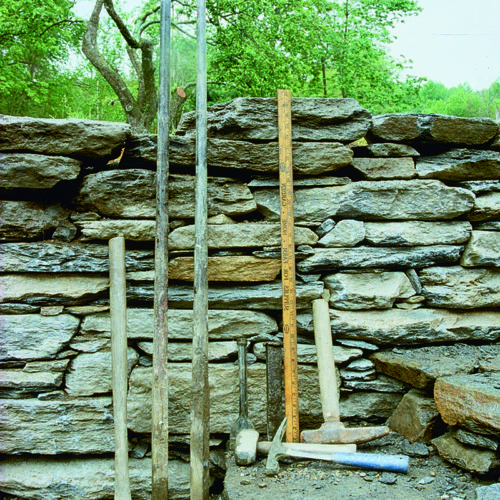
Gisa tools, you’ll need a shovel for digging your trench and backfilling, a matoka for attacking the grade, and a small sledgehammer for tamping soil. For marking your site and leveling rocks, you’ll need a line level, a few tall stakes, string, some flour, and a 4- or 8-foot level.
Now you can start digging. The easiest approach is to cut and fill—that is, dig into the slope where the wall will go and spread the earth below you to create a level terrace. When you cut and fill, the wall is backed by undisturbed soil, which is more stable than fill. For design reasons, however, you might choose to build a freestanding wall and fill behind it with soil from another site. Or you might do a partial cut and fill, which is somewhere between the two.
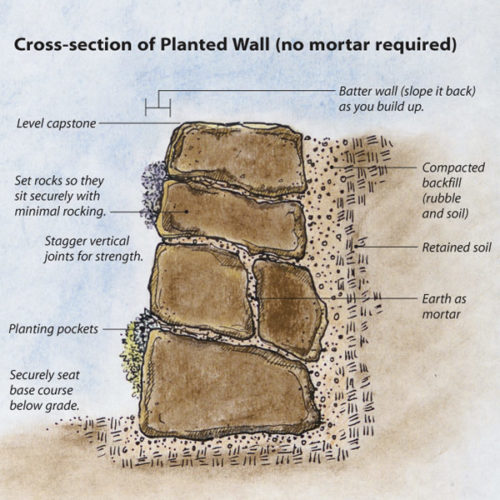
Hormak ikastaroetan eraikitzen dira. The base course is structurally the most important, while the final course, the capstone, is the most challenging. For stability, walls should be at least 20 inches wide at the base. They can taper slightly toward the top, but you’ll want a wall that is at least two rocks wide in most places. This can be accomplished by mixing stones of different sizes or by backfilling with a combination of two-thirds rubble to one-third soil.
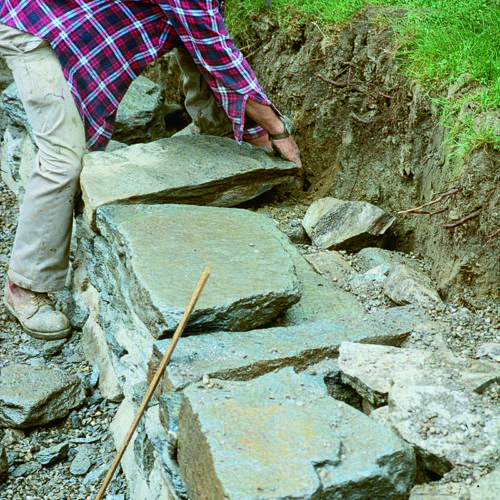
Lubaki bat zulatu oinarrizko ibilgurako
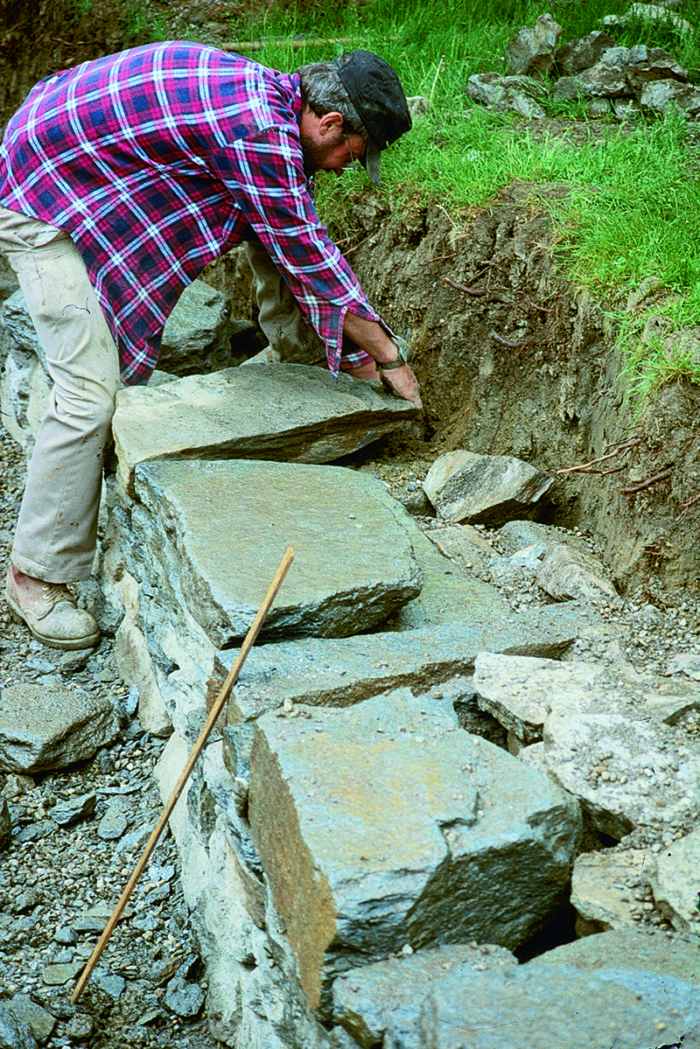
Start by digging a trench about 4 inches deep and at least 2 feet wide. A straightedged spade will give you a nice, even edge. The first course must be very solid and tightly fit because the weight of the wall will rest on it. Take the time to find rocks that lock into place, without leaving gaps. Randomly lay your largest rocks along the front edge of the trench. Set the first stone, shifting it around until it sits securely without being rocked easily, and then fill with the remaining stones. If you are using rectangular stones, you want the height of adjacent stones to be the same, or of a difference that can be made up with a smaller stone. If the rocks are irregular, then the stones will fit together leaving a triangular gap for the next course to fit into. I find irregular rocks easier to work with than flat ones; with flat rocks you have to be more precise. Find a stone that fits well and then continue for a few more feet. A rule of thumb, passed down from my wall-building teacher’s mentor, is to try a stone seven different ways. If it doesn’t fit by the seventh try, use another stone.
Ondoren, pala zikinkeria harrien atzean eta lurra kolpatu espazioetan between, behind, and beneath the stones with top of the sledgehammer. This is an important step because the dirt becomes the mortar for the wall. I also recommend adding rubble (those stones you won’t use on the face of your wall) behind the face course to give greater strength to the wall. Pound the rubble and soil mix until you are satisfied that it is solid. Continue the first course until you reach the end of the wall. When you are done, test
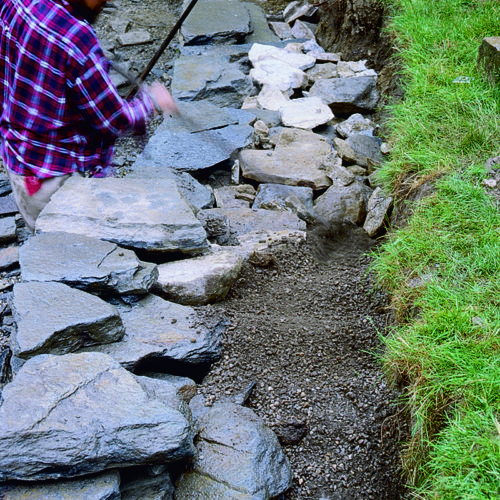
Bigarren ibilguarekin hasteko, aukeratu beheko ibilguaren lehen juntura zubi egingo duen harri bat. Avoid having joints run up the face of the wall, and angle (batter) the courses backward—approximately 1 inch per vertical foot. This creates a stable wall. For added strength, intermittently place single stones that run the full depth of the wall. This will only work with rectangular rocks. For irregular rocks, place a large rock behind a face rock every 3 feet or so. As you set a course, you will come to situations, probably quite a few of them, where the rock placement is perfect on all sides but one. These are the planting opportunities that give life to a stone wall.
Continue building in this manner until you are one course away from the finished height. Fitting stones will get easier as you go, and you’ll likely discover that there’s a certain magic moment when you’re building a wall: you hear a thump that signals you’ve placed a rock perfec
Egin zure hormaren kokapenaren altuera
The ideal height for a dry-stacked retaining wall is 18 to 22 inches—so you can sit on it when your gardening chores are done. Even if
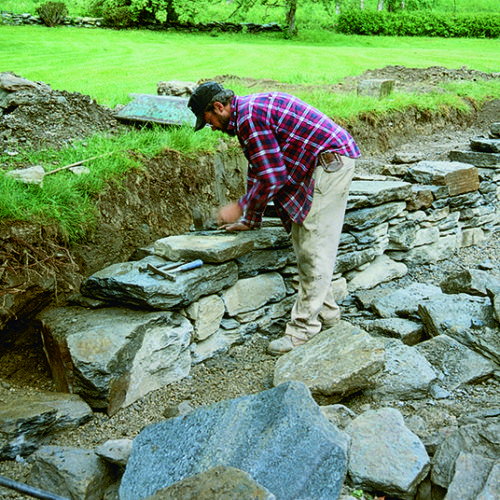
Eman pazientzia asko gailurra jartzeko prozesuari; puntura arte garatu duzun trebetasunaren gailurra da. 15 eta 18 zentimetro arteko sakonera izan behar du, bat edo hiru harriz osatua. Erabili lurra eta kokapen egokia harriak ziurtatzeko, eta hormetako junturak gertatzen diren bezala, saihestu giltzadura luzeak. Horman eseri nahi baduzu, aukeratu harri leun eta lauak. Edo, bete hutsuneak lurrez eta landatu belar usaintsuak kuxinetarako. Landatutako gailurra horma bizi baten amaiera ukitu ederra da.
 afrikarra
 Albaniarra
 Amharikoa
 arabiera
 armeniarra
 Azerbaijangoa
 euskara
 bielorrusiera
 bengalera
  bosniarra
 bulgariera
 katalana
 Cebuano
 Txina
Txina Txina (Taiwan)
 Korsikera
 kroaziera
 Txekiar
 daniera
 holandarra
 ingelesa
 esperantoa
 Estoniarra
 Finlandiera
 frantsesa
 frisiera
 galegoa
 georgiarra
 alemana
 grekoa
 gujaratera
 Haitiko kreolera
 hausa
hausa hawaiarra
 hebreera
 Ezetz
Ezetz Miao
Miao hungariera
 islandiera
 igbo
igbo Indonesian
 irlandera
 italiarra
 japoniarra
 javera
 Kannada
 kazakh
 Khmer
Khmer Ruanda
 Korean
 kurduera
 kirgizera
 TB
TB latina
 letoniera
 Lituaniera
 Luxenburgera
 Mazedoniera
 Malgashi
 malaysiera
 malayalamera
 maltera
 maoria
 Marathia
 Mongoliera
 Myanmar
 Nepaliarra
 Norvegiara
 Norvegiara
 okzitaniera
 Paxtuera
 pertsiera
 poloniarra
 portugesa
  punjabera
 errumaniera
 errusiera
 samoarra
 Eskoziako gaelikoa
 serbiarra
 ingelesa
 Shona
Shona Sindhia
 Sinhalera
 eslovakiera
 Esloveniera
 somaliera
 gaztelania
 Sundanera
 Swahilia
 Suediera
 Tagalog
 Tajik
Tajik Tamila
 tatariarra
 Telugu
 thailandiera
 turkiera
 Turkmenera
 Ukrainara
 Urdu
Urdu uigurrera
 uzbekera
 Vietnamera
 galesera