

Matiles ane ngura
Unoda kuvaka yako wega dombo rekuchengetedza madziro, asi usingazive kuti wotanga sei? Kana iwe uine kusaenzana yadhi, mudhuri wematombo unogona kubatsira kudzivirira kukukurwa uye inopa nzvimbo yakanaka yekudyara. Kuti udzidze kuisa yako pamwe chete, kubva pakutanga kusvika pakupedzisira, verenga.
To figure out how much stone you’ll need, multiply your wall’s height times the depth times the length. If your wall is 2 feet high, 1-1/2 feet wide, and 20 feet long, you’ll need roughly 60 cubic feet of stone. Most stoneyards will deliver the stones for a slight charge; have them placed as close to the site of your retaining wall as possible.
Nezve tools, you’ll need a shovel for digging your trench and backfilling, a mattock for attacking the grade, and a small sledgehammer for tamping soil. For marking your site and leveling rocks, you’ll need a line level, a few tall stakes, string, some flour, and a 4- or 8-foot level.
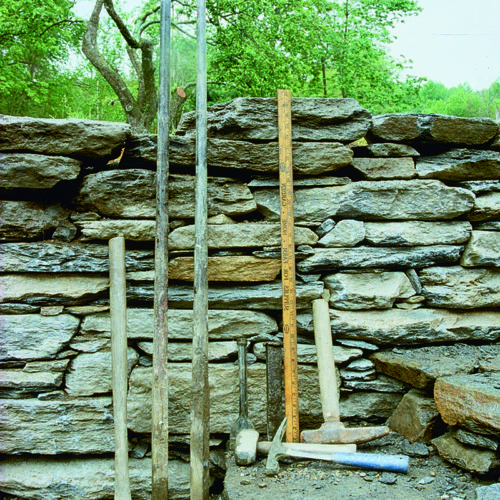
Now you can start digging. The easiest approach is to cut and fill—that is, dig into the slope where the wall will go and spread the earth below you to create a level terrace. When you cut and fill, the wall is backed by undisturbed soil, which is more stable than fill. For design reasons, however, you might choose to build a freestanding wall and fill behind it with soil from another site. Or you might do a partial cut and fill, which is somewhere between the two.
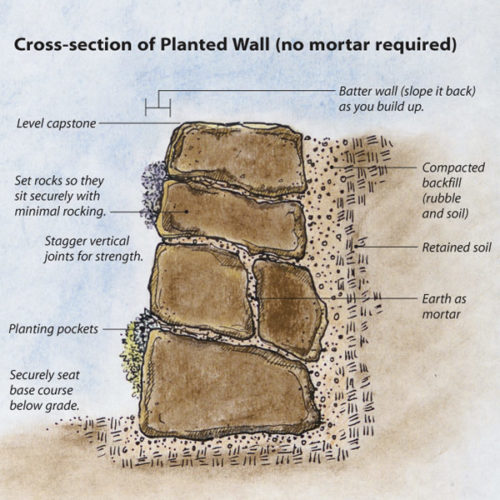
Masvingo anovakwa mumakosi. The base course is structurally the most important, while the final course, the capstone, is the most challenging. For stability, walls should be at least 20 inches wide at the base. They can taper slightly toward the top, but you’ll want a wall that is at least two rocks wide in most places. This can be accomplished by mixing stones of different sizes or by backfilling with a combination of two-thirds rubble to one-third soil.
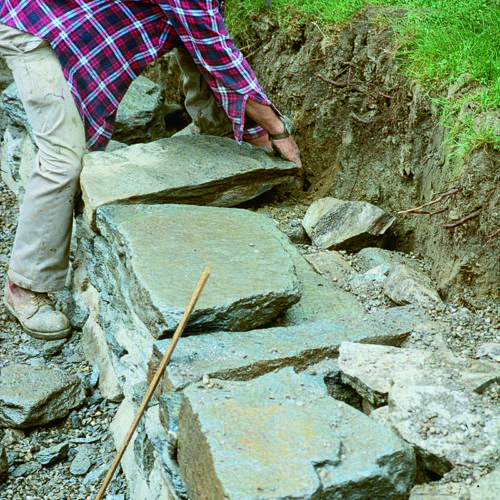
Chera mugero wekosi yepasi
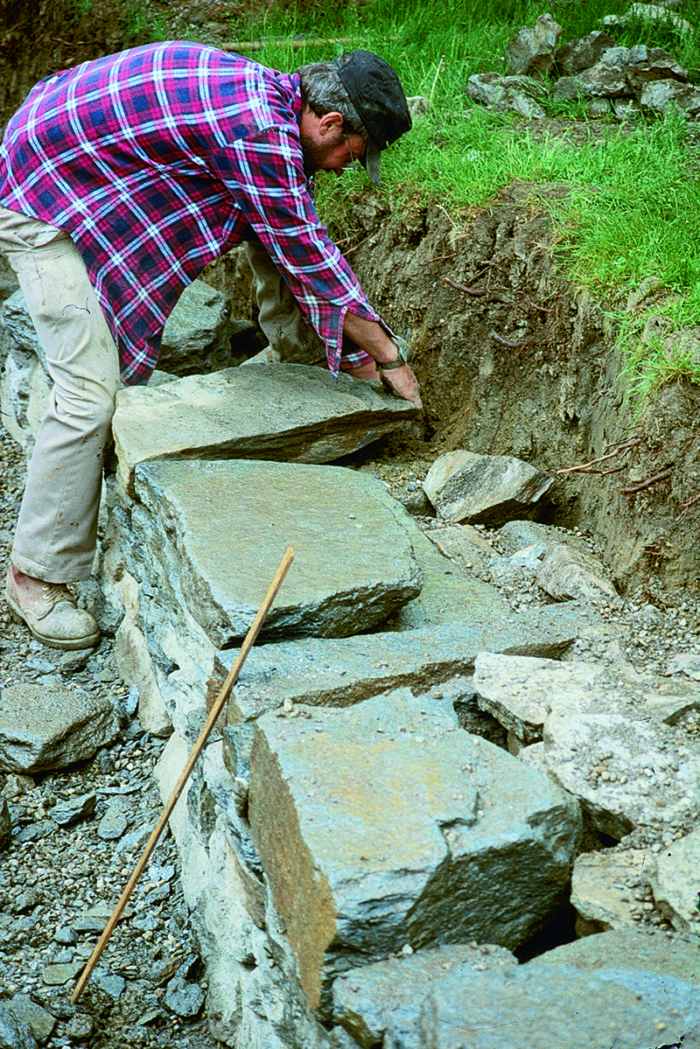
Start by digging a trench about 4 inches deep and at least 2 feet wide. A straightedged spade will give you a nice, even edge. The first course must be very solid and tightly fit because the weight of the wall will rest on it. Take the time to find rocks that lock into place, without leaving gaps. Randomly lay your largest rocks along the front edge of the trench. Set the first stone, shifting it around until it sits securely without being rocked easily, and then fill with the remaining stones. If you are using rectangular stones, you want the height of adjacent stones to be the same, or of a difference that can be made up with a smaller stone. If the rocks are irregular, then the stones will fit together leaving a triangular gap for the next course to fit into. I find irregular rocks easier to work with than flat ones; with flat rocks you have to be more precise. Find a stone that fits well and then continue for a few more feet. A rule of thumb, passed down from my wall-building teacher’s mentor, is to try a stone seven different ways. If it doesn’t fit by the seventh try, use another stone.
Zvadaro, foshoro ivhu kuseri kwematombo uye dzvanya pasi munzvimbo between, behind, and beneath the stones with top of the sledgehammer. This is an important step because the dirt becomes the mortar for the wall. I also recommend adding rubble (those stones you won’t use on the face of your wall) behind the face course to give greater strength to the wall. Pound the rubble and soil mix until you are satisfied that it is solid. Continue the first course until you reach the end of the wall. When you are done, test
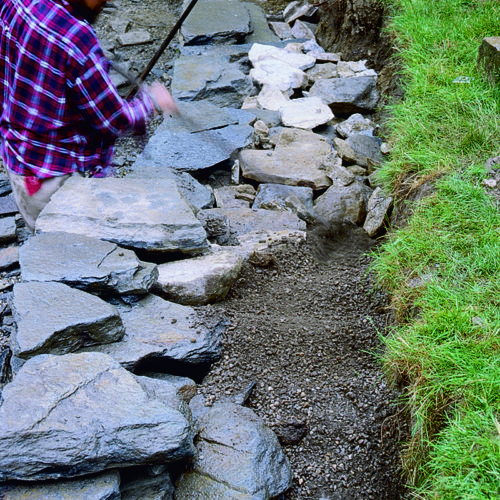
Kutanga kosi yechipiri, sarudza dombo rinozobatanidza mubatanidzwa wekutanga wekosi yepasi. Avoid having joints run up the face of the wall, and angle (batter) the courses backward—approximately 1 inch per vertical foot. This creates a stable wall. For added strength, intermittently place single stones that run the full depth of the wall. This will only work with rectangular rocks. For irregular rocks, place a large rock behind a face rock every 3 feet or so. As you set a course, you will come to situations, probably quite a few of them, where the rock placement is perfect on all sides but one. These are the planting opportunities that give life to a stone wall.
Continue building in this manner until you are one course away from the finished height. Fitting stones will get easier as you go, and you’ll likely discover that there’s a certain magic moment when you’re building a wall: you hear a thump that signals you’ve placed a rock perfec
Ita rusvingo rwako siting urefu
The ideal height for a dry-stacked retaining wall is 18 to 22 inches—so you can sit on it when your gardening chores are done. Even if
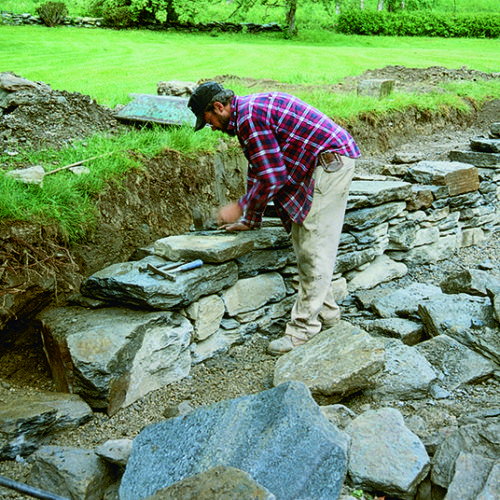
Uyai nemoyo murefu wakawanda kunzira yekuisa dombo remusoro; ndiwo magumo ehunyanzvi hwawava nahwo kusvika panguva ino. Inofanira kunge yakadzika 15 kusvika 18 inches, yakagadzirwa nedombo rimwe kusvika kumatatu. Shandisa ivhu uye nzvimbo yakanaka kuchengetedza matombo, uye sezvakangoita majoini emadziro, dzivirira majoini marefu mudombo remusoro. Kana iwe uchida kugara pamadziro, sarudza matombo akatsetseka, akatsetseka. Kana, zadza mapeji nevhu uye dyara miriwo inonhuhwirira yemakusheni. Ibwe remusoro rakasimwa rinonakidza kupedzisa kubata kumadziro mhenyu.






 African
 ChiAlbanian
 ChiAmharic
 ChiArabic
 ChiArmenian
 Azerbaijani
 ChiBasque
 Chiberaruzi
 ChiBengali
  ChiBosnian
 ChiBulgarian
 Katarani
 Cebuano
 China
China China (Taiwan)
 Kosikeni
 ChiCroatian
 ChiCzech
 ChiDanish
 ChiDutch
 Chirungu
 Esiperando
 ChiEstonian
 ChiFinish
 ChiFrench
 Frisian
 ChiGalician
 ChiGeorgian
 ChiJerimani
 ChiGiriki
 ChiGujarati
 Kiriyoro yeHaiti
 ChiHausa
 Chihawayi
 ChiHebhuru
 kwete
kwete Miao
Miao ChiHungarian
 ChiIcelandic
 igbo
igbo ChiIndonesian
 ChiIrish
 ChiItalian
 ChiJapanese
 ChiJavanese
 ChiKannada
 Kazaki
 Khmer
Khmer Rwandan
 ChiKorean
 ChiKedhi
 Kiyagizi
 TB
TB Ratini
 ChiLatvian
 Ritunia
 Rukusembogi
 ChiMacedonian
 Malgashi
 ChiMalay
 ChiMalayalam
 ChiMaltese
 Maori
Maori ChiMarati
 ChiMongoria
 Mayanima
 ChiNepali
 ChiNorwegian
 ChiNorwegian
 Occitan
 Pashito
 ChiPersian
 ChiPolish
 ChiPutukezi
  Punjabi
 ChiRomanian
 ChiRussian
 Samoan
 ChiGaelic cheScottish
 ChiSebhiya
 Chirungu
 Shona
Shona ChiSindhi
 Sinhala
 ChiSlovak
 ChiSlovanian
 Somari
 ChiSpanish
 Sundanese
 ChiSwahili
 ChiSwedish
 ChiTagalog
 Tajik
Tajik ChiTamil
 Tatar
Tatar ChiTelugu
 ChiThai
 Turkish
 ChiTeki
 Ukrainian
 Urdu
Urdu Uighur
 Uzbek
Uzbek Vietnamese
 Welsh
Welsh