

Tiles daxalaystay
Ma doonaysaa in aad dhisto gidaarkaada dhagxaanta, laakiin ma hubin sida loo bilaabo? Haddii aad leedahay mid aan sinnayn deyrka, gidaarka xajinta dhagaxa ayaa kaa caawin kara ka hortagga nabaad-guurka wuxuuna bixiyaa meel fiican oo lagu beero. Si aad u barato sida loo isu geeyo kuwaaga, bilow ilaa dhamaad, sii wad.
To figure out how much stone you’ll need, multiply your wall’s height times the depth times the length. If your wall is 2 feet high, 1-1/2 feet wide, and 20 feet long, you’ll need roughly 60 cubic feet of stone. Most stoneyards will deliver the stones for a slight charge; have them placed as close to the site of your retaining wall as possible.
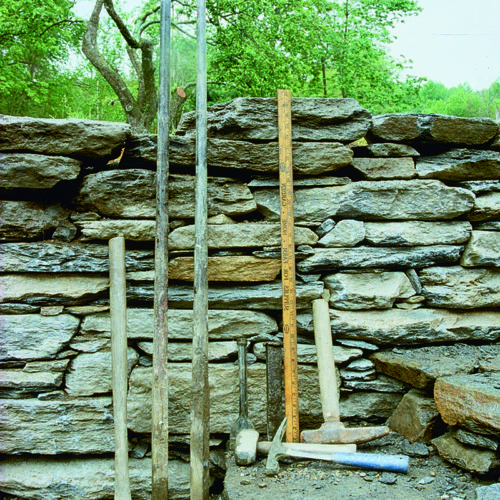
Sida tools, you’ll need a shovel for digging your trench and backfilling, a maaddo for attacking the grade, and a small sledgehammer for tamping soil. For marking your site and leveling rocks, you’ll need a line level, a few tall stakes, string, some flour, and a 4- or 8-foot level.
Now you can start digging. The easiest approach is to cut and fill—that is, dig into the slope where the wall will go and spread the earth below you to create a level terrace. When you cut and fill, the wall is backed by undisturbed soil, which is more stable than fill. For design reasons, however, you might choose to build a freestanding wall and fill behind it with soil from another site. Or you might do a partial cut and fill, which is somewhere between the two.
Derbiyada waxaa lagu dhisay koorsooyin. The base course is structurally the most important, while the final course, the capstone, is the most challenging. For stability, walls should be at least 20 inches wide at the base. They can taper slightly toward the top, but you’ll want a wall that is at least two rocks wide in most places. This can be accomplished by mixing stones of different sizes or by backfilling with a combination of two-thirds rubble to one-third soil.
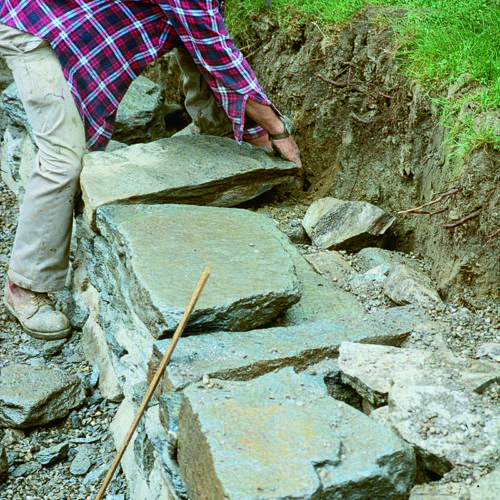
Qod koorsada saldhiga u qod
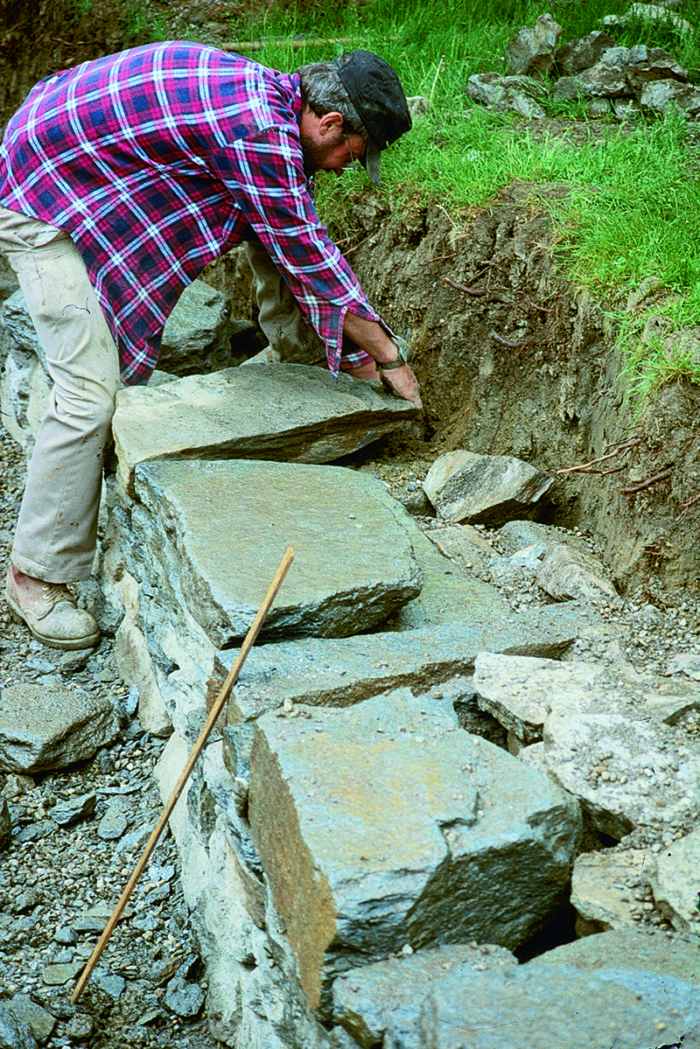
Start by digging a trench about 4 inches deep and at least 2 feet wide. A straightedged spade will give you a nice, even edge. The first course must be very solid and tightly fit because the weight of the wall will rest on it. Take the time to find rocks that lock into place, without leaving gaps. Randomly lay your largest rocks along the front edge of the trench. Set the first stone, shifting it around until it sits securely without being rocked easily, and then fill with the remaining stones. If you are using rectangular stones, you want the height of adjacent stones to be the same, or of a difference that can be made up with a smaller stone. If the rocks are irregular, then the stones will fit together leaving a triangular gap for the next course to fit into. I find irregular rocks easier to work with than flat ones; with flat rocks you have to be more precise. Find a stone that fits well and then continue for a few more feet. A rule of thumb, passed down from my wall-building teacher’s mentor, is to try a stone seven different ways. If it doesn’t fit by the seventh try, use another stone.
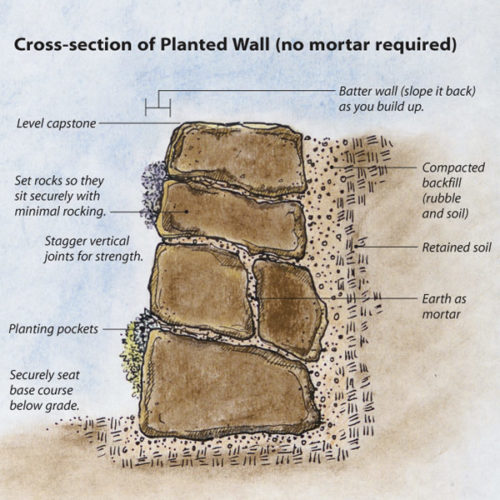
Marka xigta, majarafad wasakhda dhagxaanta gadaasheeda oo taabo dhulka meelaha bannaan between, behind, and beneath the stones with top of the sledgehammer. This is an important step because the dirt becomes the mortar for the wall. I also recommend adding rubble (those stones you won’t use on the face of your wall) behind the face course to give greater strength to the wall. Pound the rubble and soil mix until you are satisfied that it is solid. Continue the first course until you reach the end of the wall. When you are done, test
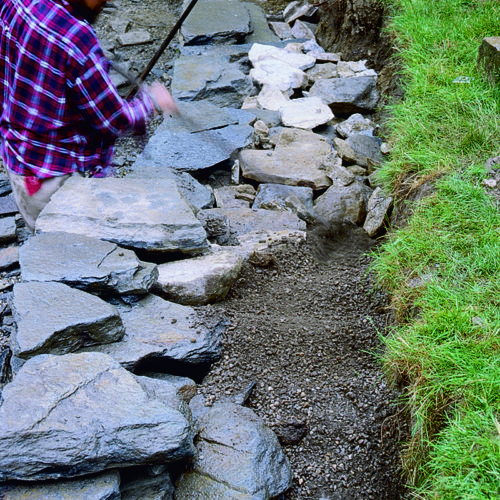
Si aad u bilowdo koorsada labaad, dooro dhagax isku xidhi doona isku-dhafka koowaad ee koorsada hoose. Avoid having joints run up the face of the wall, and angle (batter) the courses backward—approximately 1 inch per vertical foot. This creates a stable wall. For added strength, intermittently place single stones that run the full depth of the wall. This will only work with rectangular rocks. For irregular rocks, place a large rock behind a face rock every 3 feet or so. As you set a course, you will come to situations, probably quite a few of them, where the rock placement is perfect on all sides but one. These are the planting opportunities that give life to a stone wall.
Continue building in this manner until you are one course away from the finished height. Fitting stones will get easier as you go, and you’ll likely discover that there’s a certain magic moment when you’re building a wall: you hear a thump that signals you’ve placed a rock perfec
Dhererka fadhiga derbigaaga ka dhig
The ideal height for a dry-stacked retaining wall is 18 to 22 inches—so you can sit on it when your gardening chores are done. Even if
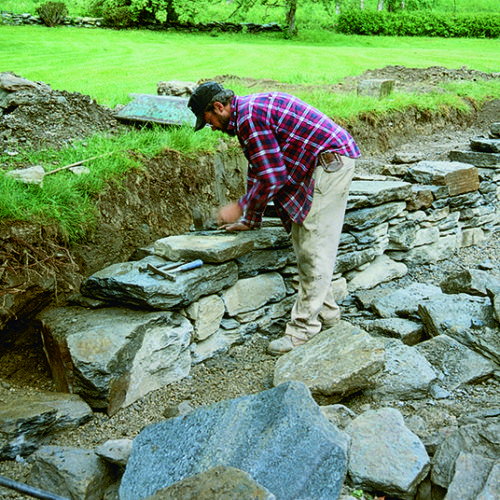
Samir badan u keen habka dhigista dhagaxa; waa gebogebada xirfadda aad horumarisay ilaa heerkan. Waa inay ahaataa ilaa 15 ilaa 18 inch oo qoto dheer, oo ka samaysan hal ilaa saddex dhagax. Isticmaal ciidda iyo meelaynta wanaagsan si aad u ilaaliso dhagxaanta, iyo sida kala-goysyada gidaarka, iska ilaali kala-goysyada dhaadheer ee dhagaxa. Haddii aad rabto inaad darbiga ku fadhiisato, dooro dhagxaan siman oo siman. Ama, ka buuxi daldaloolada ciidda oo ku beer geedo caraf udgoon oo loogu talagalay barkinnada. Dhagax-dhagax la beeray waa taabasho qurux badan oo dhammays ah oo ku aaddan gidaarka nool.






 Afrikaan
 Albaaniyaan
 Amxaari
 Carabi
 Armeeniyaan
 Asarbayjaan
 Basque
 Belarusiyaanka
 Bengali
  Bosnia
 Bulgaariya
 Catalan
 Cebuano
 Shiinaha
 Shiinaha (Taiwan)
 Korsican
 Croatian
 Czech
Czech Danish
 Dutch
Dutch Ingiriis
 Esperanto
 Istooniyaan
 Finnish
 Faransiis
 Frisian
 Galiciyan
 Joorjiyaan
 Jarmal
 Giriig
 Gujarati
 Haitian Creole
 afka Soomaaliga
 hawiye
 Cibraaniga
 Maya
Maya Miao
Miao Hungarian
 Icelandic
 igbo
igbo Indonesian
 iriish
 Talyaani
 Jabbaan
 Javanese
 Kannada
 Kazakh
 Khmer
Khmer Ruwanda
 Kuuriyaan
 Kurdish
 Kyrgyzs
 Qaaxo
Qaaxo Laatiinka
 Latvia
 Lithuanian
 Luxembourgish
 Masedooniyaan
 Malgashi
 Malaay
 Malayalam
 Malta
Malta Maori
Maori Marathi
 Mongoliyaan
 Myanmar
 Nepali
 Noorwiiji
 Noorwiiji
 Occitan
 Pashto
 Faaris
 Polish
 Boortaqiis
  Punjabi
 Romanian
 Ruush
Ruush Samoan
 Scottish Gaelic
 Seerbiyaan
 Ingiriis
 Shona
Shona Sindhi
 Sinhala
 Slovakia
 Islovenian
 Somali
 Isbaanish
 Sundanese
 Sawaaxili
 Iswidish
 Tagalog
 Taajik
 Tamil
Tamil Tataarka
 Telugu
 Thai
Thai Turki
Turki Turkmen
 Yukreeniyaan
 Urduu
Urduu Uighur
 Uzbekistan
 Vietnamese
 Welsh
Welsh