

Rostiga plattor
Vill du bygga din egen stenstödsmur men osäker på hur du ska börja? Om du har en ojämn gård, en stenstödmur kan hjälpa till att förhindra erosion och ger en trevlig plats att plantera. För att lära dig hur du sätter ihop din egen, från början till slut, läs vidare.
To figure out how much stone you’ll need, multiply your wall’s height times the depth times the length. If your wall is 2 feet high, 1-1/2 feet wide, and 20 feet long, you’ll need roughly 60 cubic feet of stone. Most stoneyards will deliver the stones for a slight charge; have them placed as close to the site of your retaining wall as possible.
Som för tools, you’ll need a shovel for digging your trench and backfilling, a hacka for attacking the grade, and a small sledgehammer for tamping soil. For marking your site and leveling rocks, you’ll need a line level, a few tall stakes, string, some flour, and a 4- or 8-foot level.
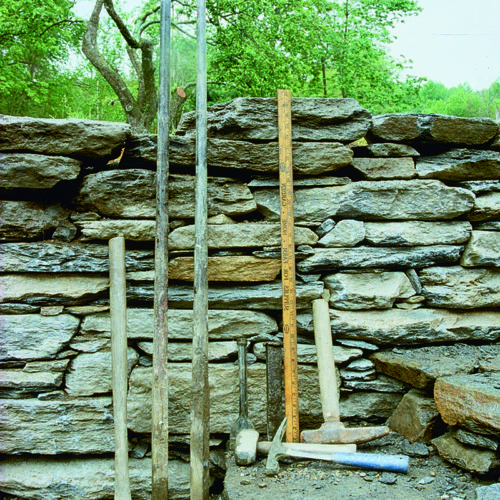
Now you can start digging. The easiest approach is to cut and fill—that is, dig into the slope where the wall will go and spread the earth below you to create a level terrace. When you cut and fill, the wall is backed by undisturbed soil, which is more stable than fill. For design reasons, however, you might choose to build a freestanding wall and fill behind it with soil from another site. Or you might do a partial cut and fill, which is somewhere between the two.
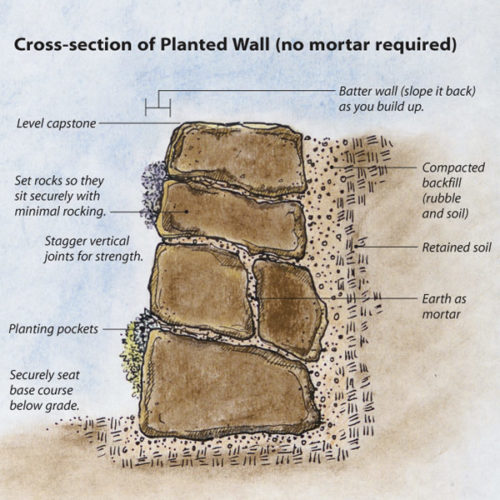
Väggar byggs i banor. The base course is structurally the most important, while the final course, the capstone, is the most challenging. For stability, walls should be at least 20 inches wide at the base. They can taper slightly toward the top, but you’ll want a wall that is at least two rocks wide in most places. This can be accomplished by mixing stones of different sizes or by backfilling with a combination of two-thirds rubble to one-third soil.
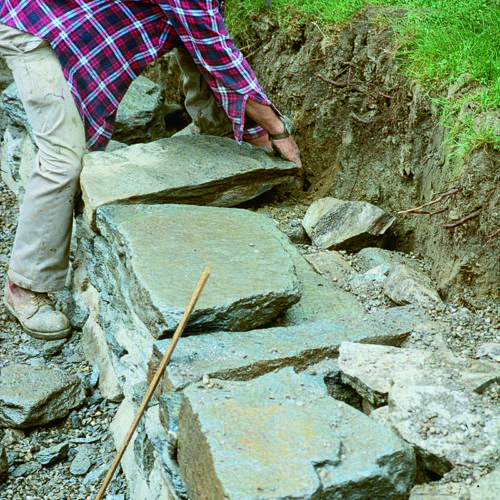
Gräv ett dike för underlaget
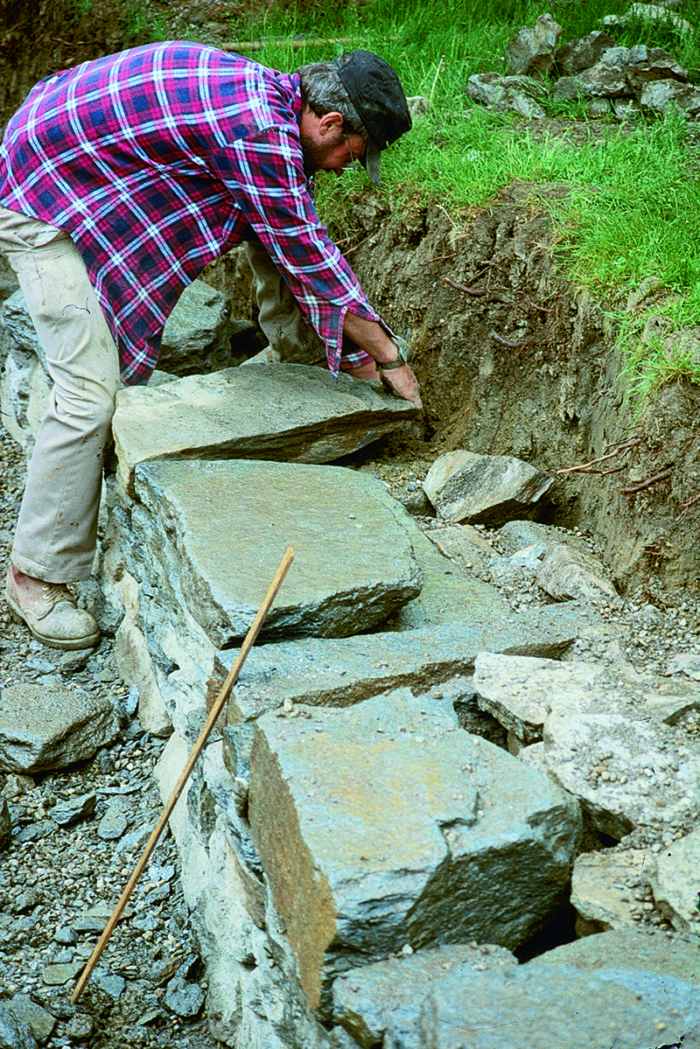
Start by digging a trench about 4 inches deep and at least 2 feet wide. A straightedged spade will give you a nice, even edge. The first course must be very solid and tightly fit because the weight of the wall will rest on it. Take the time to find rocks that lock into place, without leaving gaps. Randomly lay your largest rocks along the front edge of the trench. Set the first stone, shifting it around until it sits securely without being rocked easily, and then fill with the remaining stones. If you are using rectangular stones, you want the height of adjacent stones to be the same, or of a difference that can be made up with a smaller stone. If the rocks are irregular, then the stones will fit together leaving a triangular gap for the next course to fit into. I find irregular rocks easier to work with than flat ones; with flat rocks you have to be more precise. Find a stone that fits well and then continue for a few more feet. A rule of thumb, passed down from my wall-building teacher’s mentor, is to try a stone seven different ways. If it doesn’t fit by the seventh try, use another stone.
Skotta sedan smuts bakom stenarna och trampa in jorden i utrymmena between, behind, and beneath the stones with top of the sledgehammer. This is an important step because the dirt becomes the mortar for the wall. I also recommend adding rubble (those stones you won’t use on the face of your wall) behind the face course to give greater strength to the wall. Pound the rubble and soil mix until you are satisfied that it is solid. Continue the first course until you reach the end of the wall. When you are done, test
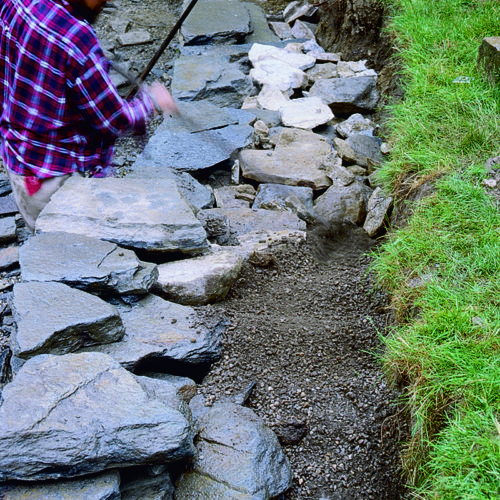
För att börja den andra banan, välj en sten som kommer att överbrygga den första leden av den nedre banan. Avoid having joints run up the face of the wall, and angle (batter) the courses backward—approximately 1 inch per vertical foot. This creates a stable wall. For added strength, intermittently place single stones that run the full depth of the wall. This will only work with rectangular rocks. For irregular rocks, place a large rock behind a face rock every 3 feet or so. As you set a course, you will come to situations, probably quite a few of them, where the rock placement is perfect on all sides but one. These are the planting opportunities that give life to a stone wall.
Continue building in this manner until you are one course away from the finished height. Fitting stones will get easier as you go, and you’ll likely discover that there’s a certain magic moment when you’re building a wall: you hear a thump that signals you’ve placed a rock perfec
Gör din väggplacering i höjd
The ideal height for a dry-stacked retaining wall is 18 to 22 inches—so you can sit on it when your gardening chores are done. Even if
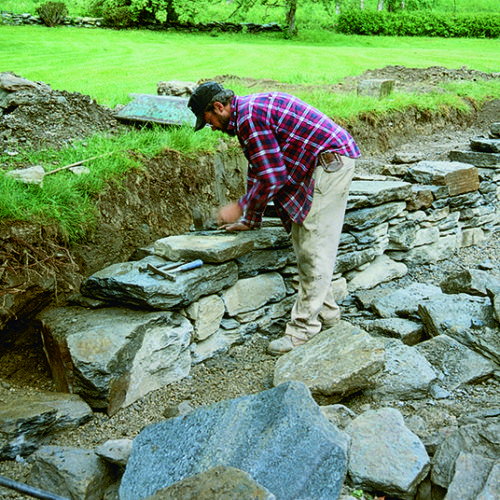
Ta med mycket tålamod till processen att lägga slutstenen; det är en kulmen på den färdighet du har utvecklat hittills. Det bör vara cirka 15 till 18 tum djupt och består av en till tre stenar. Använd jord och bra placering för att säkra stenarna och undvik precis som med väggfogar långa fogar i kapstenen. Om du vill sitta på väggen, välj släta, platta stenar. Eller fyll luckor med jord och plantera doftande örter som kuddar. En planterad täcksten är en härlig finish på en levande vägg.
 afrikanska
 albanska
 amhariska
 arabiska
 armeniska
 azerbajdzjanska
 baskiska
 vitryska
 bengaliska
  bosniska
 bulgariska
 katalanska
 Cebuano
 Kina
Kina Kina (Taiwan)
 korsikanska
 Kroatisk
 tjeckiska
 danska
 holländska
 engelsk
 esperanto
 estniska
 finska
 franska
 frisiska
 galiciska
 georgiska
 tysk
tysk grekisk
 Gujarati
 haitisk kreol
 hausa
hausa hawaiian
 hebreiska
 Nej
Nej Miao
Miao ungerska
 isländska
 igbo
igbo indonesiska
 irländsk
 italienska
 japanska
 javanesiska
 Kannada
 kazakiska
 Khmer
Khmer rwandiska
 koreanska
 kurdiska
 kirgiziska
 TB
TB latin
latin lettiska
 litauiska
 Luxemburgiska
 makedonska
 Malgashi
 malajiska
 Malayalam
 maltesiska
 Maori
Maori Marathi
 mongoliska
 Myanmar
 nepalesiska
 norska
 norska
 occitanska
 Pashto
 persiska
 putsa
putsa portugisiska
  Punjabi
 rumänska
 ryska
ryska Samoan
 skotsk gaeliska
 serbiska
 engelsk
 Shona
Shona Sindhi
 singalesiska
 slovakiska
 slovenska
 somaliska
 spanska
 Sundanesiska
 Swahili
 svenska
 Tagalog
 tadzjikiska
 Tamil
Tamil tatariska
 Telugu
 Thai
Thai turkiska
 turkmeniska
 ukrainska
 Urdu
Urdu Uigur
Uigur uzbekiska
 vietnamesiska
 walesiska