

Tiles zenye kutu
Je! unataka kujenga ukuta wako wa kubakiza mawe, lakini huna uhakika jinsi ya kuanza? Ikiwa una kutofautiana yadi, ukuta wa kuzuia mawe unaweza kusaidia kuzuia mmomonyoko wa udongo na kutoa mahali pazuri pa kupanda. Ili kujifunza jinsi ya kuweka yako mwenyewe pamoja, kutoka mwanzo hadi mwisho, soma.
To figure out how much stone you’ll need, multiply your wall’s height times the depth times the length. If your wall is 2 feet high, 1-1/2 feet wide, and 20 feet long, you’ll need roughly 60 cubic feet of stone. Most stoneyards will deliver the stones for a slight charge; have them placed as close to the site of your retaining wall as possible.
Kuhusu tools, you’ll need a shovel for digging your trench and backfilling, a godoro for attacking the grade, and a small sledgehammer for tamping soil. For marking your site and leveling rocks, you’ll need a line level, a few tall stakes, string, some flour, and a 4- or 8-foot level.
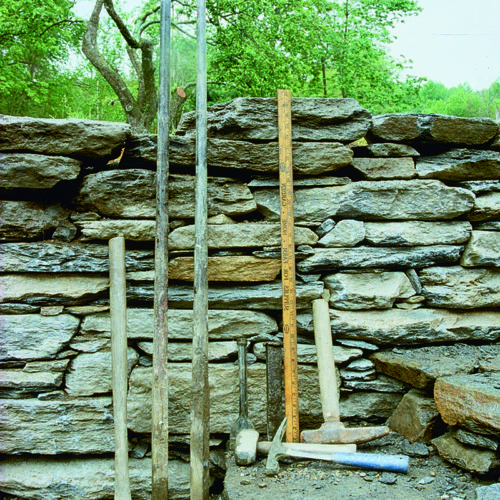
Now you can start digging. The easiest approach is to cut and fill—that is, dig into the slope where the wall will go and spread the earth below you to create a level terrace. When you cut and fill, the wall is backed by undisturbed soil, which is more stable than fill. For design reasons, however, you might choose to build a freestanding wall and fill behind it with soil from another site. Or you might do a partial cut and fill, which is somewhere between the two.
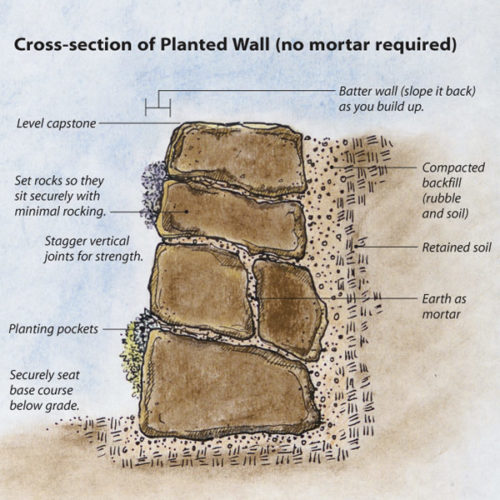
Kuta zimejengwa kwa kozi. The base course is structurally the most important, while the final course, the capstone, is the most challenging. For stability, walls should be at least 20 inches wide at the base. They can taper slightly toward the top, but you’ll want a wall that is at least two rocks wide in most places. This can be accomplished by mixing stones of different sizes or by backfilling with a combination of two-thirds rubble to one-third soil.
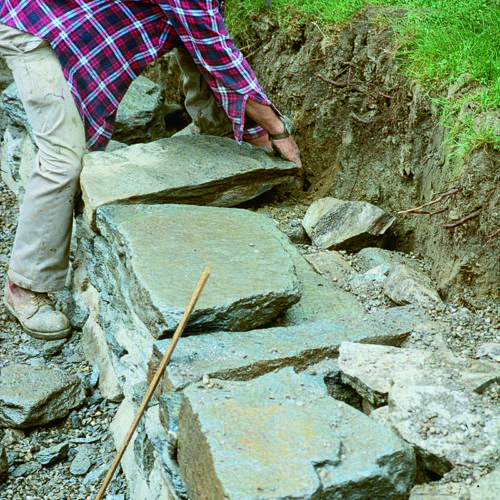
Chimba mfereji kwa kozi ya msingi
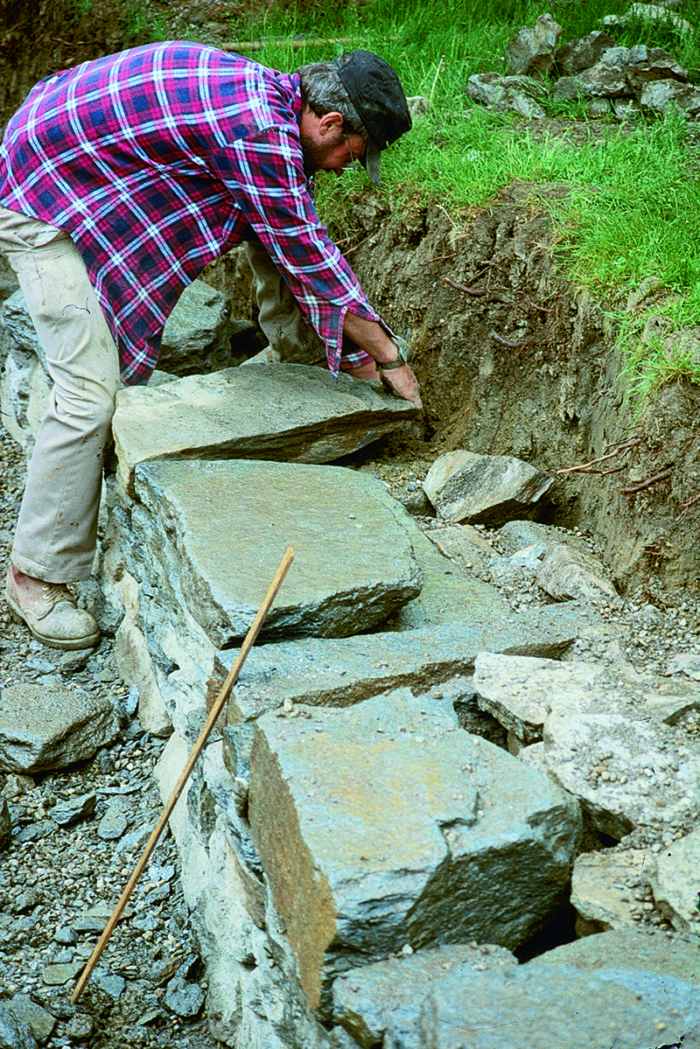
Start by digging a trench about 4 inches deep and at least 2 feet wide. A straightedged spade will give you a nice, even edge. The first course must be very solid and tightly fit because the weight of the wall will rest on it. Take the time to find rocks that lock into place, without leaving gaps. Randomly lay your largest rocks along the front edge of the trench. Set the first stone, shifting it around until it sits securely without being rocked easily, and then fill with the remaining stones. If you are using rectangular stones, you want the height of adjacent stones to be the same, or of a difference that can be made up with a smaller stone. If the rocks are irregular, then the stones will fit together leaving a triangular gap for the next course to fit into. I find irregular rocks easier to work with than flat ones; with flat rocks you have to be more precise. Find a stone that fits well and then continue for a few more feet. A rule of thumb, passed down from my wall-building teacher’s mentor, is to try a stone seven different ways. If it doesn’t fit by the seventh try, use another stone.
Ifuatayo, chora uchafu nyuma ya mawe na piga ardhi kwenye nafasi between, behind, and beneath the stones with top of the sledgehammer. This is an important step because the dirt becomes the mortar for the wall. I also recommend adding rubble (those stones you won’t use on the face of your wall) behind the face course to give greater strength to the wall. Pound the rubble and soil mix until you are satisfied that it is solid. Continue the first course until you reach the end of the wall. When you are done, test
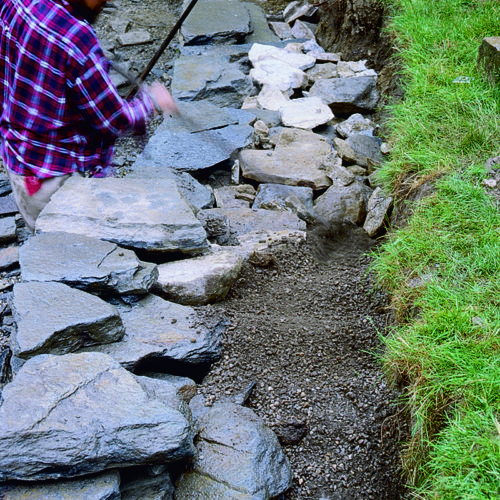
Ili kuanza kozi ya pili, chagua jiwe ambalo litaunganisha sehemu ya kwanza ya kozi ya chini. Avoid having joints run up the face of the wall, and angle (batter) the courses backward—approximately 1 inch per vertical foot. This creates a stable wall. For added strength, intermittently place single stones that run the full depth of the wall. This will only work with rectangular rocks. For irregular rocks, place a large rock behind a face rock every 3 feet or so. As you set a course, you will come to situations, probably quite a few of them, where the rock placement is perfect on all sides but one. These are the planting opportunities that give life to a stone wall.
Continue building in this manner until you are one course away from the finished height. Fitting stones will get easier as you go, and you’ll likely discover that there’s a certain magic moment when you’re building a wall: you hear a thump that signals you’ve placed a rock perfec
Fanya urefu wa ukuta wako
The ideal height for a dry-stacked retaining wall is 18 to 22 inches—so you can sit on it when your gardening chores are done. Even if
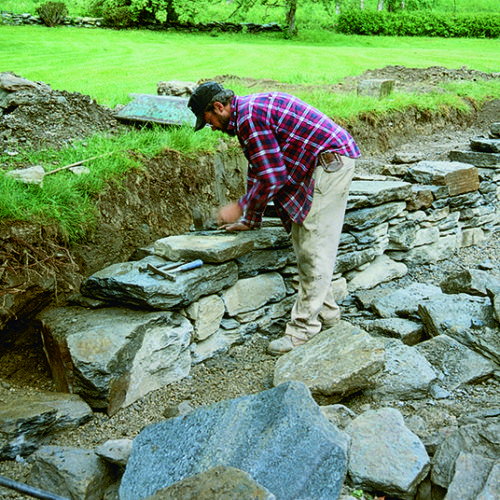
Kuleta uvumilivu mwingi kwa mchakato wa kuweka jiwe la kifuniko; ni kilele cha ustadi uliokuza hadi hapa. Inapaswa kuwa na kina cha inchi 15 hadi 18, kilichoundwa na jiwe moja hadi tatu. Tumia udongo na uwekaji mzuri ili kuweka mawe salama, na kama vile viungio vya ukuta, epuka viungo virefu kwenye jiwe la msingi. Ikiwa unataka kukaa kwenye ukuta, chagua mawe laini, gorofa. Au, jaza mapengo na udongo na kupanda mimea yenye harufu nzuri kwa matakia. Jiwe la juu lililopandwa ni mguso wa kumaliza wa kupendeza kwa ukuta ulio hai.






 Mwafrika
 Kialbeni
 Kiamhari
 Kiarabu
 Kiarmenia
 Kiazabajani
 Kibasque
 Kibelarusi
 Kibengali
  Kibosnia
 Kibulgaria
 Kikatalani
 Cebuano
 China
China Uchina (Taiwan)
 Kikosikani
 Kikroeshia
 Kicheki
 Kideni
 Kiholanzi
 Kiingereza
 Kiesperanto
 Kiestonia
 Kifini
 Kifaransa
 Kifrisia
 Kigalisia
 Kijojiajia
 Kijerumani
 Kigiriki
 Kigujarati
 Krioli ya Haiti
 hausa
hausa Kihawai
 Kiebrania
 Hapana
 Miao
Miao Kihungaria
 Kiaislandi
 igbo
igbo Kiindonesia
 irish
irish Kiitaliano
 Kijapani
 Kijava
 Kikanada
 kazakh
 Khmer
Khmer Mnyarwanda
 Kikorea
 Kikurdi
 Kirigizi
 TB
TB Kilatini
 Kilatvia
 Kilithuania
 Kilasembagi
 Kimasedonia
 Malgashi
 Kimalei
 Kimalayalam
 Kimalta
 Kimaori
 Marathi
 Kimongolia
 Myanmar
 Kinepali
 Kinorwe
 Kinorwe
 Oksitani
 Kipashto
 Kiajemi
 Kipolandi
 Kireno
  Kipunjabi
 Kiromania
 Kirusi
 Kisamoa
 Kigaeli cha Kiskoti
 Kiserbia
 Kiingereza
 Kishona
 Kisindhi
 Kisinhala
 Kislovakia
 Kislovenia
 Msomali
 Kihispania
 Kisunda
 kiswahili
 Kiswidi
 Kitagalogi
 Tajiki
 Kitamil
 Kitatari
 Kitelugu
 Thai
Thai Kituruki
 Waturukimeni
 Kiukreni
 Kiurdu
 Uighur
 Kiuzbeki
 Kivietinamu
 Kiwelisi